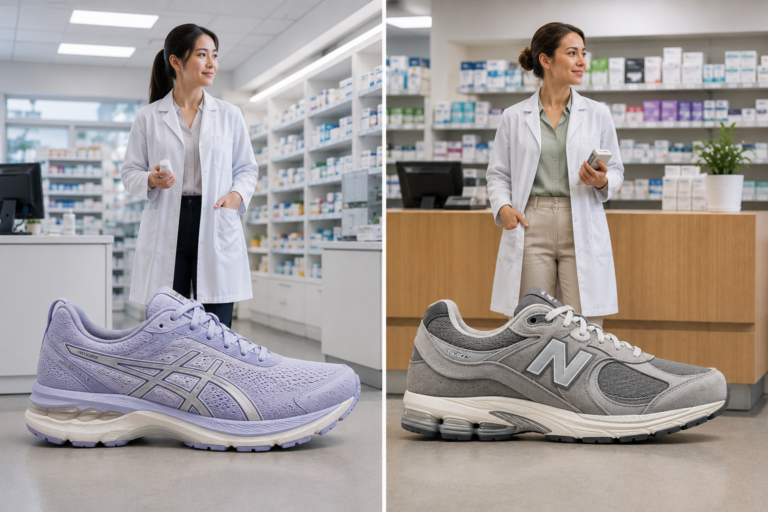
Nurse Mates Align Velocity vs Shoes For Crews Endurance II for Pharmacy Technicians
Quick decision: Pharmacy technicians choosing between Nurse Mates Align Velocity and Shoes For Crews Endurance II are comparing two very different work-shoe ideas. Align Velocity is the healthcare-oriented option with an Align footbed, adjustable bungee-style lacing, easy-clean construction, and a lightweight sneaker format. Endurance II is the work-sneaker option built around a TRACTIONiQ slip-resistant outsole, extra EVA cushioning, a SPILL GUARD water-resistant membrane, and a removable cushioned insole. The better choice depends on the pharmacy’s floor rules, dress expectations, and how much of the shift is spent pivoting behind the counter versus walking to stock areas.
Start with the pharmacy, not the brand
A pharmacy technician can spend one block of the day filling prescriptions, another retrieving stock, another moving between counter and shelving, and another repeatedly squatting to lower storage. That mix makes it risky to choose from a single feature such as cushioning. The first screen should be the actual workplace requirement. If the employer specifies a particular slip standard, protective toe, electrical feature, or other safety characteristic, verify the exact SKU before considering comfort preferences. Neither shoe should be treated as a substitute for a requirement it does not document.
For broader pharmacist-oriented comparisons, the site already covers Brooks Ghost Max 4 vs New Balance 928v3 for Pharmacists and Skechers Arch Fit 2.0 vs Dansko XP 2.0 for Pharmacists. Those pages are useful if this pair feels too healthcare-specific or too work-sneaker oriented.
Nurse Mates Align Velocity: where it fits the technician workflow
Nurse Mates presents Align Velocity around its Align footbed, a lightweight healthcare-oriented sneaker shape, easy-adjust bungee-style lacing, and easy-clean construction. For a technician who starts at a fill station and repeatedly turns between computer, bins, and counter, the practical advantage is convenience: once the lacing is adjusted, the shoe can be quick to put on and the upper is designed for a healthcare environment rather than a rugged industrial floor.
The model is not a safety-toe shoe, and its healthcare styling should not be assumed to satisfy an industrial dress code. If a pharmacy is inside a hospital or large facility with a written footwear policy, read that policy first. If the policy only requires a closed, cleanable shoe and does not call for a specific protective rating, Align Velocity becomes a more plausible candidate.
Fit matters particularly during repeated squat-and-rise tasks. Pharmacy technicians should check whether the heel stays seated when reaching low shelves, whether the forefoot has enough room later in the shift, and whether the bungee adjustment remains secure when the foot flexes. A convenient closure is useful only if it still produces a stable fit.
Shoes For Crews Endurance II: why it is the more work-specific option
Endurance II approaches the job from the opposite direction. Shoes For Crews lists a TRACTIONiQ slip-resistant outsole with current SRO language, extra EVA cushioning, a SPILL GUARD water-resistant membrane, and a removable cushioned insole. For technicians who move through stockrooms, back counters, receiving zones, or areas where floor contamination is a realistic concern, those work-focused features may carry more weight than healthcare styling.
The tradeoff is that Endurance II is still a soft-toe work sneaker, not a safety-toe substitute. Its athletic appearance may also be less suitable in pharmacies with a formal uniform policy. Slip resistance is not permanent or universal: outsole condition, contamination, wear, and the exact surface still matter. Treat the cited outsole as a product feature, not a promise that every pharmacy floor will behave the same way.
If you are comparing more work-oriented pharmacist footwear, see Clove Classic vs Brooks Addiction Walker 2 for Pharmacists and Calzuro Classic Without Holes vs Dansko XP 2.0 for Pharmacists.
Five pharmacy tasks that can change the winner
Fill-station pivots
At a fill station, the important question is not maximum walking cushioning. It is whether the shoe remains secure through short turns, small side steps, and repeated standing-to-moving transitions. Align Velocity may appeal if the healthcare fit and closure feel natural. Endurance II may appeal if the technician gives more weight to a work-oriented outsole and spill-focused upper treatment.
Stockroom retrieval
Stock work adds short walking bursts, shelf reaches, and more changes in direction. Check heel hold and toe room in the socks normally worn at work. A model that feels soft for the first five minutes but allows heel movement on repeated turns is a poor match for this part of the shift.
Counter-to-shelf walking
Repeated short routes reward consistency. Endurance II’s listed slip-resistant work outsole is a meaningful product distinction, while Align Velocity’s healthcare design may feel less work-shoe-like. The actual decision should still follow the floor policy and the technician’s fit, not a generic brand hierarchy.
Squat-and-rise work
Lower shelving exposes fit problems quickly. Look for forefoot pressure, heel lift, and an upper that folds uncomfortably at the toes. This is one area where a technician should try the actual movement rather than judging either shoe while standing still in a store.
Long hard-floor shifts
For long standing periods, compare how the whole platform feels after the foot has warmed and expanded. Endurance II lists extra EVA cushioning; Align Velocity uses its Align footbed system. Those are different approaches, and neither guarantees that one will feel better to every wearer.
Cleaning and shift rotation
Pharmacy footwear benefits from a routine that is simple enough to follow. Wipe the upper according to the manufacturer’s care guidance, clear debris from the outsole, and allow the shoe to dry before the next shift. If the technician rotates two pairs, compare them under the same socks and similar shift lengths rather than relying on first impressions from different days.
Who should lean toward each shoe?
Lean toward Nurse Mates Align Velocity when the pharmacy environment resembles a healthcare setting, the dress policy accepts this style, easy adjustment is useful, and the wearer prefers the Align footbed approach.
Lean toward Shoes For Crews Endurance II when work-focused slip resistance, a water-resistant membrane, and a removable cushioned insole are more relevant to the floor conditions. Verify the exact product listing if the employer requires a named standard.
Choose neither when the workplace requires a protective toe, electrical classification, or another feature not documented for the exact shoe being considered. Compliance comes before comfort preference.
FAQ
Is Endurance II automatically safer on every pharmacy floor?
No. It has a listed slip-resistant work outsole, but real traction depends on the exact surface, contamination, outsole condition, and the employer’s rules.
Is Align Velocity only for nurses?
No. It is healthcare-oriented footwear, but whether it works for a pharmacy technician depends on fit and workplace policy rather than the job title printed on a marketing page.
Which one is better for lower-shelf work?
There is no universal winner. Check heel security, forefoot room, and flex comfort while performing the same squat-and-rise motion used at work.
Official sources
Research research note: source-based model comparison using manufacturer information and workplace-oriented decision criteria. No medical outcome is claimed, and employer footwear rules take priority.