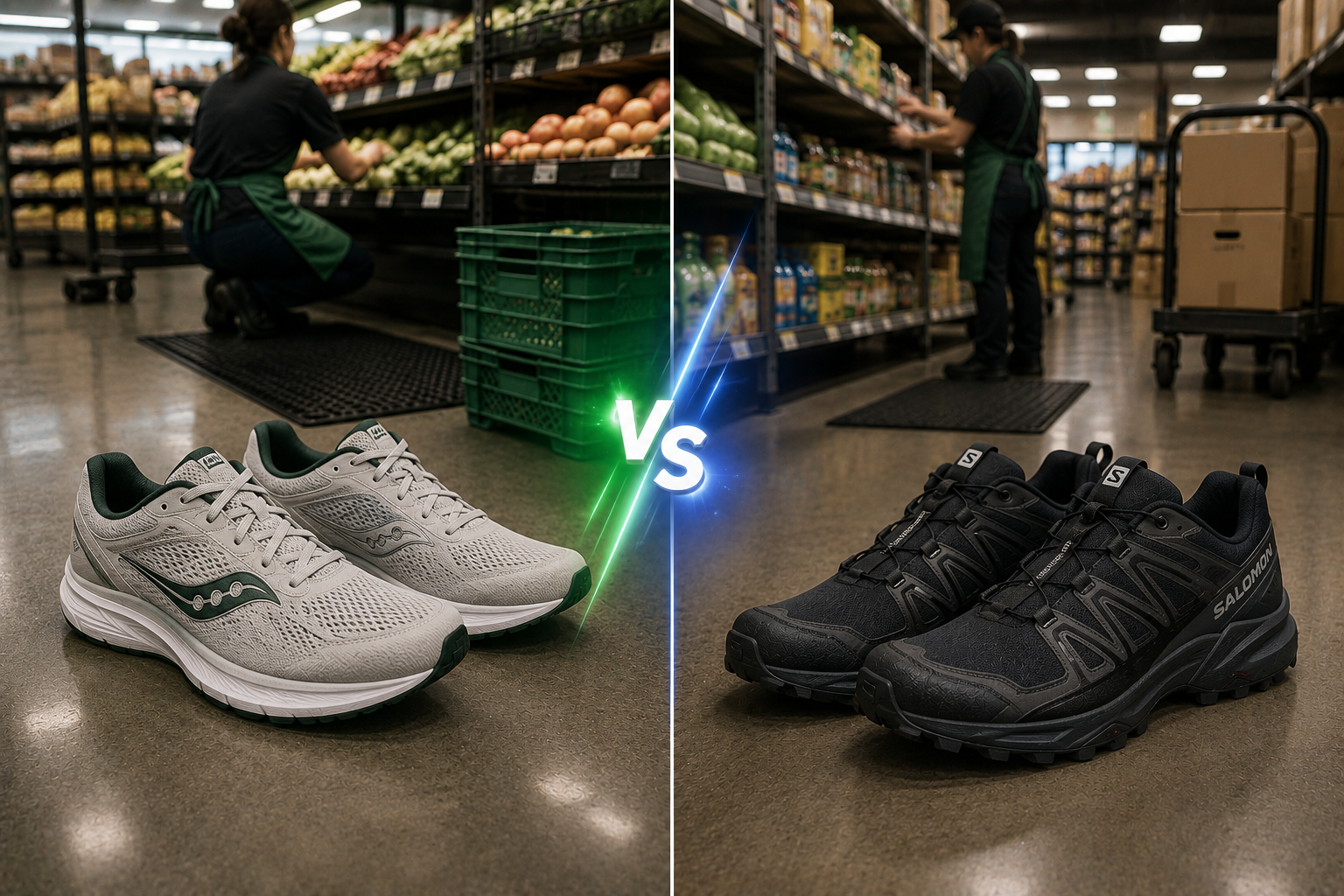
Saucony vs Salomon for Grocery Store Workers
If you work in a grocery store, you already know that a long shift can be harder on your feet than a tough workout. Whether you’re standing behind a checkout counter, stocking shelves, working in the produce department, or unloading deliveries, your feet absorb thousands of impacts every day. Most grocery store employees walk between 15,000 and 25,000 steps during a typical shift while spending 8 to 12 hours on unforgiving concrete or tile floors.
Choosing the right shoes isn’t just about comfort—it’s about reducing foot fatigue, preventing heel pain, supporting your knees and lower back, and helping you finish your shift with energy left for the rest of your day.
Two brands that frequently appear on shopping lists are Saucony and Salomon. Both are respected footwear companies with loyal followings, but they were built for very different purposes. Saucony specializes in road running shoes known for their plush cushioning and smooth ride, while Salomon built its reputation creating rugged trail shoes designed for stability, grip, and durability on uneven terrain.
So, which brand is the better choice for grocery store workers?
The answer depends on your job duties, foot shape, and work environment. For most employees who spend long hours standing on hard indoor floors, Saucony is the better overall choice thanks to its softer cushioning, wider fit options, and excellent shock absorption. However, Salomon can be the smarter option for workers who regularly move between indoor and outdoor areas, handle deliveries, or need extra stability while carrying heavy loads.
This detailed comparison breaks down every important factor—from cushioning and comfort to slip resistance, orthotic compatibility, and durability—so you can choose the right pair for your next shift.
Quick Answer
If you only have a minute, here’s the short version.
Choose Saucony if you:
- Spend most of your shift standing in one place.
- Work as a cashier.
- Have plantar fasciitis or heel pain.
- Need maximum cushioning on concrete floors.
- Have wide feet or use custom orthotics.
Choose Salomon if you:
- Frequently stock shelves and move heavy products.
- Work both indoors and outdoors.
- Need exceptional stability.
- Want a durable shoe that can handle rough conditions.
- Prefer a secure, locked-in fit.
For the majority of grocery store workers, Saucony offers the better combination of comfort, cushioning, and long-shift support.
Saucony vs Salomon Comparison Table
| Feature | Saucony | Salomon | Winner |
|---|---|---|---|
| Standing Comfort | ⭐⭐⭐⭐⭐ | ⭐⭐⭐ | Saucony |
| Cushioning | ⭐⭐⭐⭐⭐ | ⭐⭐⭐⭐ | Saucony |
| Walking Comfort | ⭐⭐⭐⭐⭐ | ⭐⭐⭐⭐ | Saucony |
| Stability | ⭐⭐⭐⭐ | ⭐⭐⭐⭐⭐ | Salomon |
| Durability | ⭐⭐⭐⭐ | ⭐⭐⭐⭐⭐ | Salomon |
| Grip on Dry Floors | ⭐⭐⭐⭐⭐ | ⭐⭐⭐⭐ | Saucony |
| Grip on Outdoor Surfaces | ⭐⭐⭐ | ⭐⭐⭐⭐⭐ | Salomon |
| Wide Sizes | Excellent | Limited | Saucony |
| Orthotic Friendly | Excellent | Fair | Saucony |
| Breathability | ⭐⭐⭐⭐⭐ | ⭐⭐⭐⭐ | Saucony |
| Weight | Lightweight | Slightly Heavier | Saucony |
| Best Overall for Grocery Workers | ⭐⭐⭐⭐⭐ | ⭐⭐⭐⭐ | Saucony |
Why Grocery Store Workers Need Different Shoes Than Runners
One of the biggest mistakes people make is buying shoes based solely on running reviews. A shoe that performs exceptionally during a 10K race isn’t always the best option for standing behind a register all day.
Grocery store workers face unique challenges that require different footwear characteristics.
Standing for Hours on Concrete
Unlike trails or asphalt roads, grocery stores use polished concrete or hard tile flooring. These surfaces absorb very little impact, meaning every step sends force back into your feet, ankles, knees, and lower back.
Over time, this repeated impact can contribute to:
- Heel pain
- Plantar fasciitis
- Shin splints
- Knee discomfort
- Lower back fatigue
- Hip pain
Shoes with soft, responsive cushioning help reduce these forces and keep your legs feeling fresher throughout the day.
Constant Walking
Even if your job isn’t physically demanding, you’ll likely cover several miles every shift.
Cashiers constantly pivot and shift weight.
Stockers walk aisle after aisle.
Produce workers move between coolers and displays.
Bakery employees spend hours standing while preparing products.
This combination of standing and walking places continuous stress on your feet.
Wet and Slippery Floors
Grocery stores are full of potential hazards.
Think about:
- Water near produce displays
- Melted ice from seafood counters
- Spilled milk
- Cleaning solutions
- Refrigerated aisles
- Recently mopped floors
Good traction becomes essential for preventing slips.
However, it’s important to understand that trail traction and indoor traction aren’t always the same thing.
This is one area where many buyers misunderstand Salomon shoes.
Deep trail lugs are fantastic on mud, gravel, and loose dirt because they dig into soft surfaces. On smooth supermarket tile, however, aggressive lugs can reduce the amount of rubber touching the floor. That’s why some road-running shoes with flatter outsoles actually feel more secure indoors.
Instead of assuming “more grip” always means “better grip,” grocery workers should choose outsole designs that match the surfaces they encounter every day.
Foot Swelling During Long Shifts
Another issue many workers don’t expect is foot swelling.
After several hours of standing, your feet naturally expand.
A shoe that feels comfortable at the beginning of your shift may become painfully tight by lunchtime.
This is where fit matters just as much as cushioning.
Saucony has built a strong reputation for offering many popular models in Wide (2E) and Extra Wide (4E) sizes. This extra room helps accommodate natural foot swelling without creating pressure points.
Salomon, by comparison, generally fits narrower and prioritizes a secure, performance-oriented fit. While this locked-in feel works well for trail running and hiking, some grocery workers may find it restrictive during long indoor shifts.
Repetitive Movements
Grocery store employees rarely move in straight lines.
Instead, they:
- Twist while stocking shelves.
- Reach overhead.
- Bend repeatedly.
- Push heavy carts.
- Lift boxes.
- Turn quickly around displays.
These repetitive movements demand a shoe that combines cushioning with stability.
The ideal shoe should protect your joints without feeling unstable when carrying heavy loads.
Understanding the Brands
Before comparing them directly, it’s helpful to understand what each company designed its shoes to do.
Saucony: Built for Cushioning and Everyday Comfort
Founded in Pennsylvania in 1898, Saucony has spent decades developing footwear for runners who spend hours on roads and sidewalks.
Because of this heritage, many Saucony shoes focus on:
- Soft cushioning
- Smooth heel-to-toe transitions
- Lightweight construction
- Comfortable uppers
- Long-distance comfort
Technologies like PWRRUN and PWRRUN PB midsoles provide excellent shock absorption without making the shoe feel excessively heavy.
For grocery workers, these features translate into less foot fatigue during long shifts on concrete floors.
Another advantage is fit.
Many Saucony models are available in multiple widths, making them an excellent option for workers with:
- Wide feet
- Bunions
- High-volume feet
- Custom orthotics
If your priority is standing comfortably all day, Saucony has a clear advantage.
Salomon: Built for Stability and Tough Conditions
Salomon began in the French Alps, designing equipment for mountain sports before expanding into trail running footwear.
Their shoes are engineered to handle:
- Rocks
- Mud
- Steep descents
- Uneven terrain
- Wet trails
- Technical mountain routes
To achieve this, Salomon emphasizes:
- Stable midsoles
- Protective uppers
- Secure heel hold
- Durable construction
- Aggressive Contagrip outsoles
- Quicklace systems
For grocery workers who spend part of their shift outdoors, unload deliveries, or frequently move heavy inventory, these characteristics can be valuable.
However, workers whose day consists mainly of standing on polished indoor floors may find some Salomon models firmer than ideal.
That’s why choosing the right model—not just the right brand—is so important.
Head-to-Head Comparison: Saucony vs Salomon for Grocery Store Workers
Now that we’ve covered what grocery workers need and the design philosophy behind each brand, let’s compare Saucony and Salomon where it matters most: real-world performance during long retail shifts.
Rather than focusing on running performance, this comparison is based on the daily demands of grocery store employees, including standing on concrete, walking thousands of steps, lifting boxes, and working around wet floors.
Cushioning
Saucony
For most grocery workers, cushioning is the biggest reason to choose Saucony.
The brand has invested heavily in midsole technology, with foams such as PWRRUN, PWRRUN+, and PWRRUN PB delivering a soft yet supportive ride. Instead of feeling overly squishy, these midsoles absorb impact while maintaining enough responsiveness to prevent your legs from feeling sluggish during long shifts.
This cushioning helps reduce fatigue in your:
- Feet
- Ankles
- Knees
- Hips
- Lower back
If you regularly finish work with sore heels or aching arches, the extra shock absorption can make a noticeable difference.
Salomon
Salomon shoes generally feel firmer underfoot.
That firmness is intentional. Trail runners need a stable platform to move confidently across rocks, roots, and uneven terrain. A softer shoe would feel unstable on technical trails.
Inside a grocery store, however, that same firmness can translate into more pressure on your feet after several hours of standing still.
Some newer Salomon road-focused models, such as the Aero Glide and Ultra Glide, offer significantly more cushioning than classic trail shoes, but they still tend to feel firmer than comparable Saucony models.
Winner: Saucony
For standing on concrete floors all day, softer cushioning usually wins.
Standing Comfort
Standing is very different from running.
When you run, your muscles constantly change position and distribute pressure across your feet.
When you’re standing at a checkout lane or customer service desk, pressure remains concentrated in the same areas for hours.
Saucony
Saucony excels here because its midsoles compress gently under body weight, reducing pressure points throughout the shift.
Many grocery workers describe the experience as feeling less “beaten up” at the end of the day.
Models like the Triumph and Echelon are particularly effective because they combine thick cushioning with stable platforms.
Salomon
Salomon performs well if you’re constantly moving.
If you’re mostly stationary, though, the firmer ride may become noticeable after several hours.
That doesn’t mean Salomon is uncomfortable—it simply prioritizes stability over plushness.
Winner: Saucony
Cashiers, customer service representatives, and bakery workers will likely appreciate the softer ride.
Walking Comfort
Walking comfort depends on more than just cushioning.
A comfortable walking shoe should also provide:
- Smooth transitions
- Lightweight construction
- Flexible forefoot
- Stable heel
Saucony
Road-running shoes naturally excel in this category.
Most Saucony shoes transition smoothly from heel to toe, making every step feel effortless.
Even after walking several miles during a shift, they rarely feel cumbersome.
Salomon
Salomon’s walking experience depends heavily on the model.
Trail shoes often feature stiffer midsoles and aggressive outsoles that can feel less natural on polished floors.
Road-oriented models improve this considerably, but Saucony still maintains the advantage for indoor walking.
Winner: Saucony
Stability
Stability becomes increasingly important if your job involves:
- Carrying heavy boxes
- Using ladders
- Pushing loaded carts
- Turning quickly
- Stocking shelves
Saucony
Despite its softer cushioning, Saucony offers excellent stability in many models.
Shoes like the Guide and Echelon provide supportive platforms without feeling overly rigid.
However, maximum-cushion shoes can sometimes feel slightly less planted during quick lateral movements.
Salomon
This is one of Salomon’s greatest strengths.
Features such as:
- SensiFit construction
- Reinforced heel counters
- Secure midsoles
- Structured uppers
create a locked-in feeling that inspires confidence while lifting or carrying heavy items.
Workers who frequently move stock or unload deliveries may appreciate this additional support.
Winner: Salomon
Slip Resistance
This category deserves extra attention because it’s often misunderstood.
Many shoppers assume that aggressive trail shoes automatically provide the best grip everywhere.
In reality, the type of floor matters just as much as the type of outsole.
Dry Concrete Floors
Both brands perform very well.
Saucony’s flatter road-running outsoles provide excellent surface contact, making them feel predictable on smooth supermarket flooring.
Salomon also performs well, although some trail models can feel less planted because of their deeper lug patterns.
Wet Tile Floors
When water is present, rubber compound becomes more important than lug depth.
Flatter outsoles generally maintain better contact with polished tile, while aggressive trail lugs may leave gaps between the rubber and the floor.
Road-specific Salomon models perform much better here than their trail counterparts.
Greasy or Soapy Floors
No standard running shoe should be considered a replacement for certified slip-resistant work footwear if your employer requires it.
However, among athletic shoes:
- Saucony road models usually perform better on smooth indoor surfaces.
- Salomon trail shoes are designed for loose terrain, not polished grocery aisles.
Produce Department and Refrigerated Areas
Water from misting systems, melting ice, and condensation can create slippery conditions.
If you’re considering Salomon, choose models designed for road running or urban environments rather than aggressive trail shoes.
Winner
Tie—depending on the model.
- Indoor retail work: Saucony
- Indoor/outdoor work: Salomon Road models
Durability
Replacing work shoes every few months can become expensive.
Fortunately, both brands have strong reputations for durability.
Saucony
Most employees can expect approximately 400–500 miles of useful cushioning before the midsole begins to lose its responsiveness.
The outsole rubber generally wears evenly when used indoors.
Salomon
Salomon is exceptionally durable.
Its reinforced uppers, protective toe caps, and rugged rubber compounds often outlast many traditional running shoes.
If your work includes outdoor loading docks, rough pavement, or warehouse areas, Salomon’s durability becomes a major advantage.
Winner: Salomon
Breathability
Standing for long hours often means warm feet.
Poor ventilation increases sweating, discomfort, and the likelihood of blisters.
Saucony
Most Saucony running shoes feature engineered mesh uppers that allow heat to escape efficiently.
Even during busy summer shifts, they remain relatively cool.
Salomon
Many Salomon trail shoes prioritize durability over ventilation.
Their thicker materials provide protection outdoors but may retain more heat indoors.
Road-focused models improve airflow but generally don’t match Saucony’s breathable designs.
Winner: Saucony
Weight
Even small differences in shoe weight become noticeable after thousands of steps.
Lighter shoes reduce the effort required with every stride, helping minimize fatigue.
Saucony
Most road-running models are lightweight without sacrificing cushioning.
This balance contributes to their excellent all-day comfort.
Salomon
Because many Salomon shoes include additional protection, thicker rubber, and reinforced uppers, they usually weigh slightly more.
While the difference isn’t dramatic, workers walking several miles each day may appreciate Saucony’s lighter feel.
Winner: Saucony
Fit and Toe Box
Comfort isn’t just about cushioning.
A shoe that fits poorly can cause:
- Blisters
- Numb toes
- Bunions
- Hot spots
- Foot fatigue
Saucony
Saucony is known for accommodating a wide variety of foot shapes.
Many popular models are available in:
- Standard width
- Wide (2E)
- Extra Wide (4E)
This makes the brand an excellent choice for workers whose feet naturally swell during long shifts.
Salomon
Salomon typically offers a snug, performance-oriented fit.
The secure midfoot and narrower toe box help improve control on technical trails but may feel restrictive for some people after several hours of standing.
If you have naturally narrow feet, this secure fit can actually be an advantage.
Winner: Saucony
Orthotic Compatibility
Many grocery workers rely on custom orthotics or aftermarket insoles to manage conditions like plantar fasciitis, flat feet, or overpronation.
Saucony
This is one of Saucony’s biggest strengths.
Models such as the Echelon feature:
- Deep heel cups
- Spacious interiors
- Removable insoles
- Stable platforms
These characteristics make replacing the factory insole with a custom orthotic straightforward.
Salomon
Salomon’s snug fit and contoured interior can make fitting thick orthotics more challenging.
In some cases, adding an orthotic may reduce available space or alter the intended fit of the shoe.
Thin aftermarket insoles usually work better than bulky custom devices.
Winner: Saucony
Quicklace vs Traditional Laces
One feature that often attracts buyers to Salomon is the Quicklace system.
Instead of tying traditional laces, you simply pull a cord and lock it with a small toggle.
Advantages of Quicklace
- Fast to tighten.
- Won’t come untied.
- Even pressure distribution.
- Convenient during busy shifts.
Potential Drawbacks
Quicklace isn’t perfect for everyone.
Workers with high insteps may find it difficult to relieve pressure over the top of the foot because the system tightens more uniformly than standard laces.
Traditional laces, like those used on Saucony shoes, allow you to customize the fit using techniques such as window lacing or heel lock lacing, which can reduce pressure points and improve comfort.
If you’ve ever experienced lace bite or discomfort across the top of your foot, traditional laces provide more flexibility.
Winner
- Convenience: Salomon
- Customization: Saucony
Overall Performance Score
| Category | Winner |
|---|---|
| Cushioning | Saucony |
| Standing Comfort | Saucony |
| Walking Comfort | Saucony |
| Stability | Salomon |
| Durability | Salomon |
| Breathability | Saucony |
| Orthotic Compatibility | Saucony |
| Fit for Wide Feet | Saucony |
| Indoor Grocery Work | Saucony |
| Indoor & Outdoor Work | Salomon |
Overall Winner: Saucony
For most grocery store employees, Saucony delivers the combination of cushioning, comfort, and fit needed to stay comfortable through long shifts on hard indoor floors. Salomon remains an excellent choice for workers who prioritize stability, rugged durability, or frequently transition between indoor and outdoor environments.
Best Saucony Shoes for Grocery Store Workers
Not every Saucony shoe is designed for the same purpose. Some prioritize maximum cushioning, while others focus on stability or affordability. Below are the models that offer the best balance of comfort, support, and durability for long shifts on concrete floors.
Saucony Triumph
Best Overall for Standing All Day
If your primary concern is foot fatigue after long shifts, the Saucony Triumph is hard to beat.
Its premium cushioning provides a soft landing with every step while maintaining enough responsiveness to prevent the shoe from feeling overly mushy. Whether you’re standing at a register for hours or walking from aisle to aisle, the Triumph does an excellent job of absorbing impact.
Pros
- Outstanding cushioning for concrete floors
- Comfortable for 8–12 hour shifts
- Smooth heel-to-toe transition
- Breathable engineered mesh upper
- Suitable for long-distance walking
Cons
- Higher price than most Saucony models
- Slightly bulkier than lightweight trainers
Best for
- Cashiers
- Customer service staff
- Bakery employees
- Workers with heel pain
- Anyone standing most of the day
Saucony Ride
Best Value for Most Grocery Workers
The Ride series has long been one of Saucony’s most versatile shoes.
It delivers plenty of cushioning without becoming too soft, making it ideal for employees who spend their shifts alternating between standing and walking.
If you want one shoe that performs well in almost every grocery store role, the Ride deserves serious consideration.
Pros
- Balanced cushioning
- Lightweight
- Comfortable from day one
- Great everyday work shoe
- Excellent durability
Cons
- Slightly less plush than the Triumph
- Neutral support may not suit severe overpronation
Best for
- Grocery clerks
- General retail employees
- Produce workers
- Employees who walk several miles per shift
Saucony Guide
Best for Extra Support
If your feet tend to roll inward (overpronation) or you experience arch pain after work, the Guide offers additional stability without feeling stiff.
Unlike traditional stability shoes that can feel bulky, the Guide maintains a comfortable ride while gently supporting your stride.
Pros
- Excellent arch support
- Stable platform
- Comfortable cushioning
- Good for mild overpronation
- Lightweight for a support shoe
Cons
- May feel firmer than neutral models
- Not necessary for workers with neutral feet
Best for
- Flat feet
- Mild overpronation
- Workers needing additional support
- Long shifts on hard floors
Saucony Echelon
Best for Orthotics and Wide Feet
The Echelon is one of Saucony’s most underrated work shoes.
Its spacious interior and stable base make it an excellent option for workers who wear custom orthotics or have naturally wide feet.
Because it offers plenty of room inside, it also accommodates foot swelling that commonly occurs during long shifts.
Pros
- Orthotic friendly
- Wide and Extra Wide options
- Stable platform
- Comfortable for extended standing
- Deep heel cup
Cons
- Less responsive than performance models
- Conservative appearance
Best for
- Plantar fasciitis
- Wide feet
- Bunions
- Custom orthotics
- Older workers needing maximum support
Saucony Cohesion
Best Budget Pick
Not everyone wants to spend premium prices on work shoes.
The Cohesion offers surprisingly good comfort for its price and is a solid choice for part-time grocery employees or students working retail.
Although it doesn’t provide the luxurious cushioning of the Triumph, it still performs well for everyday shifts.
Pros
- Affordable
- Lightweight
- Comfortable for moderate shifts
- Durable outsole
Cons
- Basic cushioning
- Less premium materials
Best for
- Budget-conscious shoppers
- Part-time workers
- Students
- First-time Saucony buyers
Best Salomon Shoes for Grocery Store Workers
Salomon’s lineup is much broader than many people realize.
Some models are designed for technical mountain trails, while others focus on road running or everyday comfort. For grocery workers, choosing the right model is especially important.
Salomon Aero Glide
Best Salomon Shoe for Grocery Store Workers
If you’re determined to buy Salomon for work, the Aero Glide should be at the top of your list.
Unlike aggressive trail shoes, the Aero Glide is built for smooth surfaces and offers significantly more cushioning than traditional Salomon models.
This makes it a much better option for concrete floors.
Pros
- Softest Salomon cushioning
- Lightweight
- Comfortable for long walks
- Smooth ride
- Better suited to indoor work
Cons
- Less rugged than trail models
- Premium price
Best for
- Grocery workers
- Retail employees
- Long indoor shifts
- Employees who prefer Salomon’s fit
Salomon Ultra Glide
Best for Walking Comfort
Originally designed for ultra-distance trail running, the Ultra Glide combines generous cushioning with excellent stability.
Although it still carries trail DNA, its softer midsole makes it noticeably more comfortable for extended standing than older Salomon models.
Pros
- Excellent cushioning
- Stable platform
- Durable construction
- Comfortable upper
Cons
- Trail outsole isn’t ideal for every indoor surface
- Higher cost
Best for
- Stockers
- Workers moving constantly
- Mixed indoor and outdoor duties
Salomon XA Pro
Best for Stability and Durability
The XA Pro is one of Salomon’s most recognizable shoes.
It excels in jobs requiring heavy lifting, pushing carts, or working around loading docks.
While it’s not the softest option, its stability is exceptional.
Pros
- Extremely durable
- Excellent lateral support
- Secure heel lockdown
- Tough outsole
Cons
- Firm cushioning
- Heavy compared to road shoes
- Limited wide sizing
Best for
- Warehouse associates
- Stockroom employees
- Receiving departments
- Outdoor loading docks
Salomon XT-6
Best Premium Option
The XT-6 has become famous for both performance and lifestyle wear.
Although originally designed for demanding trail races, many workers appreciate its supportive fit and premium build quality.
Still, its firm ride means it won’t suit everyone spending an entire shift on concrete.
Pros
- Premium materials
- Outstanding durability
- Excellent stability
- Secure fit
Cons
- Expensive
- Narrow fit
- Firm underfoot
Best for
- Narrow feet
- Workers constantly moving
- Employees needing rugged footwear
Which Shoe Fits Your Job?
Not every grocery store position places the same demands on your feet.
Here’s a quick guide based on common roles.
| Job Role | Best Choice | Why |
|---|---|---|
| Cashier | Saucony Triumph | Maximum cushioning for prolonged standing |
| Customer Service | Saucony Ride | Comfortable for standing and walking |
| Grocery Clerk | Saucony Ride | Balanced comfort and durability |
| Produce Worker | Saucony Guide | Stable support on potentially wet floors |
| Bakery Employee | Saucony Triumph | Cushioned comfort during long standing shifts |
| Meat Department | Saucony Echelon | Wide fit and orthotic compatibility |
| Night Stocker | Salomon Aero Glide | Cushioning plus stability for constant movement |
| Warehouse Associate | Salomon XA Pro | Durable and supportive for lifting and carrying |
| Receiving Department | Salomon XA Pro | Excellent stability for heavy work |
Which Brand Is Better for Common Foot Problems?
Many grocery workers aren’t simply looking for a comfortable shoe—they’re trying to reduce pain that develops after months or years on hard floors.
Here’s how each brand compares for common conditions.
Plantar Fasciitis
Winner: Saucony
The softer cushioning helps reduce stress on the plantar fascia, especially in models like the Triumph and Echelon. Their removable insoles also make it easy to use custom orthotics if recommended by a podiatrist.
Flat Feet
Winner: Saucony Guide
The Guide provides gentle stability to control excessive inward rolling without feeling overly rigid, making it a great choice for many workers with flexible flat feet.
High Arches
Winner: Saucony Triumph
Workers with high arches often benefit from extra cushioning because their feet absorb more impact. The Triumph’s plush midsole helps distribute pressure more evenly throughout the foot.
Wide Feet
Winner: Saucony
One of Saucony’s biggest advantages is the availability of Wide (2E) and Extra Wide (4E) sizes in several popular models. This additional room can significantly improve comfort during long shifts when feet naturally swell.
Bunions
Winner: Saucony Echelon
Its roomy toe box reduces pressure on the forefoot and allows your toes to spread naturally, making it a better option for workers with bunions or sensitive joints.
Knee Pain
Winner: Saucony
Better shock absorption means less impact traveling from your feet to your knees. While footwear isn’t a cure for knee pain, choosing a well-cushioned shoe can make long shifts more manageable.
Lower Back Pain
Slight Edge: Saucony
Hard concrete floors can contribute to lower back fatigue over time. Saucony’s softer midsoles help reduce repetitive impact, which may improve overall comfort during extended standing.
Buyer’s Guide: How to Choose the Right Shoe
If you’re still undecided, ask yourself these questions before buying.
How Long Is Your Shift?
- 4–6 hours: Most neutral shoes will work well.
- 8–10 hours: Prioritize cushioning.
- 10–12 hours: Choose maximum cushioning and a roomy fit.
Do You Mostly Stand or Walk?
Mostly standing?
→ Choose Saucony Triumph or Echelon.
Mostly walking?
→ Choose Saucony Ride or Salomon Aero Glide.
Heavy lifting and stocking?
→ Choose Salomon XA Pro.
Do You Wear Orthotics?
If yes, look for shoes with:
- Removable insoles
- Deep heel cups
- Spacious interiors
Saucony generally offers more flexibility in this area than Salomon.
Do Your Feet Swell?
If your shoes feel tight by the end of the day, don’t automatically size up.
Instead, consider a model available in a wider width, such as the Saucony Ride, Triumph, or Echelon. A proper width often solves the problem more effectively than buying a longer shoe.
Are You Working Indoors or Outdoors?
Mostly indoors?
Choose a road-focused shoe with a flatter outsole for better contact on smooth floors.
Frequently outdoors?
A more rugged shoe like the Salomon XA Pro or Aero Glide may be worth considering, especially if your job includes loading docks or uneven surfaces.
Frequently Asked Questions
Is Saucony good for standing all day in a grocery store?
Yes. Saucony is one of the best athletic shoe brands for grocery store workers who spend long hours on hard floors. Models like the Triumph, Ride, and Echelon offer excellent cushioning, shock absorption, and all-day comfort, making them well-suited for cashiers, customer service employees, and retail workers.
Are Salomon shoes good for grocery store workers?
Yes, but it depends on the model.
Salomon shoes are designed primarily for trail running and hiking, so some models have firm midsoles and aggressive outsoles that aren’t ideal for smooth supermarket floors.
If you prefer Salomon, choose road-focused models like the Aero Glide instead of aggressive trail shoes such as the Speedcross.
Which brand is better for standing on concrete all day?
For most people, Saucony is the better choice.
Its softer midsoles absorb more impact, helping reduce fatigue in your feet, knees, and lower back after long shifts on concrete.
Which brand lasts longer?
Salomon generally has a slight advantage in durability.
Its reinforced uppers and rugged outsole compounds are built for rough terrain and often withstand heavy daily use extremely well.
However, Saucony’s durability is still excellent for indoor retail environments.
Are trail running shoes good for grocery stores?
Usually not.
Trail shoes are engineered for dirt, rocks, mud, and uneven terrain.
Many feature deep rubber lugs that reduce the amount of rubber touching polished supermarket floors. While they provide exceptional grip outdoors, they may not perform as well on smooth indoor surfaces.
If you work entirely indoors, road-running shoes are often the better choice.
Which Saucony shoe is best for grocery store workers?
For most employees, these are the best options:
- Saucony Triumph – Best overall
- Saucony Ride – Best value
- Saucony Guide – Best support
- Saucony Echelon – Best for orthotics and wide feet
- Saucony Cohesion – Best budget option
The right choice depends on your foot shape, work duties, and budget.
Which Salomon shoe is best for grocery store workers?
The Salomon Aero Glide is the best overall choice for indoor retail work because it offers softer cushioning than many of the brand’s trail-focused models.
Workers who regularly move between indoor and outdoor environments may also appreciate the Ultra Glide or XA Pro.
Is Saucony good for plantar fasciitis?
Many people with plantar fasciitis find Saucony shoes comfortable because they combine generous cushioning with stable platforms.
Models like the Triumph, Guide, and Echelon are especially popular among workers seeking extra support. If you have persistent heel pain, consult a healthcare professional for personalized treatment.
Is Salomon good for plantar fasciitis?
It can be, but it’s generally not the first recommendation for workers who spend most of the day standing on concrete.
Salomon’s firmer midsoles may suit some individuals, but many people with plantar fasciitis prefer the softer cushioning offered by Saucony.
Are Saucony shoes available in wide sizes?
Yes.
One of Saucony’s biggest strengths is its wide size selection. Several popular models are available in:
- Standard width
- Wide (2E)
- Extra Wide (4E)
This makes Saucony an excellent option for workers with wide feet, bunions, or foot swelling.
Can I wear custom orthotics with Saucony or Salomon?
Both brands have removable insoles, but Saucony is generally more accommodating for custom orthotics.
Models like the Echelon provide additional interior depth and a stable platform, making them particularly suitable for aftermarket insoles.
Should grocery workers choose waterproof shoes?
Only if your work environment regularly exposes you to water.
Waterproof shoes can be beneficial in produce departments, seafood counters, or outdoor receiving areas. However, waterproof membranes usually reduce breathability, making your feet warmer during long indoor shifts.
For most grocery workers, breathable mesh shoes are the better option.
How often should grocery workers replace their shoes?
Most experts recommend replacing athletic work shoes every 6 to 12 months, depending on:
- Hours worked each week
- Body weight
- Walking distance
- Floor type
- Visible outsole wear
- Midsole compression
If you notice increased foot pain or the cushioning feels flat, it may be time for a replacement.
Are running shoes better than work shoes?
It depends on your workplace requirements.
Many grocery stores allow athletic shoes, and high-quality running shoes often provide better cushioning than traditional work shoes.
However, if your employer requires certified slip-resistant footwear, always follow workplace policies.
What socks should grocery workers wear?
The right socks can improve comfort almost as much as the shoes themselves.
Look for moisture-wicking materials rather than cotton, as they help reduce sweat and blisters during long shifts.
Many workers also benefit from light compression socks, which may help reduce leg fatigue during extended periods of standing.
Final Verdict
After comparing comfort, cushioning, durability, stability, fit, and real-world workplace performance, one conclusion becomes clear.
For most grocery store workers, Saucony is the better overall brand.
Its road-running heritage translates into softer cushioning, better shock absorption, and superior comfort on hard indoor floors. The availability of wide sizes, orthotic-friendly designs, and breathable uppers makes Saucony an excellent choice for employees who spend eight or more hours standing or walking every day.
That doesn’t mean Salomon isn’t a great brand.
If your job regularly includes loading docks, outdoor work, heavy lifting, or moving between different surfaces, Salomon’s stability, rugged construction, and durable outsoles may better match your needs. Just be mindful that not every trail shoe is ideal for polished supermarket floors.
Our Recommendations
| If You Are… | Recommended Shoe |
|---|---|
| Cashier | Saucony Triumph |
| Customer Service Employee | Saucony Ride |
| Grocery Clerk | Saucony Ride |
| Produce Worker | Saucony Guide |
| Meat Department Employee | Saucony Echelon |
| Worker with Plantar Fasciitis | Saucony Triumph or Echelon |
| Worker with Wide Feet | Saucony Echelon |
| Night Stocker | Salomon Aero Glide |
| Warehouse Associate | Salomon XA Pro |
| Mixed Indoor & Outdoor Worker | Salomon Aero Glide |
| Most Grocery Store Workers | Saucony Triumph |
Ultimately, the best shoe is the one that matches your daily tasks, foot shape, and comfort needs. A cashier who stands in one place all day has very different requirements than a stocker unloading pallets or a produce employee constantly moving between coolers and sales floors.
Taking the time to choose the right footwear can reduce foot fatigue, improve comfort, and help you finish every shift feeling better.
Key Takeaways
- Saucony is the best overall choice for most grocery store workers thanks to its superior cushioning and comfort.
- Salomon is better suited to workers who need stability, durability, and occasional outdoor performance.
- Workers with plantar fasciitis, heel pain, or wide feet will generally find Saucony more accommodating.
- Avoid choosing trail shoes solely for their aggressive grip, as deep lugs aren’t always the best option on smooth supermarket floors.
- Replace your work shoes before the cushioning becomes completely worn out to maintain comfort and support.
Related Articles You May Find Helpful
If you’re still researching the best footwear for long shifts, check out these guides:
- Best Shoes for Grocery Store Workers
- Best Shoes for Standing on Concrete All Day
- Saucony Triumph Review
- Saucony Ride Review
- Salomon Aero Glide Review
- Best Shoes for Retail Workers
- Best Shoes for Warehouse Workers
- Best Shoes for Plantar Fasciitis
- Best Shoes for Wide Feet
- Hoka vs Saucony for Standing All Day
- Brooks vs Saucony for Retail Workers
These resources can help you compare more brands and find the pair that best fits your work environment and foot type.