
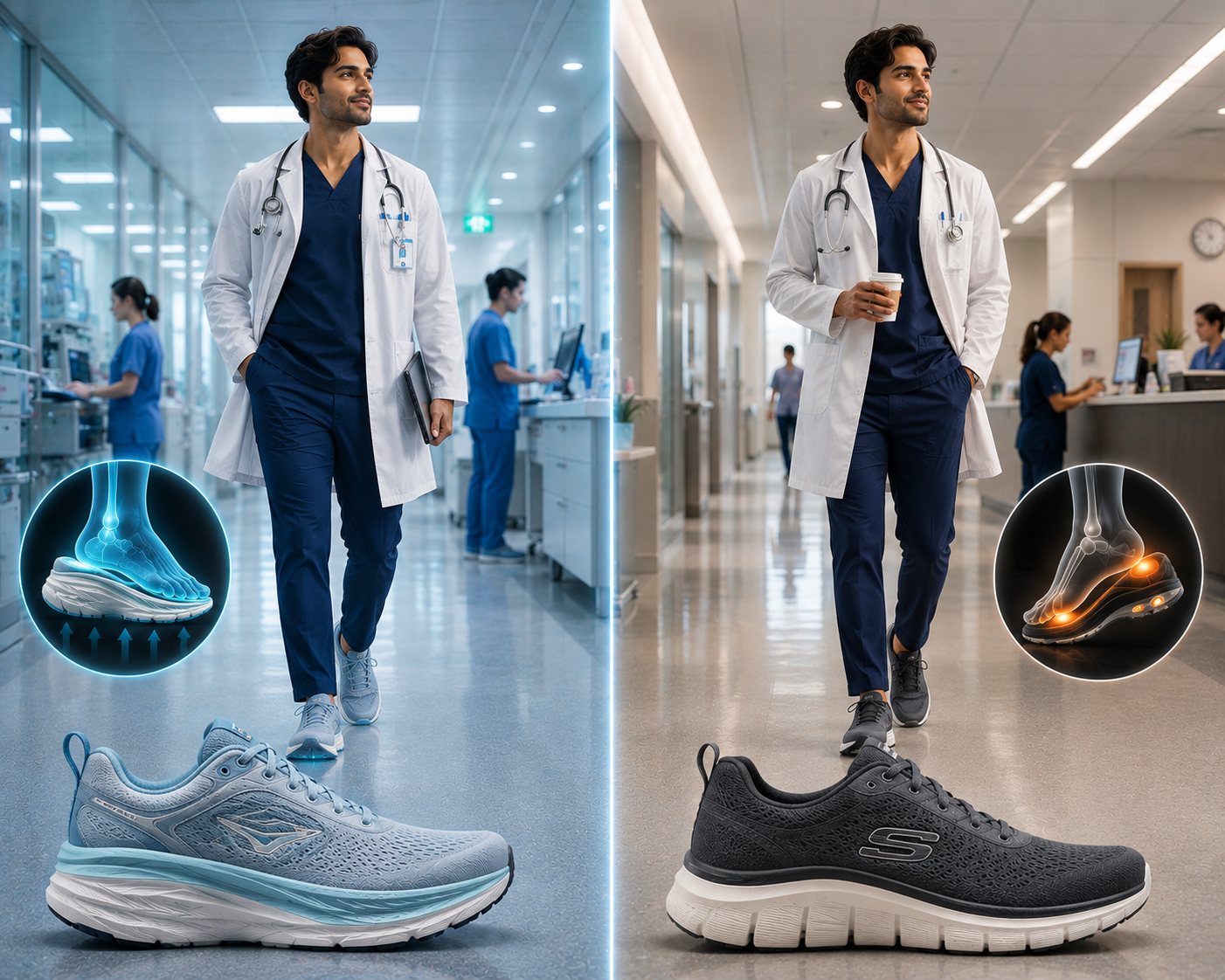
Hoka vs Skechers for Doctors
If you’re a doctor, your shoes are more than just part of your uniform—they’re essential equipment. Whether you’re making rounds across multiple hospital floors, standing through a six-hour surgery, or rushing to an emergency, the right footwear can make the difference between finishing your shift comfortably or going home with aching feet, sore knees, and lower back pain.
Two brands dominate conversations among healthcare professionals: Hoka and Skechers.
Hoka has earned a reputation for its thick cushioning, rocker sole design, and exceptional comfort during long hours on hard hospital floors. Skechers, meanwhile, is known for delivering impressive comfort at a lower price point, with popular collections like Arch Fit, Max Cushioning, and Work Slip-Resistant designed for professionals who spend the entire day on their feet.
But which brand is actually better for doctors?
The answer depends on more than price or popularity. Your specialty, the amount of walking you do during a shift, your foot type, and even the type of hospital environment you work in all play a role.
In this guide, we’ll compare Hoka and Skechers in the areas that matter most to physicians, including:
- Long-shift comfort
- Cushioning and shock absorption
- Arch support
- Stability during prolonged standing
- Slip resistance
- Durability
- Ease of cleaning
- Value for money
- The best models for different medical specialties
By the end of this article, you’ll know exactly which brand fits your daily workload and which model is worth investing in.
Quick Verdict
If you don’t have time to read the full comparison, here’s the short answer.
Choose Hoka if:
✅ You regularly work 10–14 hour shifts
✅ You walk several miles every day during hospital rounds
✅ You have plantar fasciitis, knee pain, heel pain, or lower back discomfort
✅ You want maximum cushioning and long-term comfort
✅ You’re willing to pay more for a shoe that typically lasts longer
Choose Skechers if:
✅ You want excellent comfort for under $120
✅ You’re a resident or newly practicing doctor on a tighter budget
✅ You prefer lighter shoes
✅ You need reliable comfort without spending premium prices
Overall Winner: Hoka
While Skechers offers outstanding value, Hoka consistently provides better long-term support, superior cushioning, and reduced fatigue during demanding hospital shifts. For most doctors, the higher price is justified by the added comfort and durability.
Hoka vs Skechers at a Glance
| Feature | Hoka | Skechers | Winner |
|---|---|---|---|
| Cushioning | ⭐⭐⭐⭐⭐ | ⭐⭐⭐⭐☆ | Hoka |
| Long-Shift Comfort | ⭐⭐⭐⭐⭐ | ⭐⭐⭐⭐☆ | Hoka |
| Arch Support | ⭐⭐⭐⭐⭐ | ⭐⭐⭐⭐☆ | Hoka |
| Stability | ⭐⭐⭐⭐⭐ | ⭐⭐⭐⭐☆ | Hoka |
| Weight | ⭐⭐⭐⭐☆ | ⭐⭐⭐⭐⭐ | Skechers |
| Slip-Resistant Options | ⭐⭐⭐⭐☆ | ⭐⭐⭐⭐⭐ | Skechers |
| Durability | ⭐⭐⭐⭐⭐ | ⭐⭐⭐⭐☆ | Hoka |
| Breathability | ⭐⭐⭐⭐☆ | ⭐⭐⭐⭐☆ | Tie |
| Easy Cleaning | ⭐⭐⭐⭐☆ | ⭐⭐⭐⭐☆ | Tie |
| Price | ⭐⭐⭐☆☆ | ⭐⭐⭐⭐⭐ | Skechers |
| Overall Value | ⭐⭐⭐⭐⭐ | ⭐⭐⭐⭐☆ | Hoka |
Why Doctors Need Specialized Shoes
Doctors don’t wear ordinary shoes because they don’t have ordinary workdays.
Unlike office workers who alternate between sitting and walking, physicians spend much of their day on unforgiving surfaces such as polished concrete, vinyl, and tile flooring. These materials provide almost no natural shock absorption, meaning every step sends impact forces back through your feet, ankles, knees, hips, and lower back.
Over time, this repetitive stress can contribute to:
- Heel pain
- Plantar fasciitis
- Achilles tendon discomfort
- Knee pain
- Lower back pain
- Leg fatigue
- Swollen feet
The demands vary depending on your specialty.
Surgeons
Surgeons may spend several hours standing almost motionless during lengthy procedures. While movement is limited, the continuous pressure placed on the feet can be exhausting.
For this reason, stability and supportive cushioning are often more important than an ultra-soft feel.
Emergency Physicians
Emergency medicine doctors rarely stay in one place.
A typical shift involves constant walking between patient rooms, imaging departments, trauma bays, and nursing stations. Many ER physicians easily exceed 12,000 to 18,000 steps in a single shift.
In this environment, lightweight shoes with excellent shock absorption help reduce fatigue over time.
Internal Medicine and Hospitalists
Hospitalists often cover several wards each day, walking long distances while carrying equipment or reviewing patient charts.
Their footwear needs to balance comfort, durability, and support for extended periods of walking.
Dentists and Specialists
Although dentists don’t usually walk as much as hospital physicians, they spend hours standing in relatively fixed positions.
This creates different pressure patterns under the feet compared to active walking, making stable cushioning especially important.
What Makes a Great Shoe for Doctors?
Not every comfortable sneaker performs well during a hospital shift.
Here are the qualities that matter most.
1. Cushioning That Lasts All Day
Soft shoes often feel amazing during the first few hours.
However, some cushioning materials compress as the day goes on, providing less protection by the end of a long shift.
Doctors who regularly work 12-hour schedules benefit from midsoles that maintain their shape throughout the day.
2. Reliable Arch Support
Proper arch support helps distribute body weight more evenly across the foot.
Without enough support, excessive pressure can develop beneath the heel or forefoot, increasing the likelihood of discomfort after standing or walking for extended periods.
Doctors with flat feet, high arches, or a history of plantar fasciitis often notice the biggest difference when switching to shoes with better structural support.
3. Stability
Highly cushioned shoes aren’t automatically better.
If the shoe allows too much side-to-side movement, your ankles and lower legs may have to work harder to maintain balance.
This is particularly important during long surgical procedures where you’re standing in one place for several hours.
4. Slip Resistance
Hospital floors become slippery for many reasons:
- Water
- Cleaning solutions
- Medical fluids
- Recently mopped hallways
A dependable outsole helps reduce the risk of slips without sacrificing walking comfort.
Doctors working in emergency departments, operating rooms, and laboratories should pay particular attention to slip-resistant models.
5. Easy Cleaning
Hospitals aren’t clean environments from a footwear perspective.
Blood, saline, medications, disinfectants, and other fluids can easily reach your shoes.
Leather or coated synthetic uppers are generally easier to wipe clean than breathable mesh, making them practical for many clinical settings.
6. Durability
Doctors often wear the same shoes for hundreds of hours every year.
A quality pair should continue providing support long after the first few weeks of use.
Although premium shoes cost more initially, they often maintain their cushioning and structure longer than lower-priced alternatives.
Meet the Competitors
Hoka
Originally developed for trail runners, Hoka has become one of the most popular footwear brands among healthcare professionals.
The company focuses on:
- Thick compression-molded EVA midsoles
- Rocker-shaped soles that encourage smooth forward movement
- Stable platforms
- Excellent shock absorption
- Long-distance comfort
Popular choices for doctors include:
- Hoka Bondi SR
- Hoka Bondi 9
- Hoka Clifton 10
- Hoka Gaviota
The Bondi SR, in particular, has become a favorite in hospitals because it combines maximum cushioning with a water-resistant leather upper and a slip-resistant outsole designed for workplace environments.
Skechers
Skechers has evolved far beyond casual walking shoes.
Today, the brand offers several collections designed specifically for professionals who spend long hours on their feet.
Popular technologies include:
- Arch Fit support system
- Air-Cooled Memory Foam
- Hyper Burst cushioning
- Slip-resistant Work collection
Popular models for doctors include:
- Skechers Arch Fit
- Skechers Max Cushioning Elite
- Skechers Work Slip-Resistant
- Skechers Go Walk
One of Skechers’ biggest advantages is affordability. Many of its best-performing models cost significantly less than comparable premium shoes, making them attractive to residents, interns, and doctors looking for excellent value.
First Impression: Which Brand Feels Better?
Trying on a pair of Skechers for the first time often creates an immediate “wow” moment.
The memory foam insole feels soft, plush, and comfortable straight out of the box, requiring little to no break-in period.
Hoka delivers a different experience.
Instead of feeling exceptionally soft underfoot, many Hoka models feel more structured and supportive. The rocker-shaped sole encourages a smooth rolling motion that becomes more noticeable as you walk longer distances.
For a short trip around the store, Skechers may seem more comfortable.
After eight to twelve hours in a hospital, however, many doctors find that Hoka’s supportive platform maintains its comfort more consistently, while softer foams can begin to feel compressed.
That’s one reason Hoka has become such a common sight in hospitals, surgical centers, and outpatient clinics around the world.
Hoka vs Skechers: Head-to-Head Comparison for Doctors
At first glance, Hoka and Skechers may seem similar. Both brands make comfortable shoes with thick midsoles, breathable uppers, and models designed for people who spend long hours standing.
However, after comparing them across the factors that matter most in a hospital environment, clear differences begin to emerge.
Let’s examine each category in detail.
Cushioning and Shock Absorption
Winner: Hoka ⭐⭐⭐⭐⭐
If there’s one area where Hoka consistently stands out, it’s cushioning.
Most Hoka shoes use compression-molded EVA (CMEVA) foam with a high stack height. This design absorbs impact efficiently while maintaining its structure over long shifts. Instead of sinking deeply into the shoe, your foot rests on a supportive platform that spreads pressure across a larger surface area.
This becomes especially noticeable after several hours of walking on hard hospital floors.
Skechers approaches comfort differently.
Many models feature Air-Cooled Memory Foam or Hyper Burst cushioning. Memory foam feels incredibly soft when you first put the shoes on, making Skechers immediately comfortable.
The downside is that memory foam naturally compresses with prolonged use. During demanding 10–12 hour shifts, some doctors find that it loses part of its plush feel compared to the beginning of the day.
Real-World Performance
Doctors walking more than 15,000 steps daily generally benefit more from Hoka’s firmer, resilient cushioning.
For physicians working shorter clinics or outpatient practices, Skechers still delivers excellent comfort.
Verdict
| Category | Winner |
|---|---|
| Initial Comfort | Skechers |
| All-Day Cushioning | Hoka |
| Long-Term Shock Absorption | Hoka |
Arch Support
Winner: Hoka ⭐⭐⭐⭐⭐
Arch support plays a major role in reducing fatigue during long hospital shifts.
Hoka designs most of its shoes with a stable platform and supportive midsole geometry. Instead of relying solely on a soft insole, the entire shoe contributes to supporting the foot.
This design works particularly well for doctors experiencing:
- Plantar fasciitis
- Heel pain
- Mild overpronation
- Lower back discomfort
- Knee pain
Skechers deserves credit for its Arch Fit collection.
The Arch Fit system was developed using extensive foot scan data and offers noticeably better support than standard memory foam shoes.
However, not every Skechers model includes Arch Fit technology.
Many budget-friendly options still prioritize softness over structural support.
Verdict
For doctors with healthy feet, both brands perform well.
For physicians already dealing with foot pain, Hoka generally provides more consistent support throughout long workdays.
Stability During Long Shifts
Winner: Hoka ⭐⭐⭐⭐⭐
Many people assume softer shoes automatically reduce fatigue.
In reality, excessive softness can sometimes increase muscle activity because the body constantly works to stabilize itself.
This is especially important for:
- Surgeons
- Dentists
- Anesthesiologists
- Radiologists
- Physicians performing lengthy procedures
Hoka’s wider base and Active Foot Frame help keep the foot centered within the shoe, creating a stable feeling without sacrificing comfort.
This added stability becomes valuable when standing almost motionless for several hours.
Skechers shoes tend to be softer and more flexible.
That flexibility is enjoyable while walking but may feel less supportive during prolonged standing.
Best Choice by Specialty
| Specialty | Better Brand |
|---|---|
| Surgeon | Hoka |
| Dentist | Hoka |
| Anesthesiologist | Hoka |
| ER Physician | Hoka |
| Outpatient Clinic | Tie |
Walking Efficiency
Winner: Hoka ⭐⭐⭐⭐⭐
Hospital doctors spend much of the day walking.
A physician working in emergency medicine or internal medicine can easily cover several miles during one shift.
This is where Hoka’s Meta-Rocker technology becomes noticeable.
The curved sole encourages a smooth heel-to-toe transition, helping your stride feel more efficient.
Rather than lifting your foot with every step, the shoe naturally rolls forward.
The difference isn’t dramatic after a few minutes—but after several hours, many users report feeling less fatigue in their calves and feet.
Skechers offers lightweight shoes that are easy to walk in, but they don’t provide the same rolling sensation.
Weight
Winner: Skechers ⭐⭐⭐⭐⭐
Weight affects how tired your legs feel after thousands of steps.
Many Skechers models are lighter than comparable Hoka shoes.
For doctors who value agility and flexibility, Skechers often feels less bulky.
Hoka shoes, especially the Bondi series, have thicker midsoles that add some weight.
Fortunately, the rocker design helps offset this during walking.
Verdict
If lightweight footwear is your top priority, Skechers wins.
If reducing overall fatigue matters more than saving a few ounces, Hoka remains the stronger choice.
Breathability
Winner: Tie ⭐⭐⭐⭐☆
Doctors often work in warm environments under bright hospital lighting.
A breathable upper helps reduce overheating during long shifts.
Both brands perform well here.
Most Hoka models use engineered mesh that promotes airflow while maintaining structure.
Skechers also uses lightweight mesh across many collections.
The only exception involves leather work shoes.
Models like the Hoka Bondi SR or Skechers Work series sacrifice some ventilation in exchange for easier cleaning and better protection from spills.
Verdict
Neither brand has a significant advantage.
Choose mesh if breathability matters most.
Choose leather if your workplace involves frequent exposure to fluids.
Slip Resistance
Winner: Skechers ⭐⭐⭐⭐⭐ (Overall Choice)
Slip resistance is one of the most overlooked factors when buying hospital shoes.
Doctors frequently encounter:
- Wet hallways
- Recently cleaned floors
- Saline spills
- Blood
- Medication residue
Skechers offers one of the largest selections of slip-resistant work shoes.
Its Work collection includes numerous models designed specifically for healthcare, food service, and industrial environments.
Hoka also performs exceptionally well—but mainly through the Bondi SR, which features a certified slip-resistant outsole and water-resistant leather upper.
The challenge is that Hoka provides fewer workplace-specific options.
Verdict
| Need | Better Choice |
|---|---|
| Largest Selection | Skechers |
| Premium Slip-Resistant Shoe | Hoka Bondi SR |
Ease of Cleaning
Winner: Tie
Hospital shoes eventually get dirty.
Mesh uppers provide excellent airflow but absorb liquids more easily.
Leather or coated synthetic uppers are far easier to wipe clean.
Both companies offer suitable options.
Best Models
Hoka
- Bondi SR
- Transport
Skechers
- Work Sure Track
- Work Squad
- Arch Fit Work
Doctors working in operating rooms or emergency departments often prefer leather models for this reason.
Durability
Winner: Hoka ⭐⭐⭐⭐⭐
Durability isn’t just about how long the outsole lasts.
It’s also about how well the midsole maintains support.
After months of heavy use, shoes gradually lose their ability to absorb impact.
Hoka’s compression-molded EVA generally maintains its structure longer than softer memory foam.
While Skechers shoes remain comfortable, frequent users often notice the cushioning flattening sooner.
Estimated Replacement Timeline
| Brand | Average Lifespan* |
|---|---|
| Hoka | 8–12 months |
| Skechers | 6–9 months |
*Actual lifespan depends on body weight, walking distance, and work schedule.
Heel-to-Toe Drop
Winner: Depends on Your Preference
Heel drop refers to the height difference between the heel and forefoot.
Most Hoka models use a lower heel drop, typically around 4–5 mm.
This encourages a more natural walking pattern and may reduce pressure on the knees for some users.
Skechers often uses a more traditional heel drop, which some doctors find more familiar, especially if they’re transitioning from dress shoes or clogs.
Neither approach is inherently better.
Comfort depends on your gait, ankle mobility, and previous footwear.
Value for Money
Winner: Depends on Your Budget
Let’s compare the numbers.
| Brand | Typical Price |
|---|---|
| Hoka | $150–$190 |
| Skechers | $80–$120 |
At first glance, Skechers appears to offer much better value.
However, price alone doesn’t tell the whole story.
If a Hoka shoe lasts several months longer while maintaining its support, the long-term cost difference becomes much smaller.
Example
| Brand | Purchase Price | Estimated Lifespan | Approximate Cost per Month |
|---|---|---|---|
| Hoka Bondi SR | $180 | 12 months | $15 |
| Skechers Arch Fit | $100 | 8 months | $12.50 |
For many doctors, paying a few extra dollars per month is worthwhile if it reduces foot fatigue during every shift.
Which Brand Is Better for Different Types of Doctors?
Not every doctor has the same workload.
Choosing the right shoe depends on how you spend your day.
| Medical Specialty | Recommended Brand | Why |
|---|---|---|
| Emergency Physician | Hoka | Excellent cushioning for constant walking |
| Surgeon | Hoka Bondi SR | Stable platform and easy-to-clean leather upper |
| Internal Medicine | Hoka Clifton | Lightweight with strong support |
| Cardiologist | Hoka | Comfortable during long hospital rounds |
| Pediatrician | Skechers Arch Fit | Comfortable and affordable for moderate walking |
| Family Physician | Skechers | Great value for clinic-based work |
| Dentist | Hoka Bondi | Better support during prolonged standing |
| Radiologist | Skechers | Comfortable for lighter daily movement |
| Medical Resident | Skechers | Lower upfront cost with solid comfort |
Hoka vs Skechers for Common Foot Problems
Choosing shoes based on your foot condition can make a noticeable difference in daily comfort.
| Foot Condition | Better Choice | Why |
|---|---|---|
| Plantar Fasciitis | Hoka | Excellent heel cushioning and supportive platform |
| Heel Pain | Hoka | Better shock absorption over long shifts |
| Flat Feet | Hoka Gaviota or Skechers Arch Fit | Both offer enhanced stability |
| High Arches | Hoka | Better pressure distribution |
| Lower Back Pain | Hoka | Stable cushioning may reduce fatigue |
| Wide Feet | Tie | Both brands offer wide-width options |
Best Hoka Shoes for Doctors
Not every Hoka shoe is designed for hospital work. Some models are built for racing, while others focus on maximum cushioning or stability.
These are the Hoka models most suitable for doctors.
Hoka Bondi SR – Best Overall for Doctors
Best for:
- Surgeons
- Emergency physicians
- Hospitalists
- Doctors working 10–14 hour shifts
If there is one Hoka model that consistently stands out for healthcare professionals, it’s the Bondi SR.
Unlike the regular Bondi, the SR (“Slip Resistant”) version is specifically designed for workplaces such as hospitals, clinics, and laboratories.
Why doctors like it
- Exceptional cushioning for hard hospital floors
- Slip-resistant outsole for wet surfaces
- Water-resistant leather upper that’s easy to clean
- Wide, stable platform for prolonged standing
- Comfortable even during demanding shifts
Pros
✔ Outstanding shock absorption
✔ Excellent stability
✔ Easy to wipe clean
✔ Durable construction
Cons
✘ Heavier than running shoes
✘ Premium price
Overall Rating: ⭐⭐⭐⭐⭐
Hoka Clifton 10 – Best for Doctors Who Walk All Day
Best for:
- Emergency physicians
- Internal medicine
- Cardiologists
- Hospital rounds
The Clifton series has become one of Hoka’s most popular shoes because it balances cushioning with a lighter feel.
Compared to the Bondi, the Clifton feels more agile while still providing excellent support.
Pros
- Lightweight
- Smooth heel-to-toe transition
- Comfortable for long walking distances
- Less bulky than the Bondi
Cons
- Not as stable for prolonged standing
- Mesh upper isn’t ideal for messy environments
Overall Rating: ⭐⭐⭐⭐☆
Hoka Gaviota 5 – Best for Flat Feet
Doctors with overpronation or flat feet often need extra stability.
The Gaviota provides supportive cushioning without feeling overly rigid.
Best for
- Flat feet
- Mild overpronation
- Knee discomfort
Best Skechers Shoes for Doctors
Skechers offers a wide range of models, but only a few are particularly well suited to hospital work.
Skechers Arch Fit – Best Overall Skechers
Best for
- Family physicians
- Residents
- Clinic doctors
- Doctors with mild plantar fasciitis
The Arch Fit collection combines supportive insoles with comfortable cushioning.
Unlike standard memory foam shoes, Arch Fit provides better structural support throughout the day.
Pros
✔ Affordable
✔ Comfortable immediately
✔ Good arch support
✔ Available in multiple widths
Cons
✘ Cushioning doesn’t last as long as Hoka
✘ Less stable during very long shifts
Overall Rating: ⭐⭐⭐⭐☆
Skechers Max Cushioning Elite
This model is ideal for doctors looking for maximum comfort without spending premium prices.
The thick midsole absorbs impact well and feels soft from the first wear.
Best for
- Outpatient clinics
- Family medicine
- Doctors working shorter shifts
Skechers Work Slip Resistant
If slip resistance is your highest priority, this collection deserves serious consideration.
Many models feature:
- Slip-resistant rubber outsoles
- Easy-to-clean synthetic uppers
- Comfortable all-day fit
They’re especially popular among healthcare workers who spend time in wet or fast-paced environments.
Pros and Cons
Hoka
Pros
- Exceptional cushioning
- Excellent support for long shifts
- Stable platform
- Durable midsoles
- Great for plantar fasciitis
- Ideal for walking long distances
- Premium build quality
Cons
- Expensive
- Some models feel bulky
- Limited workplace-specific options compared to Skechers
Skechers
Pros
- Excellent value for money
- Comfortable straight out of the box
- Lightweight
- Wide selection of work shoes
- Many slip-resistant options
- Good availability in wide widths
Cons
- Memory foam compresses faster
- Less durable under heavy daily use
- Not every model offers strong arch support
Which Brand Should You Buy?
Instead of asking which brand is better overall, ask which one fits your daily work.
Buy Hoka if:
- You regularly work 12-hour shifts.
- You walk more than 12,000 steps daily.
- You have plantar fasciitis or heel pain.
- You experience knee or lower back discomfort.
- You want premium cushioning that lasts.
- You’re comfortable paying more for long-term performance.
Buy Skechers if:
- You’re shopping on a tighter budget.
- You’re a resident or recently graduated doctor.
- You work mostly in clinics or outpatient settings.
- You prefer lightweight shoes.
- You want excellent comfort without spending over $100.
Frequently Asked Questions
Are Hoka shoes worth the extra money for doctors?
For doctors who spend long hours walking or standing, many find that Hoka’s superior cushioning and durability justify the higher price. The improved support may also help reduce fatigue over long shifts.
Do doctors wear Skechers?
Yes.
Many physicians choose Skechers because they’re comfortable, affordable, and widely available.
The Arch Fit and Work collections are particularly popular among healthcare professionals.
Which Hoka shoe is best for surgeons?
The Hoka Bondi SR is generally the best option.
Its stable platform, slip-resistant outsole, and water-resistant leather upper make it well suited to operating rooms and other clinical environments.
Are Skechers good for plantar fasciitis?
Some models are.
The Skechers Arch Fit collection offers better support than standard memory foam shoes and can be a good option for people with mild plantar fasciitis.
Those with more severe symptoms may prefer Hoka’s more supportive platform.
Which shoes last longer?
In general, Hoka shoes maintain their cushioning and support longer than many Skechers models.
Actual lifespan depends on walking distance, body weight, and how often the shoes are worn.
How often should doctors replace their work shoes?
Most doctors should replace their shoes every 8–12 months, or sooner if they notice:
- Flattened cushioning
- Uneven outsole wear
- Reduced support
- Persistent foot discomfort
Doctors who work five or six long shifts each week may need to replace them more frequently.
Are leather shoes better than mesh for hospitals?
It depends on your work environment.
Leather uppers are easier to clean and provide better protection against spills, making them ideal for operating rooms and emergency departments.
Mesh uppers offer superior breathability but absorb liquids more easily.
Can I use running shoes for hospital work?
Yes, provided they offer sufficient support, stability, and traction.
Many doctors wear running shoes because they provide more cushioning than traditional clogs or dress shoes.
However, if your workplace requires slip-resistant footwear, make sure the model meets those requirements.
Final Verdict
Both Hoka and Skechers make excellent shoes for doctors, but they serve slightly different needs.
If your priority is maximum comfort during long hospital shifts, Hoka is the stronger choice.
Its supportive cushioning, stable platform, and durable midsoles make it especially well suited to physicians who spend hours walking hospital corridors or standing through lengthy procedures. Although the initial investment is higher, many doctors find the added comfort and longevity worthwhile.
Skechers, on the other hand, delivers excellent value. Models like the Arch Fit and Work series provide reliable comfort, good support, and practical features at a significantly lower price. For residents, clinic-based physicians, or anyone with a tighter budget, Skechers remains a smart option.
Our Recommendations
🥇 Best Overall: Hoka Bondi SR
🥈 Best Value: Skechers Arch Fit
🏃 Best for Walking All Day: Hoka Clifton 10
🩺 Best for Surgeons: Hoka Bondi SR
💰 Best Budget Choice: Skechers Work Slip Resistant
👣 Best for Flat Feet: Hoka Gaviota 5
Key Takeaways
- Hoka is the better choice for most doctors working long hospital shifts thanks to its superior cushioning, stability, and durability.
- Skechers offers outstanding comfort and value, especially for doctors who want quality footwear at a lower price.
- If you spend most of your day walking, the Hoka Clifton 10 is an excellent option.
- If you spend hours standing in operating rooms or procedure suites, the Hoka Bondi SR stands out for its stability and easy-to-clean leather upper.
- For doctors on a budget, the Skechers Arch Fit delivers one of the best combinations of support and affordability.

