
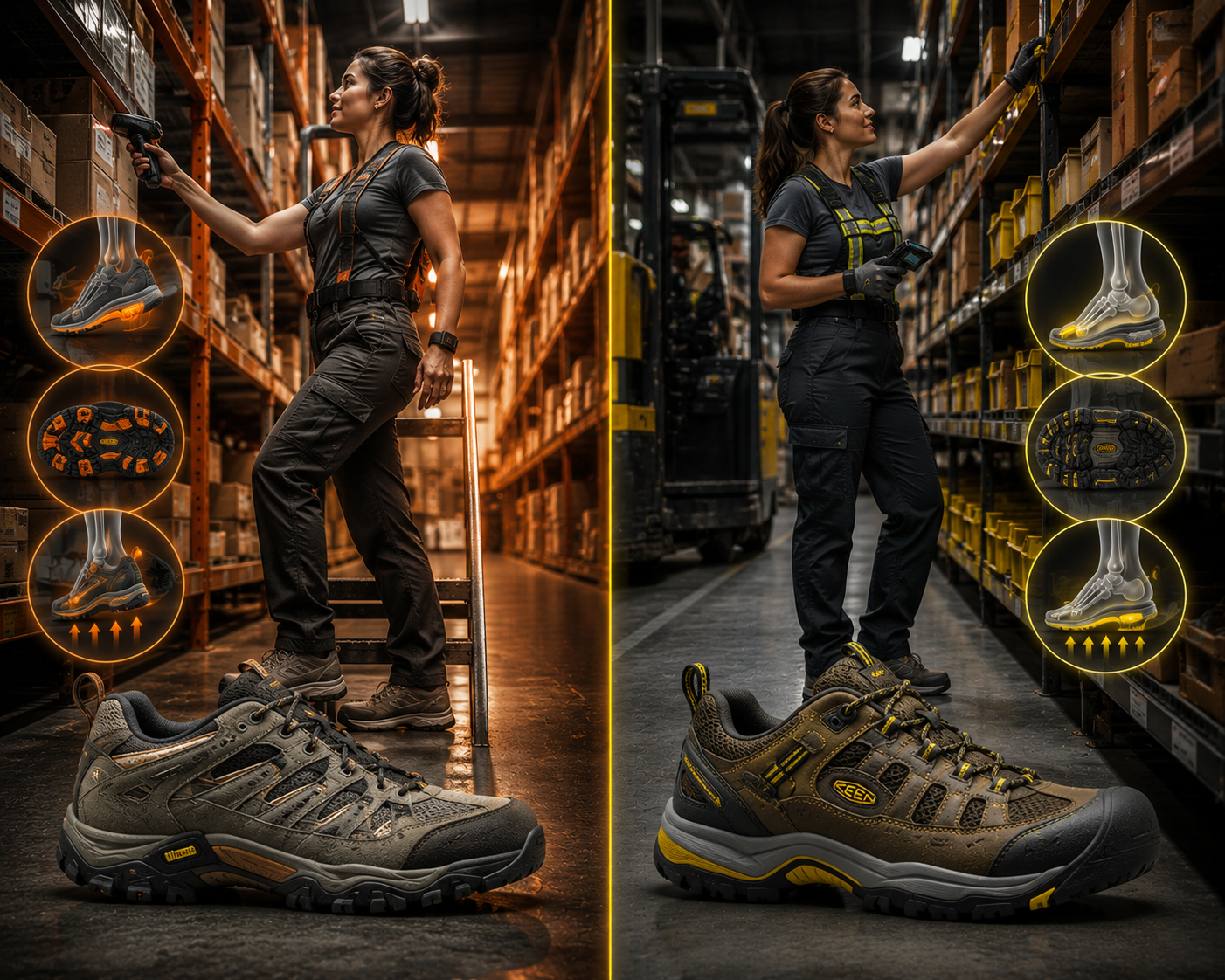
Merrell vs Keen for Warehouse Pickers
If you’ve ever finished a 10- or 12-hour warehouse shift feeling like your feet were on fire, you already know that the wrong shoes can make every step miserable. Warehouse pickers, fulfillment associates, and logistics workers often walk between 15,000 and 30,000 steps in a single shift while spending hours on unforgiving concrete floors. Add lifting, squatting, climbing ladders, and pushing heavy carts, and your footwear becomes one of the most important pieces of equipment you own.
That’s why Merrell and Keen are two brands that frequently come up in conversations among warehouse workers. Both have strong reputations for comfort, durability, and all-day support, but they aren’t built with the same priorities. Merrell leans toward lightweight, athletic-inspired comfort, while Keen focuses more on protection, stability, and generous toe room.
So, which one is actually better for warehouse work?
The answer depends on several factors, including your foot shape, whether your workplace requires safety toes or ESD protection, how many miles you walk during a shift, and whether your biggest problem is foot fatigue, sore knees, or aching heels.
In this guide, we’ll compare Merrell Work and Keen Utility shoes in the areas that matter most to warehouse employees, including:
- Comfort after 12-hour shifts
- Cushioning on concrete floors
- Weight and walking fatigue
- Slip resistance
- Durability
- Breathability
- Safety toe options
- ESD and EH certifications
- Fit for wide or narrow feet
- Best shoe models for different warehouse jobs
By the end, you’ll know which brand fits your work environment and your feet.
Quick Verdict
If you’re looking for the short answer, here’s how the two brands compare.
Choose Merrell Work if:
- You walk long distances every shift.
- You prefer lightweight shoes that feel more like running shoes.
- You want excellent comfort straight out of the box.
- Your feet are average or slightly narrow in width.
- You value flexibility and reduced leg fatigue.
Choose Keen Utility if:
- You have wide feet or need extra toe room.
- Your job requires composite or steel toe protection.
- You spend a lot of time lifting, kneeling, or working around pallets.
- Your workplace requires ESD-rated footwear.
- Durability is more important than keeping shoe weight to a minimum.
Bottom line: For workers who prioritize lightweight comfort and spend the day constantly walking, Merrell is often the better choice. For those who need more protection, stability, and a roomier fit, Keen Utility usually comes out ahead.
Merrell vs Keen: Quick Comparison
| Feature | Merrell Work | Keen Utility | Best Choice |
|---|---|---|---|
| Comfort | ⭐⭐⭐⭐⭐ | ⭐⭐⭐⭐☆ | Merrell |
| Long Shift Support | ⭐⭐⭐⭐⭐ | ⭐⭐⭐⭐⭐ | Tie |
| Cushioning | ⭐⭐⭐⭐⭐ | ⭐⭐⭐⭐☆ | Merrell |
| Toe Box Width | Medium | Wide | Keen |
| Break-in Period | Very Short | Moderate | Merrell |
| Durability | ⭐⭐⭐⭐☆ | ⭐⭐⭐⭐⭐ | Keen |
| Slip Resistance* | Excellent on certified models | Excellent on certified models | Tie |
| Safety Toe Options | Yes | Extensive | Keen |
| ESD Models | Available | Extensive selection | Keen |
| Breathability | Excellent | Very Good | Merrell |
| Weight | Lightweight | Slightly heavier | Merrell |
| Stability | Very Good | Excellent | Keen |
| Best for Walking | ⭐⭐⭐⭐⭐ | ⭐⭐⭐⭐☆ | Merrell |
| Best for Wide Feet | ⭐⭐⭐⭐ | ⭐⭐⭐⭐⭐ | Keen |
| Overall Warehouse Value | ⭐⭐⭐⭐⭐ | ⭐⭐⭐⭐⭐ | Tie |
*Always check the certification of the specific model you plan to buy. Not every Merrell or Keen work shoe includes the same slip-resistant, ESD, or safety features.
How We Evaluated Merrell and Keen for Warehouse Work
Many shoe comparisons focus on hiking trails or casual walking, but warehouse employees face a very different set of challenges. A shoe that performs well on a mountain trail doesn’t automatically become the best choice for a fulfillment center or distribution warehouse.
For this comparison, we focused on the factors that have the biggest impact during long warehouse shifts:
- Walking long distances on concrete floors
- Standing for hours at packing stations
- Repeated squatting and kneeling
- Climbing ladders and warehouse stairs
- Pushing carts and pallet jacks
- Working in warm indoor environments
- Managing foot swelling during long shifts
- Reducing fatigue in the feet, knees, and lower back
- Availability of safety certifications such as ASTM-rated composite toes, ESD, and slip resistance
Rather than relying on marketing claims alone, this guide also considers design differences between Merrell Work and Keen Utility shoes, published product specifications, and common feedback from warehouse employees who wear these shoes in real working conditions.
Meet the Brands
Merrell Work
Merrell built its reputation on hiking footwear, but its Work collection adapts many of those comfort-focused technologies for industrial environments. Instead of bulky work boots, many Merrell Work models feel closer to trail-running shoes, making them attractive to warehouse employees who spend most of the day walking.
Some of the features commonly found across Merrell Work shoes include:
- Lightweight athletic construction
- Cushioned EVA midsoles
- Merrell Air Cushion heel technology on selected models
- Breathable mesh uppers
- Flexible soles that encourage a natural walking stride
- ASTM-certified safety toe options on selected work models
- Slip-resistant outsoles designed for industrial surfaces
One reason many workers choose Merrell is the minimal break-in period. Several models feel comfortable from the first shift, reducing the discomfort often associated with traditional work boots.
If your daily routine involves covering several miles across a warehouse, Merrell’s lighter construction can make a noticeable difference by the end of the day.
Keen Utility
While Merrell started with hiking, Keen developed a dedicated reputation in industrial footwear through its Keen Utility line. These shoes and boots are designed with workplaces in mind, offering features aimed at protecting workers in demanding environments.
One of Keen’s standout characteristics is its asymmetrical toe box, which gives each foot more natural room instead of squeezing the toes into a symmetrical safety cap. Workers with wide feet often find this design significantly more comfortable during long shifts.
Depending on the model, Keen Utility shoes may include:
- Composite or carbon-fiber safety toes
- Wide toe box design
- KEEN.ReGEN cushioning on selected models
- Oil- and slip-resistant outsoles
- ESD-certified options for static-sensitive workplaces
- Reinforced toe protection
- Durable leather or abrasion-resistant textile uppers
Although many Keen shoes weigh slightly more than comparable Merrell models, the additional structure often translates into better stability and longer-lasting durability in demanding warehouse environments.
Why Warehouse Workers Need Different Shoes Than Hikers
At first glance, hiking shoes and warehouse shoes may seem similar. Both need good traction, cushioning, and durability. However, the environments are completely different.
A hiking trail provides natural variation. Dirt, grass, rocks, and uneven terrain allow your muscles and joints to move differently throughout the day.
Warehouse floors don’t.
Concrete is one of the hardest surfaces you’ll ever stand on for extended periods. Unlike soil or grass, it absorbs almost none of the impact created when your foot strikes the ground. Every step sends force back through your feet, ankles, knees, hips, and lower back.
For warehouse pickers, this impact is repeated thousands of times each shift.
A good warehouse shoe should therefore prioritize:
- Shock absorption for concrete
- Stable support when carrying loads
- Reliable traction on polished floors
- Flexibility for squatting and climbing
- Breathability to reduce heat buildup
- Enough room for feet that naturally swell during long workdays
- Safety features required by your employer
These priorities explain why two excellent outdoor shoe brands can perform very differently once they move inside a warehouse.
Head-to-Head Comparison: Merrell vs. Keen for Warehouse Workers
Now it’s time for the comparison that matters most. Rather than focusing on hiking performance or casual wear, this section looks at how both brands perform during real warehouse work.
We’ll compare them in twelve categories that directly affect comfort, safety, and long-term durability during 8- to 12-hour shifts.
Round 1: Comfort After a 12-Hour Shift
If there’s one thing warehouse workers care about most, it’s how their feet feel at the end of the day—not during the first hour.
Both Merrell Work and Keen Utility offer all-day comfort, but they achieve it differently.
Merrell prioritizes lightweight cushioning and flexibility. Many workers describe Merrell shoes as feeling comfortable almost immediately, with little to no break-in period. This makes them a popular option for employees who walk continuously throughout their shift.
Keen, on the other hand, uses a more structured design. The extra support can initially feel firmer, but many workers find it provides better stability during long shifts, especially when carrying heavy loads or frequently changing direction.
Merrell Advantages
- Softer initial feel
- Minimal break-in
- Athletic shoe sensation
- Excellent for continuous walking
Keen Advantages
- More structured support
- Better stability under load
- Comfortable once broken in
Winner: Merrell for instant comfort, Keen for workers who prefer a more supportive fit.
Round 2: Walking on Concrete Floors
Concrete is the biggest enemy of warehouse workers.
Unlike asphalt or outdoor trails, concrete absorbs almost none of the impact generated with each step. Over thousands of steps, that repetitive force contributes to sore feet, tired calves, knee discomfort, and lower back fatigue.
Merrell addresses this with lightweight EVA midsoles and, on some models, Air Cushion heel technology designed to soften heel strikes.
Keen Utility models often feature thicker midsoles and, on certain shoes, KEEN.ReGEN cushioning, which is engineered to provide responsive energy return while maintaining stability.
The practical difference?
- Merrell tends to feel softer underfoot.
- Keen tends to feel firmer but more supportive over extended periods.
If you’re constantly moving around the warehouse, Merrell may reduce fatigue through lower weight. If you spend long periods standing at one workstation before moving again, Keen’s firmer platform may feel more stable.
Winner: Tie
Round 3: Shoe Weight and Daily Fatigue
Every extra ounce matters when you’re walking 20,000 or more steps each day.
Merrell Work shoes are generally lighter than comparable Keen Utility models because they’re designed with a more athletic construction.
That difference may not seem significant when you first put the shoes on, but lighter footwear can make long shifts feel less tiring, particularly for order pickers who are constantly moving between aisles.
Keen’s additional weight usually comes from:
- Larger toe protection
- Reinforced construction
- More rugged outsoles
- Additional workplace safety features
The trade-off is simple:
Merrell
- Easier to walk in all day
- Less leg fatigue
- Faster-feeling stride
Keen
- Better protection
- More stable platform
- Slightly heavier
If your job involves walking almost nonstop, lighter shoes often become more appealing.
Winner: Merrell
Round 4: Toe Box and Foot Shape
This is where the two brands differ the most.
Merrell
Merrell generally uses a traditional athletic fit.
Workers with average-width feet often find the fit secure and supportive.
However, employees with naturally wide feet may notice pressure around the little toe after several hours, particularly if their feet swell during long shifts.
Keen
Keen is famous for its asymmetrical toe design.
Instead of forcing both feet into the same rounded shape, Keen designs the left and right toe caps to better follow the natural shape of each foot.
The benefits include:
- Less pressure on the little toe
- Better circulation
- Reduced blister risk
- More comfort during swelling
If you’ve ever taken off your shoes after work and found red marks around your toes, this wider design could make a noticeable difference.
Winner: Keen
Round 5: Safety Toe Options
Many warehouses require ASTM-certified protective footwear.
Fortunately, both brands offer work models with protective toe options.
Merrell Work
Available with:
- Composite toe (selected models)
- Aluminum toe (selected models)
Keen Utility
Available with:
- Composite toe
- Carbon-fiber toe
- Steel toe
- Aluminum toe
Keen also offers a broader selection across different work environments, making it easier to find a model that meets your employer’s safety requirements.
If your warehouse requires protective footwear, always verify the certification of the specific model before purchasing.
Winner: Keen
Round 6: Slip Resistance
Warehouse floors can become surprisingly slippery.
Common hazards include:
- Water
- Cleaning solutions
- Dust
- Plastic wrap
- Oil
- Loading dock moisture
Both Merrell Work and Keen Utility offer models with slip-resistant outsoles, but not every shoe in their lineup carries the same certification.
Merrell often uses aggressive outsole patterns inspired by hiking footwear, providing confident grip across a variety of surfaces.
Keen Utility shoes are designed for industrial environments and also perform well, particularly on polished concrete and warehouse flooring.
The real deciding factor isn’t the brand—it’s whether the specific model is certified for slip resistance.
Winner: Tie
Round 7: ESD vs. EH Protection
Many warehouse employees don’t realize there’s a difference between ESD and EH footwear until they start a new job.
ESD (Electrostatic Discharge)
Designed to safely dissipate static electricity.
Common in:
- Electronics warehouses
- Distribution centers
- Automated fulfillment facilities
EH (Electrical Hazard)
Designed to reduce the risk of electric shock from accidental contact with energized circuits.
More common in:
- Construction
- Maintenance
- Industrial trades
Keen Utility offers a wider range of ESD-certified shoes, making it a strong option for warehouses handling electronics or using automated systems where static control is important.
Merrell also offers work models with safety certifications, but availability varies by collection.
Before buying, check your employer’s footwear policy. Wearing the wrong certification can mean your shoes don’t meet workplace requirements.
Winner: Keen
Round 8: Breathability During Long Shifts
Warehouse temperatures can rise quickly, especially during summer.
Warm feet lead to:
- Sweat
- Blisters
- Odor
- Faster fatigue
Merrell’s hiking background gives it an advantage here.
Many models feature lightweight mesh uppers that allow heat to escape efficiently.
Keen also offers breathable options, particularly in its athletic-inspired Utility models, but some heavier-duty designs sacrifice airflow for additional protection.
If your warehouse isn’t climate-controlled, breathability becomes an important comfort factor.
Winner: Merrell
Round 9: Durability
A warehouse shoe isn’t a good value if it only lasts a few months.
Merrell shoes generally hold up well under continuous walking, but their lighter construction can show wear sooner if your job involves constant kneeling, dragging pallets, or frequent contact with rough surfaces.
Keen Utility shoes are built with heavier-duty materials and reinforced protection in high-wear areas.
Workers often report excellent longevity from Keen’s Utility line, especially when used in demanding industrial environments.
That doesn’t mean Merrell lacks durability—it simply prioritizes lighter weight over maximum toughness.
Winner: Keen
Round 10: Squatting, Kneeling, and Flexibility
Warehouse work isn’t just walking.
Many employees repeatedly:
- Squat to lower shelves
- Kneel while stocking
- Bend while lifting
- Climb stairs and ladders
These movements create constant stress at the shoe’s flex point.
Some newer Keen Utility models incorporate technologies designed to improve flexibility while reducing material stress in this area, helping the upper bend more naturally during repetitive movements.
Merrell’s flexible athletic construction also performs well, especially for walking, but frequent squatting in demanding environments may place greater wear on lighter textile uppers over time.
Winner: Keen (for jobs with frequent squatting and kneeling)
Round 11: Which Brand Is Better for Foot Pain?
Different foot problems require different solutions.
Plantar Fasciitis
Look for:
- Strong arch support
- Cushioned heel
- Removable insoles
Merrell’s softer cushioning appeals to many workers dealing with heel pain, though individual needs vary.
Wide Feet
Keen’s roomy toe box is often a better match.
Knee Pain
Reducing repetitive impact matters.
Some workers prefer Merrell’s softer ride, while others appreciate Keen’s stable platform. Comfort is highly individual.
Lower Back Fatigue
Proper cushioning, support, and fit all contribute. A well-fitting shoe from either brand is more important than brand loyalty alone.
Winner: Depends on your specific condition and fit.
Round 12: Overall Value for Money
Neither Merrell nor Keen is a budget brand, but both offer strong value when matched to the right job.
Choose Merrell if you value:
- Lightweight comfort
- Athletic feel
- Quick break-in
- Long walking shifts
Choose Keen if you value:
- Durability
- Wide fit
- Safety features
- Industrial stability
Rather than asking which shoe is “better,” ask which one fits your work environment and your feet.
Scorecard: Merrell vs. Keen
| Category | Winner |
|---|---|
| Comfort Out of the Box | 🟢 Merrell |
| Concrete Cushioning | 🟡 Tie |
| Lightweight Design | 🟢 Merrell |
| Wide Toe Box | 🔵 Keen |
| Safety Toe Options | 🔵 Keen |
| Slip Resistance | 🟡 Tie |
| ESD Availability | 🔵 Keen |
| Breathability | 🟢 Merrell |
| Durability | 🔵 Keen |
| Squatting & Flexibility | 🔵 Keen |
| Foot Pain Support | 🟡 Depends |
| Overall Value | 🟡 Tie |
After twelve rounds, there’s no universal winner—and that’s good news. It means your decision should be based on how you work, not just the logo on the shoe. In the next section, we’ll look at the best Merrell Work and Keen Utility models for different warehouse roles, from fast-moving order pickers to shipping and receiving teams, so you can narrow your choice even further.
Best Merrell Shoes for Warehouse Workers
Not every Merrell shoe is built for warehouse work. While the brand is best known for hiking footwear, its Merrell Work collection includes several models that combine athletic comfort with workplace safety features.
Below are some of the best options depending on your job duties.
Important: Safety certifications vary by model and version. Always check that the exact shoe you purchase meets your employer’s requirements (ASTM, slip resistance, ESD, composite toe, etc.).
1. Merrell Moab Vertex 2 Work – Best Overall Merrell for Warehouse Workers
If you ask experienced warehouse employees which Merrell work shoe they recommend most often, the Moab Vertex 2 Work is usually near the top of the list.
It borrows the comfort of the famous Moab hiking series while adding workplace-ready features.
Best for
- Order pickers
- Amazon fulfillment associates
- Distribution center employees
- Workers walking 10–15 miles per shift
Pros
- Extremely comfortable for long shifts
- Lightweight compared to many work shoes
- Excellent traction on concrete
- Breathable upper helps reduce heat buildup
- Available with safety toe options
Cons
- Not as roomy as Keen for wide feet
- Premium price
Our Rating: ⭐⭐⭐⭐⭐ (4.8/5)
2. Merrell Moab Speed 2 Work – Best Lightweight Option
If reducing leg fatigue is your biggest priority, the Moab Speed 2 Work deserves serious consideration.
Inspired by trail-running shoes, it feels faster and lighter than traditional work footwear without sacrificing workplace durability.
It’s especially popular among workers who spend almost the entire shift walking.
Best for
- Fast-paced fulfillment centers
- E-commerce warehouses
- Grocery distribution centers
Pros
- Athletic feel
- Excellent flexibility
- Comfortable right out of the box
- Lightweight construction
Cons
- Less protective than heavier-duty work shoes
- Not ideal for constant heavy impacts
Our Rating: ⭐⭐⭐⭐☆ (4.7/5)
3. Merrell Nova Work – Best for Comfort
The Nova Work line focuses on cushioning and flexibility.
If sore feet are your biggest problem after work, this model is worth considering.
Many workers compare the comfort to wearing running shoes rather than traditional safety footwear.
Best for
- Standing all day
- Packing stations
- Inventory control
- Retail warehouses
Pros
- Soft underfoot feel
- Flexible sole
- Excellent breathability
Cons
- Less rugged than some Keen Utility models
Our Rating: ⭐⭐⭐⭐☆ (4.6/5)
Best Keen Utility Shoes for Warehouse Workers
Keen Utility designs its work shoes specifically for industrial environments, making them popular in warehouses that require safety toes, ESD protection, or extra durability.
1. Keen Utility Vista Energy – Best Overall Keen Shoe
For many warehouse workers, the Vista Energy strikes the best balance between protection and comfort.
Unlike traditional work boots, it has a more athletic design while maintaining workplace certifications on qualifying models.
Best for
- Warehouse pickers
- Logistics workers
- Distribution centers
- Manufacturing facilities
Pros
- Wide toe box
- Responsive cushioning
- Excellent support
- Available in ESD versions
- Composite toe options
Cons
- Slightly heavier than Merrell alternatives
- May require a short break-in period
Our Rating: ⭐⭐⭐⭐⭐ (4.9/5)
2. Keen Sparta 2 – Best Athletic Work Shoe
The Sparta 2 is one of Keen’s lightest work shoes.
It combines sneaker-like comfort with workplace safety features, making it an attractive choice for workers who don’t want bulky boots.
Best for
- Warehouse associates
- Retail distribution
- Shipping departments
Pros
- Lightweight
- Breathable mesh
- Comfortable for long shifts
- Good flexibility
Cons
- Less rugged than heavier Keen models
Our Rating: ⭐⭐⭐⭐☆ (4.8/5)
3. Keen Flint II – Best Heavy-Duty Option
If your warehouse work involves moving pallets, handling heavy equipment, or working in rough conditions, the Flint II is one of Keen’s toughest shoes.
Its heavier construction provides excellent protection, though you’ll notice the extra weight compared to more athletic models.
Best for
- Shipping and receiving
- Industrial warehouses
- Heavy manufacturing
Pros
- Excellent durability
- Strong toe protection
- Stable platform
- Long lifespan
Cons
- Heavier
- Less breathable
Our Rating: ⭐⭐⭐⭐☆ (4.7/5)
Which Shoe Fits Your Warehouse Job?
Not every warehouse role places the same demands on your footwear. Someone who spends the day walking warehouse aisles has different needs than someone operating a forklift or unloading trucks.
Here’s a quick guide to help narrow your choice.
| Warehouse Role | Recommended Shoe | Why It Works |
|---|---|---|
| Order Picker | Merrell Moab Vertex 2 Work | Lightweight and comfortable for constant walking |
| Amazon Fulfillment Associate | Keen Vista Energy ESD | Great balance of protection, comfort, and ESD options |
| Inventory Control | Merrell Nova Work | Cushioned for standing and occasional walking |
| Shipping & Receiving | Keen Flint II | Extra durability and stability for heavy-duty tasks |
| Forklift Operator | Keen Vista Energy | Stable platform with workplace safety features |
| Packing Station Worker | Merrell Nova Work | Comfortable for long periods of standing |
| Retail Warehouse Employee | Merrell Moab Speed 2 Work | Lightweight and breathable for mixed tasks |
Common Buying Mistakes Warehouse Workers Make
Even the best work shoe won’t perform well if you choose the wrong model or fit. Here are some of the most common mistakes to avoid.
Buying Hiking Shoes Instead of Work Shoes
Merrell and Keen both make excellent hiking footwear, but hiking models don’t automatically meet workplace safety requirements.
If your employer requires composite toes, slip resistance, or ESD protection, make sure you’re looking at the Work or Utility collections—not the standard hiking lineup.
Ignoring Your Foot Width
One of the biggest reasons people return work shoes is poor fit.
If you have wide feet, don’t assume every shoe will stretch over time. A cramped toe box can lead to blisters, pressure points, and discomfort by the end of your shift.
Keen’s wider fit often works well for broader feet, while many Merrell models suit average-width feet.
Choosing Waterproof Shoes for Hot Warehouses
Waterproof footwear is helpful if you regularly work outdoors or in wet environments.
However, in warm indoor warehouses, waterproof membranes can trap heat and reduce breathability.
If your workplace is dry and climate-controlled, a breathable mesh model may keep your feet more comfortable throughout the day.
Forgetting About Insoles
Even premium work shoes won’t last forever.
If the upper is still in good condition but the cushioning feels flat, replacing the insole can restore comfort and extend the life of your shoes.
Many warehouse workers also use aftermarket insoles to improve arch support or reduce heel pain.
Buying Without Checking Workplace Requirements
Before ordering new shoes, verify your employer’s footwear policy.
Some warehouses require specific certifications, including:
- ASTM safety toe standards
- Slip-resistant outsoles
- ESD (Electrostatic Discharge)
- EH (Electrical Hazard)
Buying a shoe that doesn’t meet these requirements can be an expensive mistake.
Sizing Tips
One of the biggest questions warehouse workers ask is whether Merrell or Keen runs true to size.
While sizing can vary slightly between models, these general guidelines can help.
Merrell Work
- Usually fits true to size.
- Many models have a secure, athletic fit.
- If you wear thick work socks or your feet swell significantly during long shifts, trying a half size up may improve comfort.
Keen Utility
- Generally true to size with a naturally roomier toe box.
- Many workers with wide feet find the standard width comfortable.
- If you have narrow feet, you may prefer trying them on before buying to ensure a secure fit.
No matter which brand you choose, try on new work shoes later in the day if possible. Feet naturally swell after hours of standing and walking, so an afternoon fit is often closer to how the shoes will feel during your shift.
Frequently Asked Questions
Below are answers to some of the most common questions warehouse workers ask before buying Merrell or Keen work shoes.
Are Merrell shoes good for warehouse work?
Yes, Merrell Work shoes are an excellent choice for warehouse employees who spend most of their shift walking. Their lightweight design, comfortable cushioning, and flexible construction help reduce fatigue during long hours on concrete floors.
However, make sure you choose a Merrell Work model rather than a standard hiking shoe if your employer requires safety certifications such as composite toes, slip resistance, or ESD protection.
Are Keen shoes good for standing on concrete all day?
Yes. Many Keen Utility models are designed specifically for industrial workplaces where employees spend long hours standing or walking on hard surfaces.
Workers with wide feet often appreciate Keen’s roomy toe box, while the brand’s supportive midsoles and durable outsoles help provide stability throughout the day.
Which brand is better for walking 20,000 steps a day?
If your job involves constant walking with minimal lifting, Merrell generally has the advantage because its work shoes are often lighter and feel more like athletic footwear.
If your role combines walking with carrying heavy loads or frequent lifting, Keen may provide better long-term support and stability.
Which brand lasts longer?
Both brands produce high-quality work shoes, but Keen Utility models often have the edge in durability thanks to their reinforced construction and industrial-focused design.
That said, actual lifespan depends on factors such as:
- Daily mileage
- Floor surface
- Worker weight
- Job duties
- Shoe maintenance
Rotating between two pairs of work shoes can also extend the life of both.
Are Merrell or Keen better for wide feet?
For most people, Keen is the better option.
Its signature asymmetrical toe box gives your toes more room to spread naturally, which can reduce pressure and improve comfort during long shifts.
Workers with average or narrow feet often find Merrell’s athletic fit more secure.
Which brand offers better arch support?
Both brands provide solid support, but they feel different.
- Merrell tends to have softer cushioning with an athletic feel.
- Keen provides a firmer, more stable platform.
If you have plantar fasciitis or other foot conditions, the best choice depends on your individual needs. Some workers may also benefit from aftermarket insoles recommended by a podiatrist.
Do Merrell and Keen offer ESD work shoes?
Yes, both companies manufacture ESD-rated work shoes, although availability varies by model.
If your workplace requires protection against static electricity, always confirm that the exact shoe you’re purchasing carries the appropriate ESD certification.
Can I wear hiking shoes in a warehouse?
It depends on your employer’s requirements.
A hiking shoe may be comfortable, but it usually lacks workplace-specific features such as:
- Composite or steel safety toes
- ASTM certifications
- Slip-resistant industrial outsoles
- ESD protection
If your warehouse has mandatory safety footwear policies, choose a work-certified model instead of a hiking version.
Are composite toes as safe as steel toes?
Both can provide excellent protection when they meet the required ASTM safety standards.
Composite toes are often preferred in warehouses because they:
- Are lighter than steel
- Do not conduct temperature as easily
- Won’t trigger metal detectors in the same way as steel toes
Always follow your employer’s safety requirements when choosing protective footwear.
How often should warehouse workers replace their shoes?
There’s no universal timeline, but many workers begin noticing reduced cushioning after months of heavy daily use.
Consider replacing your shoes if you notice:
- Flattened midsoles
- Worn-out tread
- Reduced grip
- Heel pain returning
- Visible damage to the upper or sole
Regular cleaning and replacing worn insoles can help extend the life of your shoes.
Final Verdict: Merrell vs. Keen for Warehouse Workers
Choosing between Merrell and Keen isn’t about finding a universally “better” brand—it’s about choosing the shoe that best matches your job, your feet, and your work environment.
Both companies have earned strong reputations for producing comfortable, reliable footwear, but they approach warehouse work from different perspectives.
Merrell focuses on lightweight comfort, flexibility, and reducing fatigue for workers who spend most of their shift on the move. If your day consists of constant walking through warehouse aisles, scanning products, and covering several miles before clocking out, a Merrell Work shoe can feel noticeably less tiring than a heavier alternative.
Keen Utility takes a different approach. Its shoes emphasize durability, stability, toe protection, and generous toe room. Workers who regularly handle pallets, move heavy inventory, or need ESD-certified footwear often find Keen better suited to demanding industrial environments.
Choose Merrell if you:
- Walk long distances every shift.
- Prefer lightweight, athletic-style shoes.
- Want excellent comfort right out of the box.
- Have average or slightly narrow feet.
- Value flexibility and breathability.
Choose Keen if you:
- Have wide feet.
- Need composite or steel toe protection.
- Work in environments that require ESD-rated footwear.
- Want maximum durability for demanding jobs.
- Spend more time lifting, kneeling, or working around heavy equipment.
Ultimately, the “best” warehouse shoe is the one that helps you finish your shift with less pain, fewer hot spots, and enough energy left for life after work. Taking the time to choose the right pair—and replacing them when they no longer provide proper support—can make a noticeable difference in your comfort, productivity, and long-term foot health.
Our Overall Ratings
| Category | Merrell Work | Keen Utility |
|---|---|---|
| Comfort | ⭐⭐⭐⭐⭐ | ⭐⭐⭐⭐☆ |
| Cushioning | ⭐⭐⭐⭐⭐ | ⭐⭐⭐⭐☆ |
| Long-Shift Support | ⭐⭐⭐⭐⭐ | ⭐⭐⭐⭐⭐ |
| Toe Protection | ⭐⭐⭐⭐☆ | ⭐⭐⭐⭐⭐ |
| Wide-Foot Comfort | ⭐⭐⭐⭐☆ | ⭐⭐⭐⭐⭐ |
| Breathability | ⭐⭐⭐⭐⭐ | ⭐⭐⭐⭐☆ |
| Durability | ⭐⭐⭐⭐☆ | ⭐⭐⭐⭐⭐ |
| Slip Resistance* | ⭐⭐⭐⭐⭐ | ⭐⭐⭐⭐⭐ |
| Value for Money | ⭐⭐⭐⭐⭐ | ⭐⭐⭐⭐⭐ |
| Overall Score | 4.8/5 | 4.8/5 |
*Ratings assume comparable work-certified models designed for industrial use.