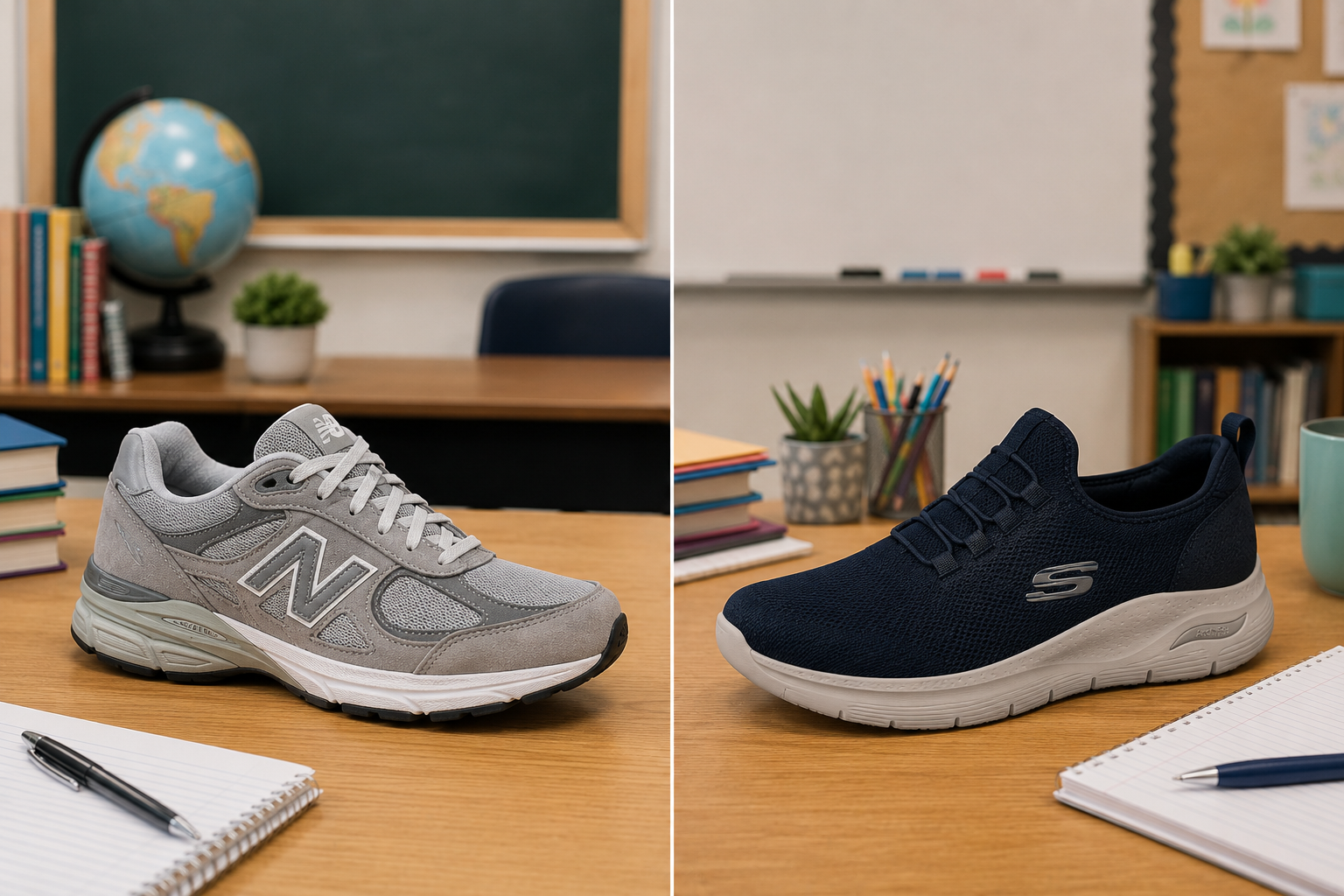
New Balance vs Skechers for Teachers
If you’re a teacher, you already know that choosing the right shoes isn’t just about style—it’s about making it through the school day without sore feet, aching knees, or lower back pain.
Unlike many professions where employees spend most of the day sitting, teachers are constantly on the move. You might spend the morning standing at the whiteboard, the afternoon walking between desks, supervise recess on concrete, climb stairs several times a day, and finish with an after-school meeting before finally heading home.
By then, your feet have supported your body for eight to ten hours.
That’s why comfortable, supportive shoes aren’t a luxury for teachers—they’re a necessity.
When educators ask for shoe recommendations, two brands consistently come up: New Balance and Skechers.
Both brands are known for comfort, but they take very different approaches. New Balance has built its reputation around support, stability, and performance, while Skechers focuses on lightweight comfort, plush cushioning, and affordability.
So which one is actually better for teachers?
After comparing both brands across comfort, cushioning, support, durability, price, and long-term performance, one brand stands out for most educators. However, the best choice ultimately depends on your teaching style, foot type, budget, and any foot conditions you may have.
In this guide, we’ll compare New Balance and Skechers in detail, recommend the best models from each brand, and help you choose the right shoes for long days in the classroom.
Quick Verdict
If you want the short answer, here it is:
New Balance is the better overall choice for most teachers.
Its shoes generally provide better arch support, stronger stability, and cushioning that maintains its comfort throughout long school days and months of daily wear. Teachers who spend hours standing in front of a classroom or who deal with plantar fasciitis, knee pain, or lower back discomfort will usually benefit from the extra support that New Balance offers.
That doesn’t mean Skechers isn’t a great option.
Skechers excels in areas like immediate comfort, lightweight construction, and affordability. If your priority is a soft, cushioned shoe that feels comfortable from the moment you put it on—or you’re shopping on a tighter budget—Skechers remains one of the best brands available.
Our Recommendation
- Best Overall: New Balance
- Best Budget Choice: Skechers
- Best for Arch Support: New Balance
- Best for Soft Cushioning: Skechers
- Best Long-Term Investment: New Balance
New Balance vs. Skechers Comparison Table
| Feature | New Balance | Skechers |
|---|---|---|
| Overall Comfort | ⭐⭐⭐⭐⭐ | ⭐⭐⭐⭐⭐ |
| Arch Support | ⭐⭐⭐⭐⭐ | ⭐⭐⭐⭐☆ |
| Cushioning | ⭐⭐⭐⭐⭐ | ⭐⭐⭐⭐⭐ |
| Stability | ⭐⭐⭐⭐⭐ | ⭐⭐⭐⭐☆ |
| Durability | ⭐⭐⭐⭐⭐ | ⭐⭐⭐⭐☆ |
| Weight | ⭐⭐⭐⭐☆ | ⭐⭐⭐⭐⭐ |
| Breathability | ⭐⭐⭐⭐☆ | ⭐⭐⭐⭐☆ |
| Professional Style | ⭐⭐⭐⭐⭐ | ⭐⭐⭐⭐☆ |
| Price | ⭐⭐⭐⭐☆ | ⭐⭐⭐⭐⭐ |
| Overall Rating | 9.6/10 | 9.1/10 |
Why Teachers Need Different Shoes Than Most People
Teaching is physically demanding in ways that many people don’t realize.
Most teachers spend six to ten hours on their feet every day. Even when you’re not actively walking, you’re standing while teaching, helping students, monitoring classrooms, or supervising hallways.
Unlike runners who exercise for an hour before resting, teachers experience continuous stress on their feet throughout the day.
A typical school day often includes:
- Standing while delivering lessons
- Walking between student desks
- Climbing stairs
- Supervising playgrounds or hallways
- Carrying books, laptops, and classroom supplies
- Bending and kneeling to help students
- Standing through meetings after classes end
By the end of the day, it’s not unusual to have walked more than 8,000 to 12,000 steps.
Hard classroom surfaces such as tile, vinyl, hardwood, and concrete provide very little shock absorption. Every step sends impact through your feet, ankles, knees, hips, and lower back.
Without supportive footwear, that repeated impact can contribute to:
- Foot fatigue
- Heel pain
- Plantar fasciitis
- Knee pain
- Shin splints
- Achilles discomfort
- Hip pain
- Lower back pain
While no shoe can completely eliminate these problems, choosing footwear with proper cushioning and support can significantly reduce daily fatigue and improve your comfort throughout the school year.
What Makes a Great Teacher Shoe?
Many shoes feel comfortable during a quick fitting at the store.
The real test comes after six or seven hours of standing on hard floors.
The best teacher shoes combine several important features rather than focusing on just one.
Cushioning That Lasts All Day
Soft cushioning feels wonderful when you first put on a shoe, but comfort shouldn’t disappear after lunch.
High-quality midsoles continue absorbing impact throughout the day while maintaining enough structure to keep your feet supported.
Proper Arch Support
Good arch support helps distribute pressure evenly across your feet.
Without it, excessive stress can travel up through your ankles, knees, hips, and lower back.
Teachers with flat feet, high arches, or plantar fasciitis often notice the biggest improvement after switching to shoes with better structural support.
Stability
Teaching requires constant changes in movement.
You might pivot to answer a student’s question, kneel beside a desk, walk across the classroom, or stand still while explaining a lesson.
A stable shoe keeps your feet properly aligned during all of these movements.
Breathability
Classrooms can become surprisingly warm, especially during late spring and early fall.
Breathable mesh uppers improve airflow, helping keep your feet cool and reducing moisture that can lead to discomfort or blisters.
Durability
Most teachers wear the same shoes five days a week.
That level of use quickly reveals differences in build quality.
Higher-quality materials may cost more initially, but they often remain supportive far longer than cheaper alternatives, making them a better investment over time.
How We Compared New Balance and Skechers
Rather than relying on marketing claims, we evaluated both brands based on the qualities that matter most to teachers after months of everyday use.
Comfort Throughout an Entire School Day
Comfort isn’t measured during the first five minutes.
It’s measured during your final class, after hours of standing and walking.
We considered how each brand performs from the first bell until the last.
Cushioning Performance
Some shoes prioritize softness, while others focus on balanced support.
We looked at how each brand absorbs impact while maintaining stability throughout the workday.
Arch Support
Proper arch support reduces strain on your feet and helps improve overall body alignment.
This category is especially important for teachers who experience plantar fasciitis, overpronation, or general foot fatigue.
Stability
Teachers constantly shift directions, turn, bend, and walk around the classroom.
We compared how well each brand keeps your feet secure during these everyday movements.
Durability
Replacing shoes every few months can become expensive.
We evaluated outsole wear, midsole compression, and overall construction quality to determine which brand offers better long-term value.
Price and Value
A lower price doesn’t always mean better value.
We considered how much comfort, support, and durability each brand delivers relative to its cost.
Brand Overview: New Balance
Founded in Boston in 1906, New Balance has earned a reputation for building shoes that prioritize support and performance over flashy marketing.
While many people know the brand for its running shoes, it has also become a favorite among healthcare professionals, warehouse workers, retail employees, and teachers—people whose jobs require long hours on their feet.
One of New Balance’s biggest strengths is fit.
Unlike many brands, New Balance offers multiple width options, making it much easier for people with narrow feet, wide feet, or bunions to find a comfortable fit.
The brand also invests heavily in cushioning technologies such as Fresh Foam X, which provides a soft ride without sacrificing stability.
Many of its stability models include additional support features that help reduce excessive inward rolling of the foot, making them popular choices for teachers with flat feet or overpronation.
Although New Balance shoes generally cost more than Skechers, they’re often praised for maintaining their comfort and support over long periods of daily wear.
For teachers looking for a reliable shoe that can handle an entire school year, New Balance has earned its reputation.
Brand Overview: Skechers
Skechers has become one of the world’s most recognizable comfort footwear brands thanks to its focus on affordability, lightweight construction, and everyday wearability.
Many teachers appreciate how comfortable Skechers feel from the very first day.
Instead of requiring a lengthy break-in period, most models deliver a soft, cushioned feel right out of the box.
The brand’s Air-Cooled Memory Foam, Arch Fit, and Max Cushioning collections have become especially popular among people who spend long hours walking or standing.
Skechers also introduced its popular Slip-ins collection, allowing wearers to put on their shoes without bending down to tie laces—a feature many busy teachers appreciate during hectic mornings.
While Skechers often emphasizes softness over structure, some models—particularly those in the Arch Fit lineup—provide surprisingly good support and have earned praise from many users dealing with everyday foot fatigue.
For teachers looking for excellent comfort at a more affordable price, Skechers continues to be one of the strongest options on the market.
Head-to-Head Comparison: New Balance vs. Skechers
Now that we’ve looked at each brand individually, it’s time to compare them where it matters most. While both companies make comfortable shoes, their design philosophy is very different. New Balance prioritizes support, stability, and long-term performance, whereas Skechers focuses on plush cushioning, lightweight comfort, and affordability.
Let’s see how they compare across the features that matter most to teachers.
Comfort: Which Brand Feels Better After a Full School Day?
Comfort is the first thing most teachers look for when buying new shoes. The challenge is that comfort after trying on a pair in the store is very different from comfort after eight hours of standing in a classroom.
New Balance
New Balance shoes are designed to provide balanced comfort rather than an overly soft feel. Their Fresh Foam X cushioning absorbs impact while maintaining enough firmness to keep your feet supported throughout the day.
Instead of allowing your feet to sink into the shoe, the cushioning works with the shoe’s structure to reduce fatigue without sacrificing stability.
This makes New Balance especially appealing for teachers who spend long periods standing in one place while teaching.
Many teachers also notice that New Balance shoes feel just as supportive during the last class of the day as they did during the first.
Skechers
Skechers takes a different approach.
The brand is known for creating shoes that feel incredibly comfortable the moment you put them on. Memory Foam insoles and Max Cushioning midsoles create a soft, pillow-like sensation that many people instantly love.
For teachers who spend most of the day walking around the classroom, that softness can feel wonderful.
However, some users find that very soft cushioning becomes less supportive after several hours of continuous standing, particularly on hard classroom floors.
Verdict
If your priority is immediate softness, Skechers is hard to beat.
If you’re looking for comfort that remains consistent from morning until the final bell, New Balance has the advantage.
Winner: New Balance
Cushioning: Fresh Foam X vs. Memory Foam
Although both brands advertise premium cushioning, the technologies behind them work very differently.
New Balance Fresh Foam X
Fresh Foam X is designed to provide a combination of softness, responsiveness, and support.
Instead of compressing deeply under your weight, it cushions impact while helping maintain proper alignment.
Teachers who spend long hours on tile or concrete often appreciate how this balanced cushioning reduces fatigue without making the shoe feel unstable.
Skechers Memory Foam and Max Cushioning
Skechers relies heavily on Air-Cooled Memory Foam and Max Cushioning technology.
The result is an exceptionally soft underfoot experience that feels almost like walking on pillows.
This makes Skechers extremely comfortable for casual walking and everyday wear.
The trade-off is that softer foams naturally compress more under continuous pressure, which may reduce support during extended standing compared with firmer midsoles.
Verdict
If you prefer a soft, luxurious feel, Skechers is an excellent choice.
If you want cushioning that balances softness with long-term support, New Balance comes out ahead.
Winner: New Balance
Arch Support
Arch support is one of the most important features for teachers because poor support can contribute to fatigue, heel pain, and discomfort throughout the legs and lower back.
New Balance
Support has always been one of New Balance’s strongest qualities.
Many models feature structured midsoles, supportive heel counters, and designs that help keep the foot properly aligned throughout the day.
Teachers with flat feet, overpronation, or plantar fasciitis often appreciate this extra support.
The availability of wide-width options is another advantage, allowing more people to achieve a better fit.
Skechers
Skechers has improved significantly in this area over the past several years.
Its Arch Fit collection, developed using thousands of foot scans, provides noticeably better support than traditional memory foam shoes.
For many teachers with mild to moderate arch discomfort, Arch Fit models provide an excellent combination of softness and support.
However, across the brand as a whole, New Balance still offers more consistently supportive designs.
Verdict
Skechers deserves credit for its Arch Fit collection, but New Balance remains the stronger choice for teachers who rely on excellent arch support every day.
Winner: New Balance
Stability
Teaching involves much more than simply standing.
Teachers constantly turn, bend, kneel, reach, and walk between desks. Stable footwear helps keep the foot aligned during these movements while reducing unnecessary strain.
New Balance
Many New Balance shoes are designed with structured midsoles and supportive heel construction.
Even highly cushioned models feel stable underfoot, giving teachers greater confidence during long hours of classroom movement.
Stability models such as the Fresh Foam X 860 are especially popular among people who need additional motion control.
Skechers
Because many Skechers shoes prioritize softness, they can feel slightly less stable during prolonged standing.
That doesn’t make them unsafe, but softer foam naturally allows more movement underfoot.
Teachers who primarily walk throughout the day may never notice this difference, but those who stand in one place for long periods often appreciate the firmer platform offered by New Balance.
Verdict
For overall stability, New Balance is the clear winner.
Winner: New Balance
Weight: Which Brand Feels Lighter?
Not every teacher spends the day standing behind a desk.
Elementary teachers, preschool teachers, and special education teachers often walk thousands of steps every day.
In these situations, shoe weight becomes more noticeable.
New Balance
Most New Balance shoes feel solid and supportive without being excessively heavy.
The additional weight usually comes from more durable materials and reinforced construction that improves stability.
For many teachers, the slight increase in weight is barely noticeable after a few days of wear.
Skechers
One of Skechers’ biggest strengths is lightweight comfort.
Many models feel almost effortless on your feet, making them an excellent choice for teachers who move constantly throughout the day.
This lightweight design also contributes to the brand’s reputation for immediate comfort.
Verdict
If minimizing shoe weight is your priority, Skechers has the advantage.
Winner: Skechers
Breathability
Few things are more uncomfortable than spending an entire day with hot, sweaty feet.
Fortunately, both brands offer plenty of breathable options.
New Balance
Most running and walking shoes feature engineered mesh uppers that allow good airflow while maintaining support.
Lifestyle models made with suede or leather tend to feel slightly warmer but still provide acceptable ventilation.
Skechers
Skechers also relies heavily on knit and mesh uppers.
Because many models emphasize lightweight construction, airflow is generally excellent.
Teachers working in warmer climates will likely find both brands equally comfortable.
Verdict
The difference here depends more on the individual model than the brand itself.
Winner: Tie
Durability
Comfort matters, but durability determines whether a shoe remains a good investment.
Teachers often wear the same shoes five days a week, so build quality becomes increasingly important over time.
New Balance
New Balance has earned a reputation for durable construction.
High-quality rubber outsoles, resilient midsoles, and reinforced uppers help many models retain their support even after months of regular classroom use.
Teachers who rotate between two pairs often report getting well over a school year from each pair.
Skechers
Skechers shoes are comfortable, but their softer cushioning can gradually compress with heavy daily use.
Many models continue looking good, but the level of support may decrease before the outsole shows significant wear.
This doesn’t mean Skechers lacks durability—it simply reflects the softer materials used in many of its comfort-focused designs.
Verdict
If long-term durability is your priority, New Balance offers the better investment.
Winner: New Balance
Professional Style
Comfort is important, but many teachers also need shoes that fit within a business casual dress code.
Fortunately, both brands offer attractive options beyond traditional athletic sneakers.
New Balance
Models such as the 574, 327, and 990 combine classic styling with modern comfort.
Neutral colors like black, white, navy, and grey pair easily with chinos, dress pants, skirts, and casual business attire.
Over the past few years, New Balance has also become one of the most fashionable sneaker brands, making it easier to wear in professional settings.
Skechers
Skechers offers many clean, understated designs, especially in black or all-white colorways.
The Slip-ins collection is particularly popular among teachers who appreciate its convenience.
However, some Skechers models have a more athletic appearance that may not suit every workplace.
Verdict
Both brands offer classroom-friendly styles, but New Balance provides a wider selection of versatile designs that transition seamlessly between work and everyday life.
Winner: New Balance
Price and Overall Value
Price is often one of the deciding factors when shopping for work shoes.
New Balance
Most New Balance shoes cost more initially.
However, many teachers feel the higher price is justified because of the brand’s durability, support, and long-lasting comfort.
For educators who wear the same shoes almost every day, paying more upfront can result in better value over time.
Skechers
Skechers offers excellent comfort at a more affordable price.
Many popular models cost significantly less than comparable New Balance shoes while still providing impressive cushioning and everyday comfort.
For teachers on a tighter budget, Skechers remains one of the best values available.
Verdict
If you’re looking for the lowest upfront cost, Skechers wins.
If you’re considering long-term value over the lifespan of the shoe, New Balance edges ahead.
Winner: Tie
Head-to-Head Results
| Category | Winner |
|---|---|
| All-Day Comfort | 🏆 New Balance |
| Cushioning | 🏆 New Balance |
| Arch Support | 🏆 New Balance |
| Stability | 🏆 New Balance |
| Weight | 🏆 Skechers |
| Breathability | 🤝 Tie |
| Durability | 🏆 New Balance |
| Professional Style | 🏆 New Balance |
| Budget | 🏆 Skechers |
| Overall Value | 🏆 New Balance |
Overall, New Balance wins more categories because it delivers a better combination of support, stability, durability, and long-term comfort—qualities that matter most to teachers who spend every workday on their feet. Skechers remains an excellent alternative for educators who prioritize soft cushioning, lightweight shoes, and affordability, but for most teachers, New Balance provides the more complete package.
Best New Balance and Skechers Shoes for Teachers
Choosing between New Balance and Skechers is only the first step. Each brand offers dozens of models, but not every shoe is designed for the demands of teaching.
Some excel at standing for hours, while others are better suited for constant walking around the classroom or campus. To help narrow your options, we’ve selected the models that consistently receive the best feedback from teachers and comfort-focused wearers.
New Balance Fresh Foam X 1080 v14 vs. Skechers Max Cushioning Elite 2.0
Best Premium Cushioned Shoes for Teachers
If your goal is maximum comfort from the first bell until the end of the school day, these are two of the strongest options available.
Both shoes feature thick, highly cushioned midsoles designed to reduce impact on hard floors. The difference lies in how that cushioning feels after several hours of continuous use.
New Balance Fresh Foam X 1080 v14
The Fresh Foam X 1080 is New Balance’s flagship neutral running shoe, but it’s equally impressive as an all-day work shoe.
Its Fresh Foam X midsole provides soft cushioning without feeling unstable. Instead of allowing your foot to sink into the foam, it distributes pressure evenly while maintaining excellent support.
Another advantage is the rocker-shaped sole, which encourages a smooth transition from heel to toe. After walking between classrooms all day, this design helps reduce fatigue and makes each step feel effortless.
Teachers who suffer from heel pain, tired legs, or lower back discomfort often praise the 1080 because it combines comfort with structure.
Why Teachers Love It
- Outstanding cushioning for long days
- Excellent shock absorption
- Stable platform despite its thick midsole
- Breathable engineered mesh upper
- Available in multiple width options
Potential Drawbacks
- Premium price
- Slightly heavier than lightweight trainers
Ideal for: Classroom teachers, lecturers, and anyone who spends most of the day standing.
Skechers Max Cushioning Elite 2.0
As the name suggests, this shoe is built around comfort.
The thick Max Cushioning midsole delivers an incredibly soft ride that feels comfortable from the first step. Walking across hallways, playgrounds, and classrooms becomes noticeably easier thanks to the generous amount of cushioning underfoot.
Unlike some running shoes that require several days of break-in, the Max Cushioning Elite feels comfortable immediately.
However, its softer foam provides slightly less stability than the New Balance 1080 during long periods of standing.
Why Teachers Love It
- Exceptionally soft cushioning
- Lightweight design
- Comfortable immediately
- Excellent value for money
Potential Drawbacks
- Less supportive than New Balance
- Cushioning compresses faster with heavy daily use
Ideal for: Teachers who spend more time walking than standing and prefer an ultra-soft ride.
Winner
Although both shoes are excellent, the New Balance Fresh Foam X 1080 v14 provides better support over an entire school day and maintains its cushioning longer.
Winner: 🏆 New Balance Fresh Foam X 1080 v14
New Balance Fresh Foam X 860 v14 vs. Skechers Arch Fit 2.0
Best for Flat Feet and Plantar Fasciitis
Teachers with flat feet or plantar fasciitis require more than soft cushioning. They need shoes that support the arch, control excessive foot movement, and reduce strain throughout the body.
These two models are among the best options available from each brand.
New Balance Fresh Foam X 860 v14
The 860 is designed for stability.
Its supportive midsole helps keep your foot aligned while reducing excessive inward rolling, making it an excellent choice for teachers with overpronation.
Despite its supportive construction, the shoe remains surprisingly comfortable and doesn’t feel overly rigid.
Many teachers who previously experienced foot fatigue report feeling less discomfort after switching to stability shoes like the 860.
Best For
- Flat feet
- Plantar fasciitis
- Knee pain
- Long periods of standing
Skechers Arch Fit 2.0
The Arch Fit collection is one of Skechers’ most successful comfort lines.
Developed using thousands of foot scans, it offers noticeably better support than standard memory foam shoes.
The removable Arch Fit insole distributes pressure evenly across the foot, making it a popular option for teachers who need extra support without spending premium prices.
Although it doesn’t offer quite as much stability as the New Balance 860, it delivers excellent comfort for everyday classroom use.
Best For
- Mild to moderate flat feet
- Teachers wanting softer cushioning
- Budget-conscious shoppers
Winner
For teachers with recurring foot pain or overpronation, the structured support of the New Balance 860 makes it the stronger choice.
Winner: 🏆 New Balance Fresh Foam X 860 v14
New Balance Fresh Foam X 880 v15 vs. Skechers GO WALK Flex
Best Everyday Teacher Shoes
Not every teacher needs maximum cushioning.
Some simply want a dependable pair of shoes they can wear every day without thinking about them.
These two models excel in that role.
New Balance Fresh Foam X 880 v15
The 880 has long been considered one of the most versatile shoes in New Balance’s lineup.
It offers enough cushioning for comfort while maintaining a balanced feel that works well for walking, standing, and everyday activities.
Unlike highly cushioned shoes, the 880 never feels bulky or unstable.
Teachers who divide their time between classrooms often appreciate this versatility.
Best For
- Daily classroom teaching
- Walking between buildings
- Teachers wanting one shoe for work and casual use
Skechers GO WALK Flex
The GO WALK series has become one of Skechers’ signature collections.
The GO WALK Flex combines lightweight construction with soft cushioning, making it ideal for teachers who spend much of the day moving.
Its flexible sole encourages natural movement, while the breathable upper keeps feet cool during warmer months.
Many elementary teachers and preschool teachers appreciate just how effortless this shoe feels after several hours of walking.
Best For
- Elementary teachers
- Preschool teachers
- Teachers constantly on the move
Winner
This comparison depends largely on your daily routine.
Choose the 880 if your day involves long periods of standing.
Choose the GO WALK Flex if you’re constantly walking around the classroom.
Winner: 🤝 Tie
New Balance 574 vs. Skechers Uno
Best Lifestyle Shoes for Teachers
Not every teacher wants a running shoe.
Many schools have business-casual dress codes where a clean lifestyle sneaker fits in better than a highly athletic design.
New Balance 574
The 574 has become one of New Balance’s most recognizable shoes.
Its timeless design pairs effortlessly with jeans, chinos, dresses, skirts, and business-casual outfits.
Unlike many lifestyle sneakers, it still provides enough cushioning and support for a full day of teaching.
Teachers who want one shoe for both work and weekends often choose the 574.
Skechers Uno
The Skechers Uno offers a more modern appearance inspired by classic streetwear sneakers.
It features comfortable cushioning and an easy-to-style silhouette that works well with casual outfits.
While it isn’t quite as supportive as the 574, it’s still a comfortable option for teachers working in relaxed environments.
Winner
For overall versatility, durability, and classroom-friendly style, the New Balance 574 takes the win.
Winner: 🏆 New Balance 574
Which Brand Is Best for Your Foot Condition?
No two teachers have the same feet.
Choosing shoes based on your specific needs often matters more than choosing a particular brand.
Best for Plantar Fasciitis
Winner: New Balance
The structured support and stable cushioning found in models like the Fresh Foam X 860 and Fresh Foam X 1080 help reduce strain on the plantar fascia during long periods of standing.
Best for Flat Feet
Winner: New Balance
Teachers with flat feet generally benefit from stronger arch support and greater stability, both of which are strengths of New Balance.
Best for High Arches
Winner: Skechers
Teachers with naturally high arches often appreciate the softer cushioning offered by Skechers, particularly in the Max Cushioning collection.
Best for Wide Feet
Winner: New Balance
Few brands offer as many width options as New Balance.
Many of its most popular models are available in standard, wide, and extra-wide sizes, making it easier to achieve a comfortable fit.
Best for Bunions
Winner: New Balance
Wide toe boxes and multiple width choices reduce pressure around the forefoot, making New Balance a popular option for teachers with bunions.
Best for Heel Pain
Winner: New Balance
The combination of supportive cushioning and excellent shock absorption helps reduce repeated heel impact throughout the school day.
Best for Knee Pain
Winner: New Balance
Better stability and consistent cushioning often translate into reduced stress on the knees, particularly during prolonged standing.
Best for Lower Back Pain
Winner: New Balance
Maintaining proper foot alignment can improve posture and reduce fatigue throughout the lower body, making supportive shoes especially valuable for teachers experiencing back discomfort.
Best for Teachers Without Foot Problems
If you simply want a comfortable everyday shoe and don’t have any specific foot conditions, either brand can serve you well.
In this case, your decision comes down to personal preference.
Choose New Balance if you prefer support and durability.
Choose Skechers if you prefer softness, lightweight comfort, and lower prices.
Which Brand Is Best for Your Teaching Role?
Not every teacher spends the school day the same way. A kindergarten teacher may walk thousands of steps while helping young children, while a high school teacher might spend hours standing at the front of the classroom. Your daily routine plays a major role in determining which shoes will feel best.
Here’s how New Balance and Skechers compare for different teaching environments.
Elementary School Teachers
Elementary teachers rarely stay in one place for long. Between classroom activities, helping students, organizing supplies, and walking around the room, they often accumulate more than 10,000 steps before the day is over.
Recommended Brand: Skechers
If you’re constantly moving, lightweight shoes become a major advantage.
The Skechers GO WALK Flex and Max Cushioning series provide soft cushioning and a lightweight feel that helps reduce fatigue during continuous walking.
Alternative
If you experience foot pain or need additional support, the New Balance Fresh Foam X 880 is an excellent alternative.
Preschool and Kindergarten Teachers
Teaching younger children is physically demanding.
You’ll spend much of the day kneeling, squatting, sitting on the floor, standing back up, and walking around the classroom.
Comfort and flexibility are especially important.
Recommended Brand: Skechers
The lightweight construction and soft cushioning make Skechers a natural choice for early childhood educators.
Many preschool teachers also appreciate the convenience of Skechers Slip-ins, which eliminate the need to bend over when putting on shoes before work.
High School Teachers
High school teachers typically spend more time standing while delivering lectures and less time constantly moving around the classroom.
Long periods of standing require shoes that maintain support throughout the day.
Recommended Brand: New Balance
Models such as the Fresh Foam X 1080 and Fresh Foam X 860 provide excellent cushioning without sacrificing stability.
Their structured midsoles help reduce fatigue during extended periods of standing.
College Professors
University instructors often alternate between lectures, office hours, and walking across campus.
Because their day combines standing and walking, they benefit from shoes that balance comfort with durability.
Recommended Brand: New Balance
The Fresh Foam X 880 and Fresh Foam X 1080 offer enough cushioning for campus walking while remaining supportive during long lectures.
Physical Education Teachers
PE teachers have very different footwear needs from classroom teachers.
Their shoes must support quick movements, demonstrations, and outdoor activities.
Recommended Brand: New Balance
Running-inspired models provide better stability during dynamic movement while remaining comfortable for all-day wear.
Art and Music Teachers
Teachers in creative subjects often move continuously between students, classrooms, and equipment.
Their work involves a mix of standing and walking.
Recommended Brand
Either brand performs well.
Choose New Balance if support is your priority.
Choose Skechers if lightweight comfort matters more.
Special Education Teachers
Special education teachers frequently experience one of the most physically demanding roles in education.
Their work may involve assisting students with mobility, walking throughout the building, kneeling, lifting, and standing for long periods.
Recommended Brand: New Balance
The combination of stability, support, and durable cushioning makes New Balance the better long-term choice.
Which Brand Is Better for Standing All Day?
Standing and walking are not the same thing.
Walking allows your muscles to contract and relax naturally, improving circulation.
Standing in one position places continuous pressure on the same muscles, joints, and connective tissues.
For teachers who spend hours standing while teaching lessons, supportive shoes become even more important.
Why New Balance Performs Better
New Balance shoes generally feature firmer midsoles and stronger heel support.
Instead of allowing your feet to sink into the cushioning, they help distribute pressure more evenly across the foot.
This reduces fatigue during prolonged standing and often helps teachers feel more comfortable during the final hours of the school day.
When Skechers May Be Better
If your schedule involves constant walking rather than prolonged standing, Skechers’ softer cushioning and lighter weight may actually feel more comfortable.
Teachers who rotate between classrooms every period often appreciate the lighter feel of Skechers shoes.
Buying Guide: How to Choose the Right Shoes for Teaching
Even after deciding between New Balance and Skechers, selecting the right model can feel overwhelming.
These tips can help you make a better decision.
Choose Shoes Based on Your Daily Routine
Think about how you spend most of your day.
If you’re standing in one classroom for several hours, prioritize stability and arch support.
If you’re constantly walking, lightweight cushioning may be the better choice.
Buy the Correct Width
One of the biggest mistakes people make is choosing shoes that are too narrow.
Your feet naturally swell throughout the day.
Buying shoes with enough room in the toe box helps prevent discomfort during long school hours.
New Balance offers one of the widest selections of width options available.
Replace Shoes Before They Wear Out
Many teachers wait until the outsole is completely worn before replacing their shoes.
Unfortunately, cushioning usually loses effectiveness long before visible wear appears.
If your shoes no longer feel as supportive as they once did, it may be time for a replacement.
Rotate Between Two Pairs
If possible, avoid wearing the same pair every day.
Rotating between two pairs allows the midsoles time to recover and dry completely, helping extend their lifespan while reducing repetitive stress on your feet.
Wear Quality Socks
Good shoes work best when paired with good socks.
Moisture-wicking socks reduce friction, improve comfort, and help prevent blisters during long school days.
Frequently Asked Questions
Are New Balance shoes good for teachers?
Yes. New Balance is one of the best footwear brands for teachers because it combines supportive cushioning, excellent arch support, durable construction, and multiple width options. Many educators choose New Balance for its ability to remain comfortable during long days of standing and walking.
Are Skechers good for standing all day?
Yes. Many Skechers models are comfortable for extended standing, particularly those in the Arch Fit and Max Cushioning collections. However, teachers who need stronger structural support may prefer New Balance.
Which brand lasts longer?
In general, New Balance shoes tend to maintain their cushioning and support longer than Skechers, making them the better long-term investment for daily classroom use.
Which brand has better arch support?
New Balance generally offers stronger arch support across its lineup, although Skechers Arch Fit models provide excellent support for many teachers.
Which brand is better for plantar fasciitis?
Teachers with plantar fasciitis usually benefit more from New Balance because of its supportive midsoles and greater stability.
Are Skechers cheaper than New Balance?
Yes. Skechers shoes are typically more affordable, making them an excellent option for teachers shopping on a budget.
Can teachers wear running shoes to school?
In most schools, yes.
Many modern dress codes allow clean, neutral-colored running shoes, especially when paired with business casual clothing.
Classic designs such as the New Balance 574 or understated Skechers models blend well with professional attire.
Should teachers choose walking shoes or running shoes?
Both can work well.
Walking shoes often provide excellent stability, while running shoes usually deliver better cushioning.
The best choice depends on your daily routine and personal comfort preferences.
Final Verdict
After comparing comfort, support, durability, weight, style, and overall value, New Balance is the better choice for most teachers.
Its shoes provide a level of support and stability that becomes increasingly important during long days spent standing on hard classroom floors. Teachers dealing with plantar fasciitis, knee pain, flat feet, or lower back discomfort will likely appreciate the additional structure and long-lasting cushioning that New Balance offers.
That said, Skechers remains an excellent alternative.
If your priorities are lightweight comfort, soft cushioning, and affordability, Skechers delivers exceptional value. The GO WALK, Arch Fit, Max Cushioning, and Slip-ins collections continue to be favorites among educators who spend much of the day walking.
Ultimately, the best shoe is the one that matches your daily routine, foot type, and comfort preferences.
Choose New Balance if you:
- Spend most of the day standing.
- Need excellent arch support.
- Have plantar fasciitis or flat feet.
- Want long-lasting durability.
- Prefer structured cushioning.
Choose Skechers if you:
- Walk more than you stand.
- Prefer softer cushioning.
- Need lightweight shoes.
- Want a lower-priced option.
- Like the convenience of slip-on designs.
If you’re looking for the best overall investment for long school days, New Balance earns our recommendation. Its combination of support, comfort, durability, and consistent performance makes it one of the most reliable footwear brands for teachers who spend every day on their feet.
Teacher Experiences: What Real Educators Say About New Balance and Skechers
One of the best ways to judge a pair of shoes is to look beyond product descriptions and see what people who actually spend all day on their feet have to say. Teachers frequently discuss footwear recommendations in online communities, and two brands appear repeatedly: New Balance and Skechers.
While individual experiences vary depending on foot shape and teaching style, several common themes emerge.
Why Many Teachers Prefer New Balance
Teachers who switched to New Balance often mention that the shoes feel more supportive during long periods of standing.
Instead of feeling extremely soft, they describe the cushioning as balanced and stable. Many educators say they noticed less foot fatigue by the end of the day, particularly when standing on tile or concrete floors.
Teachers with plantar fasciitis, flat feet, or chronic heel pain also tend to recommend New Balance because of its structured midsoles and wide sizing options.
Another frequently mentioned advantage is durability. Many educators report wearing the same pair throughout an entire school year while maintaining good comfort.
Why Teachers Love Skechers
Skechers receives praise for a different reason.
Teachers consistently describe the shoes as comfortable from the very first wear. Unlike some supportive shoes that require a break-in period, Skechers often feels soft immediately.
Elementary teachers, preschool teachers, and educators who spend the day walking rather than standing frequently appreciate the lightweight construction.
Slip-ins also receive positive feedback from busy teachers who value convenience during rushed mornings.
Common Complaints
No shoe is perfect.
Some New Balance users mention that premium models are more expensive than expected.
Skechers users occasionally report that the memory foam loses some of its softness after months of daily classroom use.
Understanding these trade-offs can help you choose the shoe that best matches your priorities.
Cost Per Wear: Which Brand Gives Better Value?
Many shoppers focus only on the purchase price.
However, teachers often wear the same shoes five days every week, making cost per wear a better measurement of value.
Let’s compare an example.
New Balance Example
Purchase price: $150
Estimated lifespan: 15 months
School days per year: approximately 190
Estimated wears: 285 days
Cost per wear:
$150 ÷ 285 = $0.53 per day
Skechers Example
Purchase price: $85
Estimated lifespan: 8 months
Estimated wears: 150 school days
Cost per wear:
$85 ÷ 150 = $0.57 per day
Although New Balance costs more initially, its longer lifespan often results in a similar—or even lower—cost per day.
For teachers who wear the same shoes almost every weekday, investing in higher-quality footwear can actually save money over time.
How to Make Your Teacher Shoes Last Longer
Even the best shoes eventually wear out, but proper care can significantly extend their lifespan.
Rotate Between Two Pairs
Wearing the same pair every day prevents the midsole foam from fully recovering.
Alternating between two pairs allows the cushioning to regain its shape while reducing moisture buildup.
Clean Them Regularly
Dust and dirt gradually break down shoe materials.
Wipe your shoes with a damp cloth every week and clean mesh uppers with mild soap when necessary.
Always allow shoes to air dry naturally.
Replace Insoles
If the outsole is still in good condition but the shoe feels less comfortable, replacing the insole can restore some of the original comfort.
Many teachers also upgrade to aftermarket orthotic insoles for additional arch support.
Don’t Ignore Early Signs of Wear
Many people wait until holes appear in the outsole before replacing their shoes.
In reality, midsoles lose cushioning much earlier.
If your feet begin feeling unusually tired or sore, it may be time to replace your shoes even if they still look new.
Final Scorecard
| Category | Winner |
|---|---|
| Best Overall | 🏆 New Balance |
| Best Budget Option | 🏆 Skechers |
| Best for Standing All Day | 🏆 New Balance |
| Best for Walking | 🏆 Skechers |
| Best Arch Support | 🏆 New Balance |
| Best for Plantar Fasciitis | 🏆 New Balance |
| Best for Flat Feet | 🏆 New Balance |
| Best for Wide Feet | 🏆 New Balance |
| Best Cushioning | 🏆 New Balance |
| Softest Feel | 🏆 Skechers |
| Best Durability | 🏆 New Balance |
| Best Value Over Time | 🏆 New Balance |
| Best Lightweight Shoe | 🏆 Skechers |
| Best Professional Style | 🏆 New Balance |
Our Overall Recommendation
After comparing every category that matters to teachers—comfort, cushioning, arch support, stability, durability, style, and long-term value—New Balance earns the top spot.
Its shoes are better suited for the realities of classroom life, especially for teachers who spend long hours standing on hard floors. The combination of supportive cushioning, excellent stability, and durable construction makes New Balance a smart investment for educators who want reliable comfort throughout the school year.
That said, Skechers remains an outstanding choice for teachers who prioritize lightweight comfort, soft cushioning, and affordability. Models like the Arch Fit, GO WALK, and Max Cushioning collections continue to be among the most comfortable options in their price range.
In the end, there isn’t a single perfect shoe for every teacher. The best choice depends on your daily routine, foot shape, and personal comfort preferences. But if you’re looking for the best all-around brand for standing, walking, and teaching all day, New Balance is our top recommendation.
