Birkenstock vs Crocs for Nurses
Healthcare professionals spend more time on their feet than almost anyone else. Whether you’re rushing between patient rooms, standing through long surgeries, or covering a busy emergency department, your shoes become one of the most important pieces of equipment you wear.
After several hours on hard hospital floors, the wrong footwear can contribute to tired feet, sore knees, lower back pain, and overall fatigue. That’s why many nurses eventually narrow their choices to two names that dominate the conversation: Birkenstock and Crocs.
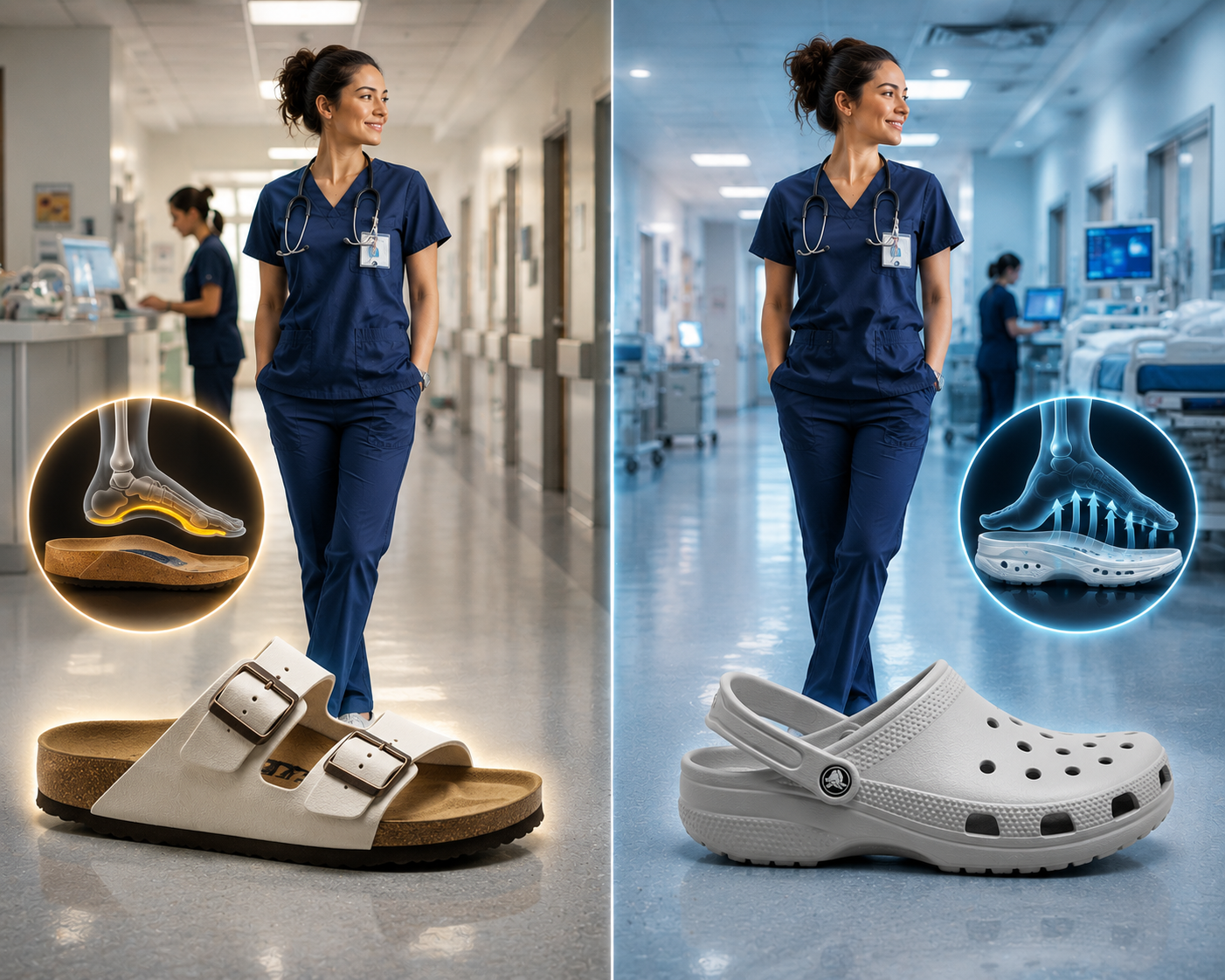
Although both brands have loyal followings, they take completely different approaches to comfort. Birkenstock focuses on anatomical support and proper foot alignment, while Crocs prioritize lightweight cushioning and immediate comfort.
However, there’s one mistake many comparison articles make—they compare regular fashion models instead of shoes actually designed for healthcare workers.
In this guide, we’ll compare Birkenstock Professional models, including the Super-Birki, Profi-Birki, and Tokio Pro, against Crocs At Work models such as the Bistro, Bistro Pro, and On The Clock. We’ll examine everything that matters during a demanding hospital shift, including comfort, arch support, slip resistance, hygiene, durability, and long-term value.
By the end of this comparison, you’ll know which option is the better investment for your feet, your work environment, and your budget.
Quick Verdict
If you don’t have time to read the full comparison, here’s the short answer.
| Category | Winner | Why It Matters |
|---|---|---|
| Overall Arch Support | 🏆 Birkenstock | Better anatomical support for long shifts |
| Cushioning | 🏆 Crocs | Softer underfoot feel with immediate comfort |
| Slip Resistance | 🤝 Tie | Both offer certified work models |
| Cleaning & Sanitizing | 🏆 Crocs | Easier daily maintenance |
| Long-Term Foot Health | 🏆 Birkenstock | Better alignment and pressure distribution |
| Lightweight Design | 🏆 Crocs | Less leg fatigue after thousands of steps |
| Durability | 🏆 Birkenstock | Built to last for years |
| Value for Money | Depends | Crocs cost less, Birkenstock lasts longer |
Our Recommendation
Choose Birkenstock Professional if you spend most of your shift standing in one place, deal with plantar fasciitis, or want maximum arch support that improves with time.
Choose Crocs At Work if you prefer soft cushioning, walk long distances during every shift, need something lightweight, or simply want a comfortable shoe that feels good from day one.
Neither brand is objectively better for every nurse. The right choice depends on how you work, your foot shape, and the environment where you spend your shifts.
Why Nurses Need Different Shoes Than Everyone Else
Walking around a shopping mall for a few hours isn’t the same as working a twelve-hour hospital shift.
Most nurses cover between 8,000 and 15,000 steps during a typical day, while those in emergency departments or large hospitals may exceed 20,000 steps. Add hours of standing beside hospital beds, operating tables, or medication stations, and it’s easy to understand why foot pain is so common in healthcare.
Hospital floors are also much less forgiving than outdoor surfaces. Concrete covered with vinyl or tile creates constant impact on your heels and joints, especially during long shifts.
A good nursing shoe should do far more than simply feel comfortable. It should help reduce fatigue, improve stability, protect against slips, and remain easy to clean after exposure to spills or bodily fluids.
When evaluating nursing footwear, these are the features that matter most:
- Reliable arch support for standing all day
- Slip-resistant outsoles for wet hospital floors
- Easy-to-clean materials
- Comfortable cushioning without sacrificing stability
- Lightweight construction
- Long-term durability
- Compliance with workplace dress codes
Birkenstock and Crocs both meet many of these requirements, but they achieve them in very different ways.
Meet the Contenders
Before comparing features, it’s important to understand which models are actually intended for healthcare professionals.
Many online reviews compare Classic Crocs with Birkenstock Boston clogs. While those are popular casual shoes, they’re not always suitable for hospitals.
Instead, we’ll focus on each brand’s professional collection.
Birkenstock Professional
Birkenstock has built its reputation around orthopedic-inspired footwear that promotes natural foot alignment.
Its Professional line is specifically designed for demanding workplaces where employees spend long hours standing.
Popular models include:
Super-Birki
The Super-Birki features a durable polyurethane shell that is waterproof, resistant to oils and grease, and easy to clean. Inside, it uses a removable anatomically shaped footbed that supports the arches and heel.
This model is particularly popular in hospitals, kitchens, and laboratories.
Profi-Birki
The Profi-Birki builds on the Super-Birki with improved traction and a slightly different outsole designed for slippery work environments.
It’s often chosen by healthcare professionals who prioritize safety and durability.
Tokio Pro
Unlike the fully molded Birki models, the Tokio Pro uses premium leather combined with an adjustable backstrap for additional heel security.
Many nurses prefer this model because it feels more like a traditional shoe while maintaining Birkenstock’s famous foot support.
Best Features
✔ Excellent anatomical arch support
✔ Deep heel cup
✔ Long lifespan
✔ Replaceable footbed on many models
✔ Excellent stability during long periods of standing
Potential Drawbacks
- Higher price
- Requires a break-in period
- Slightly heavier than Crocs
Crocs At Work
Crocs became popular because of one simple feature: comfort.
Instead of firm orthopedic support, Crocs rely on lightweight Croslite™ foam that cushions every step.
The company later developed a dedicated work collection aimed at nurses, chefs, and other professionals.
The three most popular options include:
Crocs Bistro
The Bistro replaces the ventilation holes found on Classic Crocs with a closed upper that helps protect against spills.
It also features slip-resistant outsoles designed specifically for workplace environments.
Bistro Pro LiteRide
This upgraded version combines Crocs’ traditional durability with softer LiteRide foam for additional cushioning.
Many nurses appreciate the extra comfort during long walking shifts.
On The Clock
Unlike the traditional clog design, the On The Clock resembles a regular work shoe.
Its enclosed heel makes it suitable for workplaces that don’t allow open-back footwear.
Best Features
✔ Extremely lightweight
✔ Comfortable immediately
✔ Easy to clean
✔ Affordable
✔ Soft cushioning
Potential Drawbacks
- Less structured arch support
- Foam compresses over time
- Doesn’t mold to your foot like Birkenstock
Head-to-Head Comparison
Now let’s compare the two brands across the categories that matter most during a demanding nursing shift.
Comfort
Comfort is often the first thing nurses consider when buying work shoes, but comfort isn’t as simple as choosing the softest shoe.
Crocs and Birkenstock deliver comfort in completely different ways.
Crocs provide what many people describe as instant comfort. The soft Croslite foam cushions every step from the moment you put them on, making them feel lightweight and forgiving. If you’ve just finished a long shift in worn-out sneakers, slipping into a pair of Crocs can feel like walking on pillows.
That immediate softness is one of the biggest reasons Crocs remain so popular among healthcare workers.
Birkenstock, on the other hand, can feel surprisingly firm at first.
Instead of relying on thick cushioning, Birkenstock uses an anatomically shaped footbed designed to support the natural structure of your foot. During the first few days—or even weeks—the shoes may feel stiff. However, as the footbed gradually adapts to your feet, many users report a noticeable improvement in comfort and stability.
For nurses who spend long hours standing in one place rather than constantly walking, this structured support often becomes more comfortable over time than softer footwear.
Winner
- Immediate comfort: 🏆 Crocs
- Long-term comfort: 🏆 Birkenstock
There isn’t a universal winner here. If you want comfort right out of the box, Crocs have the advantage. If you’re willing to go through a break-in period for better long-term support, Birkenstock is often the better investment.
Arch Support
If there’s one category where Birkenstock has earned its reputation, it’s arch support.
Unlike standard foam clogs, Birkenstock Professional shoes are built around an anatomical footbed designed to mirror the natural shape of the foot. The design includes a pronounced medial arch, transverse arch support, a deep heel cup, and a raised toe bar that encourages a more natural walking motion. Together, these features help distribute pressure more evenly across the foot, reducing strain during long periods of standing.
Crocs take a different approach. Their Croslite™ foam offers gentle contouring and cushioning, but it doesn’t provide the same level of structural support. For many nurses with neutral feet, this may be perfectly adequate. However, those with flat feet, high arches, or recurring plantar fasciitis may find the softer design less supportive over the course of a 12-hour shift.
If your priority is keeping your feet properly aligned and minimizing fatigue over years of demanding work, Birkenstock holds a clear advantage.
Winner
🏆 Birkenstock Professional
Its anatomical footbed offers superior support for nurses who spend long hours on their feet, particularly those managing foot conditions or seeking long-term comfort.
Cushioning
When people first try on a pair of Crocs, the first thing they usually notice is the cushioning. The soft Croslite™ foam compresses slightly with every step, creating a plush feel that many nurses describe as “walking on clouds.”
This extra cushioning can make a big difference if your shift involves constant walking. It absorbs impact well, helping reduce the pounding your heels experience on hard hospital floors.
Birkenstock takes almost the opposite approach.
Rather than relying on thick foam, Birkenstock Professional clogs use a firm, supportive footbed that spreads pressure more evenly across the entire foot. While they don’t feel as soft, the goal isn’t to cushion every step—it’s to keep your foot in a stable, natural position throughout the day.
Think of it this way:
- Crocs prioritize shock absorption.
- Birkenstock prioritizes structural support.
Neither philosophy is wrong. It simply depends on what your feet need.
If you often finish your shift with sore heels from constant walking, you’ll probably appreciate the softer feel of Crocs. If your discomfort comes from poor alignment or foot fatigue after standing for hours, Birkenstock’s firmer support may provide greater long-term relief.
Winner
🏆 Crocs
For pure underfoot softness and impact absorption, Crocs are hard to beat.
Standing for 12-Hour Shifts
This is where the comparison becomes much more interesting.
Many people assume that softer shoes are automatically better for long shifts. In reality, that’s not always true.
A twelve-hour nursing shift places continuous stress on your feet, ankles, knees, hips, and lower back. Shoes that feel incredibly soft during the first hour can sometimes become less comfortable as the foam compresses throughout the day.
Birkenstock During Long Shifts
Birkenstock Professional shoes are designed to support your body’s natural alignment rather than simply cushion each step.
Because the footbed distributes pressure across the entire foot, many nurses report less arch fatigue and better posture after extended periods of standing. This makes Birkenstock especially popular among operating room staff, dialysis nurses, and anyone who spends long periods in one location.
Crocs During Long Shifts
Crocs shine when your day involves constant movement.
Their lightweight design reduces the effort required to lift your feet thousands of times during a shift. Many emergency department and medical-surgical nurses appreciate this because they’re constantly walking between patient rooms.
However, some long-term users notice that the foam gradually compresses over months of daily use, reducing the level of cushioning.
Winner
It depends on your work style.
Choose Birkenstock if you:
- Stand in one place for extended periods
- Experience arch pain
- Want better posture and support
Choose Crocs if you:
- Walk several miles every shift
- Prefer soft cushioning
- Want to minimize leg fatigue caused by shoe weight
Slip Resistance
Hospital floors can become slippery without warning. Water, cleaning products, medications, or bodily fluids all increase the risk of slips and falls.
Fortunately, both brands offer work-specific models designed with this in mind.
Birkenstock Professional
Models like the Super-Birki and Profi-Birki feature durable polyurethane outsoles with tread patterns designed for workplace environments. These shoes provide dependable traction on smooth hospital flooring while maintaining excellent stability.
Crocs At Work
The Bistro, Bistro Pro, and On The Clock collections also include slip-resistant outsoles that perform well on wet tile and vinyl floors.
Many hospitals specifically recommend these work models instead of Classic Crocs.
It’s worth noting that regular Classic Crocs aren’t designed for professional healthcare environments. Their vent holes and casual outsole make them less suitable where fluid exposure is common.
Winner
🤝 Tie
Both brands perform well when you choose their professional work models.
The deciding factor should be fit and comfort rather than slip resistance.
Cleaning and Infection Control
Cleaning may not be the most exciting feature, but for nurses, it’s one of the most important.
Hospital shoes are exposed to blood, saline, disinfectants, medications, food spills, and countless other contaminants.
Your footwear should be easy to sanitize without degrading over time.
Crocs
Crocs have one major advantage here.
Their closed-cell Croslite™ material doesn’t absorb liquids, making it simple to wipe clean with soap and water or approved disinfectant wipes.
Because there are no fabric uppers or exposed cork components, routine cleaning takes only a few minutes.
However, Crocs should never be exposed to excessive heat, as high temperatures can cause the material to warp or shrink.
Birkenstock
Professional Birkenstock models made from polyurethane are also easy to clean and can handle frequent washing.
However, leather models such as the Tokio Pro require more care than molded polyurethane versions.
If easy maintenance is your highest priority, molded PU models are the better option.
Winner
🏆 Crocs
Their simple, non-porous construction makes daily cleaning slightly easier.
Break-In Period
This is one of the biggest differences between the two brands.
Crocs
Put them on.
Go to work.
That’s it.
Crocs feel comfortable almost immediately, making them an excellent choice for nurses who don’t want to wait weeks before their shoes feel right.
Birkenstock
Birkenstock requires patience.
During the first few weeks, the firm footbed may feel stiff or even uncomfortable.
As you continue wearing them, the footbed gradually conforms to your feet, creating a personalized fit.
Many long-time Birkenstock wearers believe this break-in period is worth it because comfort continues improving over time.
Winner
🏆 Crocs
For immediate comfort, Crocs are the clear winner.
Breathability and Sweaty Feet
Long hospital shifts can leave your feet warm and sweaty, especially during busy days.
Neither Birkenstock Professional nor Crocs At Work models are particularly breathable because they’re designed to protect against spills.
However, there are some differences.
Crocs
The enclosed work models can trap heat, especially when paired with thick socks.
Some users also notice squeaking when moisture builds up inside the shoe.
Moisture-wicking socks can help reduce this problem.
Birkenstock
Birkenstock Professional shoes generally have a roomier toe box, allowing your toes to move more naturally.
Some leather models also manage moisture better than fully synthetic materials, although they require additional drying time if they become soaked.
Winner
🏆 Birkenstock
Slight advantage for long-term comfort, though moisture-wicking socks are recommended with either brand.
Weight
Shoe weight becomes surprisingly important after several thousand steps.
A heavier shoe requires slightly more effort every time you lift your foot.
Over a twelve-hour shift, that extra effort adds up.
Crocs
Crocs are among the lightest professional work shoes available.
This lightweight construction helps reduce fatigue, particularly for nurses who spend most of the day walking.
Birkenstock
Birkenstock Professional shoes are noticeably heavier.
While that extra weight contributes to stability and durability, some users find them more tiring during highly active shifts.
Winner
🏆 Crocs
If minimizing leg fatigue is your goal, Crocs have the advantage.
Durability
Comfort matters, but so does longevity.
Replacing nursing shoes every few months can quickly become expensive.
Birkenstock
Birkenstock Professional clogs are known for their exceptional durability.
The materials resist daily wear well, and many nurses use the same pair for several years with proper care.
Certain models even feature replaceable footbeds, extending their lifespan.
Crocs
Crocs are durable, but the foam naturally compresses over time.
Depending on your workload, you may notice reduced cushioning after one to two years of regular use.
They’re still a good value, but they generally don’t last as long as Birkenstock.
Winner
🏆 Birkenstock
Higher upfront cost, but often a better long-term investment.
Comparison Scorecard
After comparing every major category, here’s how the two brands stack up.
| Category | Winner |
|---|---|
| Comfort (Immediate) | Crocs |
| Comfort (Long-Term) | Birkenstock |
| Arch Support | Birkenstock |
| Cushioning | Crocs |
| Standing All Day | Birkenstock |
| Walking Long Distances | Crocs |
| Slip Resistance | Tie |
| Cleaning | Crocs |
| Break-In Period | Crocs |
| Breathability | Birkenstock |
| Weight | Crocs |
| Durability | Birkenstock |
| Overall Foot Health | Birkenstock |
Hospital Dress Code Considerations
One of the biggest mistakes nurses make when buying work shoes is assuming that if a pair is comfortable, it’s automatically acceptable at work. In reality, many hospitals have footwear policies designed to reduce the risk of slips, trips, and exposure to bodily fluids.
Before purchasing any nursing shoe, it’s worth checking your employer’s dress code. Requirements vary between hospitals, departments, and even individual units.
Here are some of the most common rules you’ll encounter:
- Closed-toe shoes to protect against dropped instruments and fluid exposure.
- Slip-resistant soles for wet or polished floors.
- Fully enclosed uppers in operating rooms or sterile environments.
- Heel security, such as a backstrap or enclosed heel, in facilities where open-back clogs are restricted.
- Shoes that can be cleaned and disinfected easily.
Birkenstock Professional
Models like the Tokio Pro and Kay Pro include adjustable backstraps, making them suitable for hospitals that don’t allow open-back footwear. The Super-Birki and Profi-Birki are also popular because their polyurethane construction is easy to clean and resistant to many workplace contaminants.
Crocs At Work
Avoid assuming that all Crocs are appropriate for nursing. Classic Crocs with ventilation holes may not comply with hospital policies because they allow liquids to reach your feet.
Instead, look at the Bistro, Bistro Pro, or On The Clock collections, which are specifically designed for professional environments with enclosed uppers and slip-resistant outsoles.
Tip: If you’re starting a new nursing position, ask your manager or HR department about footwear requirements before investing in a new pair.
Which Shoe Is Best for Different Nursing Roles?
Not every nursing job places the same demands on your feet. The ideal shoe for an operating room nurse may not be the best choice for someone working in home healthcare or a fast-paced emergency department.
Here’s a quick guide based on common nursing specialties.
| Nursing Role | Recommended Choice | Why |
|---|---|---|
| Emergency Room (ER) | Crocs Bistro Pro | Lightweight for constant walking and quick movement. |
| Intensive Care Unit (ICU) | Birkenstock Tokio Pro | Excellent support during long periods of standing. |
| Operating Room (OR) | Birkenstock Super-Birki | Stable support and easy-to-clean polyurethane construction. |
| Medical-Surgical Floor | Crocs On The Clock | Comfortable for high daily step counts. |
| Pediatrics | Crocs Bistro | Lightweight, comfortable, and easy to sanitize. |
| Labor & Delivery | Birkenstock Tokio Pro | Strong support with added heel security. |
| Home Health Nurse | Crocs On The Clock | Comfortable for frequent walking, driving, and varied environments. |
| Long-Term Care | Birkenstock Profi-Birki | Durable support for extended shifts. |
Of course, personal preference still matters. Foot shape, walking style, and existing foot conditions can all influence which shoe feels best.
Which Shoe Is Better for Different Foot Conditions?
Foot pain isn’t one-size-fits-all, and neither are nursing shoes. Here’s how Birkenstock and Crocs compare for some of the most common conditions healthcare professionals experience.
Plantar Fasciitis
If you’ve ever felt a sharp pain in your heel when taking your first steps in the morning, you know how frustrating plantar fasciitis can be.
Birkenstock’s anatomical footbed provides better structural support, helping distribute pressure across the foot and reducing strain on the plantar fascia.
Best Choice: 🏆 Birkenstock
Flat Feet
People with flat feet often benefit from stronger arch support rather than soft cushioning alone.
Birkenstock’s firm footbed generally offers better support for maintaining foot alignment during long shifts.
Best Choice: 🏆 Birkenstock
High Arches
High arches can create extra pressure on the heel and forefoot. Birkenstock’s supportive footbed helps spread weight more evenly, making it a popular choice for nurses with this foot type.
Best Choice: 🏆 Birkenstock
Wide Feet
Crocs are known for their roomy fit, especially in the toe box. Many nurses with wider feet appreciate the extra space, particularly during long shifts when feet naturally swell.
Some Birkenstock Professional models are also available in regular and wide widths, but Crocs generally provide a more forgiving fit straight out of the box.
Best Choice: 🏆 Crocs
Heel Pain
Heel pain can result from several different issues.
If your pain is caused by repeated impact while walking, Crocs’ softer cushioning may provide immediate relief.
If it’s related to poor foot alignment or plantar fasciitis, Birkenstock’s supportive design may be the better long-term solution.
Best Choice: Depends on the underlying cause.
Bunions
Both brands offer relatively generous toe boxes, but fit varies by model.
Many nurses with bunions appreciate the wider forefoot available in Crocs, while others prefer Birkenstock’s structured support.
Whenever possible, try shoes on before purchasing if you have significant foot concerns.
Long-Term Cost of Ownership
Price is important, but it shouldn’t be the only factor in your decision.
A shoe that costs twice as much but lasts twice as long may actually offer better value.
| Feature | Birkenstock Professional | Crocs At Work |
|---|---|---|
| Typical Price | Higher | Lower |
| Lifespan | Often several years with proper care | Usually 1–2 years of heavy daily use |
| Cushion Retention | Excellent | Gradually decreases as foam compresses |
| Maintenance | Moderate | Easy |
| Overall Value | Excellent long-term investment | Excellent budget option |
If you’re planning to wear your shoes five or six days a week for years, Birkenstock’s higher upfront cost may be easier to justify.
On the other hand, Crocs remain one of the best values for nurses who want reliable comfort without a large initial investment.
Frequently Asked Questions
Are Birkenstocks good for nurses?
Yes. Birkenstock Professional shoes are widely used by nurses because they provide excellent arch support, stable footing, and long-lasting durability. They are particularly popular among healthcare workers who spend long hours standing.
Are Crocs good for 12-hour nursing shifts?
Yes. Crocs At Work models are lightweight, comfortable, and easy to clean, making them a favorite among nurses who walk long distances during every shift.
Are regular Crocs allowed in hospitals?
Not always.
Many hospitals discourage or prohibit Classic Crocs with ventilation holes because they offer less protection against spilled liquids and sharp objects. Professional work models with enclosed uppers are often the better choice.
Which Crocs are best for nurses?
Popular options include:
- Crocs Bistro
- Crocs Bistro Pro
- Crocs On The Clock
These models are designed specifically for workplace safety and comfort.
Which Birkenstock shoes are best for nurses?
The most popular professional options include:
- Super-Birki
- Profi-Birki
- Tokio Pro
- Kay Pro
Each offers different levels of support, heel security, and workplace protection.
Do Birkenstocks require a break-in period?
Yes.
Most users need one to three weeks before the footbed fully adapts to their feet. After the break-in period, many find them exceptionally comfortable.
Can Crocs be disinfected?
Yes.
Crocs can be cleaned with mild soap and water or disinfectant wipes approved by your workplace. Avoid exposing them to excessive heat, which may warp the material.
Which brand lasts longer?
Birkenstock generally has the advantage when it comes to long-term durability. Their professional clogs are designed to withstand years of regular use with proper care.
Which is better for plantar fasciitis?
Birkenstock is usually the preferred option because of its anatomical footbed and superior arch support. However, individual needs vary, and persistent foot pain should be evaluated by a qualified healthcare professional.
Final Verdict
Choosing between Birkenstock and Crocs isn’t about finding the “best” nursing shoe—it’s about finding the best shoe for your feet and the way you work.
If your priority is long-term support, proper foot alignment, and durability, Birkenstock Professional stands out as the stronger choice. Its anatomical footbed, excellent stability, and robust construction make it a smart investment for nurses who spend much of their shift standing or who deal with recurring foot pain.
If you value lightweight comfort, soft cushioning, easy cleaning, and a more affordable price, Crocs At Work remains one of the most practical options available. It’s especially well-suited for nurses who walk thousands of steps every day and want a shoe that feels comfortable from the first wear.
Ultimately, both brands have earned their place in hospitals for good reason. The right choice depends on your work environment, foot shape, and personal preferences.
No matter which option you choose, investing in high-quality nursing footwear is one of the best ways to reduce fatigue, stay comfortable during long shifts, and support your overall foot health for years to come.