Hoka vs New Balance for Nurses
When you spend 12 hours on your feet, your shoes stop being just another part of your uniform—they become one of the most important pieces of equipment you own. Whether you’re rushing between patient rooms, standing through a long surgery, or walking miles during an overnight shift, the wrong pair can leave you dealing with sore feet, aching knees, and lower back pain before your shift is over.
That’s why two brands consistently appear at the top of every nurse’s shopping list: Hoka and New Balance.
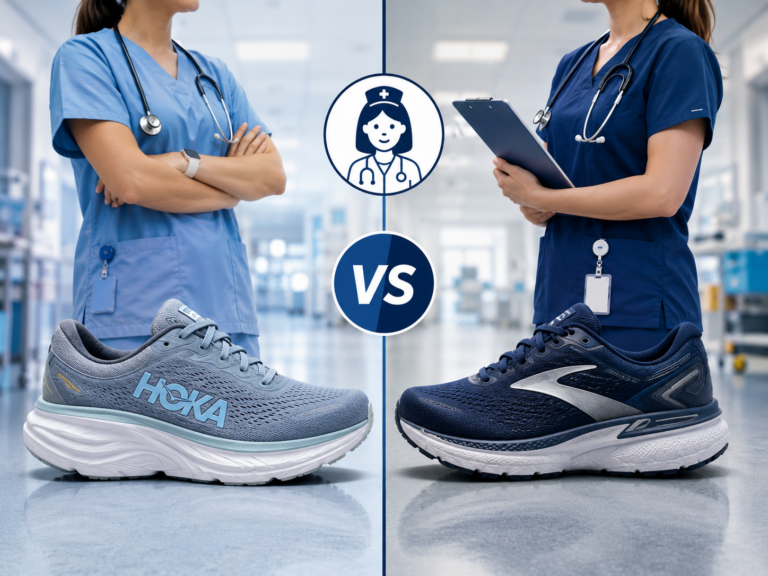
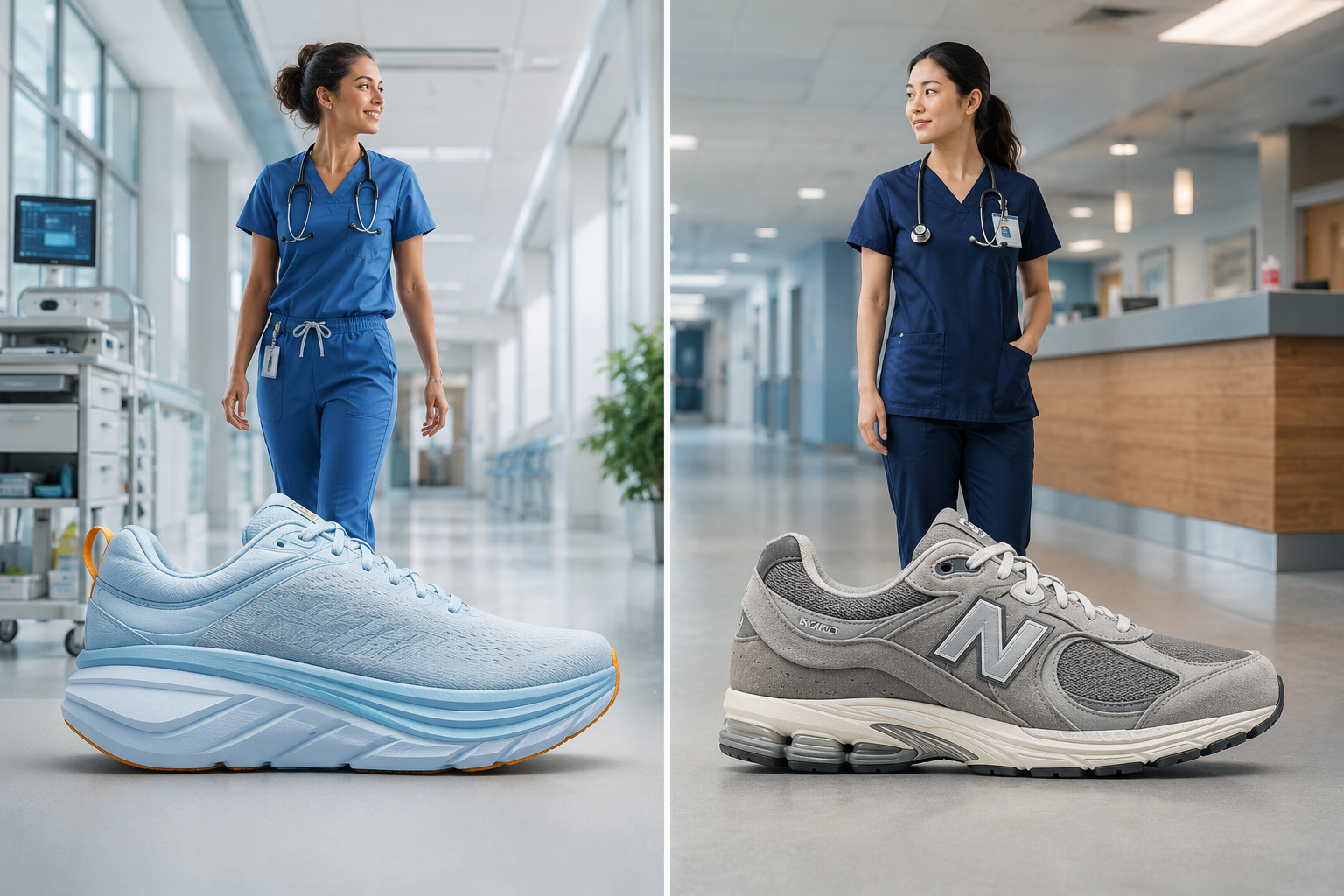
Both are known for exceptional comfort, premium cushioning, and all-day support, but they don’t feel the same once you’re wearing them through an entire hospital shift. Hoka focuses on maximum cushioning and a smooth rolling stride, while New Balance emphasizes balanced comfort, lightweight performance, and a wider range of fit options.
So, which one is actually better for nurses?
The answer depends on how you work, how your feet are shaped, and what kind of discomfort you’re trying to prevent. An emergency room nurse walking 18,000 steps a day has very different footwear needs than an operating room nurse who spends hours standing in one place.
This guide compares Hoka and New Balance from a nurse’s perspective—not a runner’s. We’ll look at comfort during 12-hour shifts, support for common foot conditions, durability, slip resistance, fit, and the best models for different hospital environments, helping you choose the pair that keeps you comfortable from clock-in to clock-out.
Quick Verdict
Don’t have time to read the full comparison? Here’s the short answer.
Choose Hoka if you:
- Spend most of your shift standing on hard hospital floors.
- Experience heel pain or plantar fasciitis.
- Prefer soft, highly cushioned shoes that absorb impact.
- Want a rocker-style sole that reduces fatigue while walking.
- Need a work-specific model like the Hoka Bondi SR with a water-resistant leather upper and slip-resistant outsole.
Choose New Balance if you:
- Walk long distances during every shift.
- Need wide or extra-wide sizing.
- Prefer a lighter, more flexible shoe.
- Want a balanced feel instead of maximum cushioning.
- Need one pair that works both inside and outside the hospital.
Our Overall Recommendation
- Best for maximum comfort: Hoka
- Best for wide feet: New Balance
- Best for plantar fasciitis: Hoka
- Best value for money: New Balance
- Best for 12-hour standing shifts: Hoka
- Best for nurses constantly walking: New Balance
Hoka vs. New Balance for Nurses: Quick Comparison
| Feature | Hoka | New Balance |
|---|---|---|
| Overall Comfort | ⭐⭐⭐⭐⭐ | ⭐⭐⭐⭐☆ |
| Cushioning | ⭐⭐⭐⭐⭐ | ⭐⭐⭐⭐☆ |
| Long Shift Comfort | ⭐⭐⭐⭐⭐ | ⭐⭐⭐⭐☆ |
| Stability | ⭐⭐⭐⭐☆ | ⭐⭐⭐⭐⭐ |
| Arch Support | ⭐⭐⭐⭐⭐ | ⭐⭐⭐⭐☆ |
| Heel Support | ⭐⭐⭐⭐⭐ | ⭐⭐⭐⭐☆ |
| Weight | ⭐⭐⭐⭐☆ | ⭐⭐⭐⭐⭐ |
| Breathability | ⭐⭐⭐⭐☆ | ⭐⭐⭐⭐⭐ |
| Wide Sizes | ⭐⭐⭐☆ | ⭐⭐⭐⭐⭐ |
| Durability | ⭐⭐⭐⭐☆ | ⭐⭐⭐⭐⭐ |
| Slip-Resistant Work Models | ⭐⭐⭐⭐⭐ | ⭐⭐⭐☆☆ |
| Best for Plantar Fasciitis | ⭐⭐⭐⭐⭐ | ⭐⭐⭐⭐☆ |
| Best for Walking | ⭐⭐⭐⭐☆ | ⭐⭐⭐⭐⭐ |
| Best for Standing | ⭐⭐⭐⭐⭐ | ⭐⭐⭐⭐☆ |
| Overall Winner | Hoka | Close Second |
Why Nurses Need Different Shoes Than Runners
One of the biggest mistakes people make is assuming that the best running shoe automatically makes the best nursing shoe.
It doesn’t.
Running is repetitive and predictable. Every stride follows a similar motion, with periods of impact followed by moments when both feet leave the ground.
A hospital shift is completely different.
Nurses rarely move in a straight line. Instead, they spend hours:
- Standing beside patients
- Pivoting around beds
- Walking on polished tile or concrete floors
- Squatting to check equipment
- Lifting or repositioning patients
- Climbing stairs
- Pushing heavy medical carts
- Responding quickly to emergencies
Many nurses also wear compression socks, causing their feet to swell throughout the day. By the end of a 12-hour shift, shoes that felt comfortable in the morning may suddenly feel tight and restrictive.
Because of these unique demands, the best nursing shoes should provide:
- Long-lasting cushioning that doesn’t flatten quickly
- Stable support for standing and walking
- A secure fit without creating pressure points
- Reliable traction on smooth hospital floors
- Breathable materials to keep feet cool
- Enough room to accommodate swelling during long shifts
These are the areas where Hoka and New Balance begin to separate themselves.
Understanding Hoka: Why So Many Nurses Swear by Them
If you’ve walked through a hospital recently, you’ve probably noticed the oversized soles on many nurses’ shoes.
There’s a good chance they were wearing Hokas.
Hoka built its reputation on maximal cushioning. Unlike traditional athletic shoes, Hoka models use thick midsoles designed to absorb impact with every step.
Another defining feature is the brand’s Meta-Rocker geometry. Instead of forcing your foot to bend naturally through each stride, the curved sole gently rolls your body forward. Many nurses say this rolling motion helps reduce fatigue after spending an entire day on hard floors.
Popular Hoka models for healthcare professionals include:
- Bondi 9
- Bondi SR
- Clifton 10
- Arahi
- Gaviota
Among these, the Bondi SR deserves special attention because it’s specifically designed for workplace environments. Unlike standard running shoes, it features a water-resistant leather upper and a slip-resistant outsole, making it one of the few Hoka models built specifically with healthcare workers in mind.
Pros of Hoka for Nurses
- Exceptional cushioning for standing all day
- Excellent shock absorption
- Great for heel pain and plantar fasciitis
- Comfortable during long shifts
- Stable platform despite thick cushioning
- Bondi SR offers workplace-friendly features
Potential Drawbacks
No shoe is perfect.
Some nurses find Hokas slightly bulky, especially during the first few days of wear. Others prefer a more flexible shoe, particularly if they spend most of their shift walking rather than standing.
They’re also among the more expensive options on the market, although many nurses feel the comfort justifies the investment.
Understanding New Balance: Comfort Without the Bulk
While Hoka focuses on maximum cushioning, New Balance takes a different approach.
The brand aims to balance softness, responsiveness, and flexibility while offering one major advantage many competitors can’t match:
Fit options.
New Balance is one of the few major athletic brands that consistently offers narrow, standard, wide, and extra-wide widths across many of its most popular models.
For nurses with difficult-to-fit feet, this alone can make New Balance the better choice.
Their Fresh Foam X midsole delivers a plush ride, but it feels more responsive than Hoka’s deeply cushioned platform. Instead of feeling like you’re walking “inside” the shoe, New Balance tends to provide a more natural stride.
Popular choices among nurses include:
- Fresh Foam X 1080
- Fresh Foam X More
- 880
- 860
These shoes are generally lighter than comparable Hokas, making them a favorite among emergency department nurses, pediatric nurses, and anyone covering thousands of steps during a typical shift.
Pros of New Balance for Nurses
- Excellent width options
- Lightweight feel
- Responsive cushioning
- Durable construction
- Great ventilation
- Suitable for long walking shifts
Potential Drawbacks
Most Fresh Foam models feature engineered mesh uppers. While highly breathable, they are not ideal when liquids are involved.
If you regularly encounter spills or need a shoe that’s easy to wipe clean, you’ll likely prefer a work-specific model with a leather upper rather than a knit running shoe.
Our Testing Philosophy
This comparison isn’t based on marketing claims alone.
Instead, we evaluated both brands using publicly available product specifications, manufacturer information, podiatry recommendations for prolonged standing, verified buyer feedback from healthcare professionals, and long-term wear patterns commonly reported by nurses.
Rather than declaring one brand universally better, we’ve focused on which performs best for different working conditions and foot types.
After all, the best shoe for an ICU nurse may not be the best choice for someone working in the emergency department or labor and delivery.
In the next section, we’ll compare Hoka and New Balance head-to-head in the areas that matter most—including cushioning, stability, support, durability, walking comfort, and performance during long hospital shifts.
Hoka vs. New Balance: Head-to-Head Comparison for Nurses
Both brands make outstanding shoes, but they excel in different areas. Instead of declaring one universal winner, it’s more helpful to compare how they perform during the challenges nurses face every day.
Cushioning
Winner: Hoka ⭐⭐⭐⭐⭐
If there’s one category where Hoka has built its reputation, it’s cushioning.
Most Hoka shoes use thick midsoles designed to absorb impact from every step. Combined with the brand’s Meta-Rocker geometry, the result is a smooth, rolling stride that many nurses describe as feeling like “walking on clouds.”
This extra cushioning can make a noticeable difference if you spend hours standing on hard hospital floors. Less impact reaches your heels, knees, and lower back, which may help reduce fatigue during long shifts.
New Balance isn’t lacking in this department. Its Fresh Foam X cushioning is soft and comfortable, but it has a different personality. Instead of a deep, sink-in feel, it offers a lighter, springier ride with more energy return.
If you like feeling connected to the floor while still enjoying plenty of cushioning, New Balance may actually suit you better.
Verdict
- Choose Hoka for maximum softness and impact absorption.
- Choose New Balance if you prefer a more responsive, bouncy feel.
Comfort During 12-Hour Shifts
Winner: Hoka (Slight Edge)
Comfort isn’t just about how a shoe feels when you first put it on. The real test is how your feet feel after 10 or 12 hours.
Many nurses notice that highly cushioned Hokas maintain their comfort throughout an entire shift, especially when standing for long periods. The thick foam helps reduce foot fatigue, particularly in the heel and forefoot.
New Balance performs exceptionally well too, especially for nurses who are constantly walking. Because the shoes are generally lighter and more flexible, they may feel less tiring during high-step days.
Best Choice by Role
| Nurse Role | Better Choice |
|---|---|
| ICU Nurse | Hoka |
| OR Nurse | Hoka |
| Surgical Nurse | Hoka |
| ER Nurse | New Balance |
| Pediatric Nurse | New Balance |
| Home Health Nurse | New Balance |
| Travel Nurse | New Balance |
Bottom line: If your shift involves more standing than walking, Hoka has the advantage. If you’re constantly moving, New Balance often feels quicker and lighter.
Arch Support
Winner: Hoka
Arch support matters because many nurses spend years working on unforgiving surfaces.
Hoka shoes generally have a supportive midsole that helps distribute pressure across the foot. Combined with the rocker design, this reduces strain on the arch during repetitive walking.
New Balance also offers excellent support, particularly in stability models like the 860. However, its neutral shoes usually provide a slightly more natural feel rather than aggressive support.
Best for Different Arch Types
| Foot Type | Recommended Brand |
|---|---|
| Flat Feet | Tie (depends on model) |
| Neutral Arch | Hoka |
| High Arch | Hoka |
| Overpronation | New Balance 860 or Hoka Arahi |
| Underpronation | Hoka Bondi |
Stability
Winner: New Balance
At first glance, Hoka’s thick soles might look unstable, but the wide base actually provides impressive balance.
Still, New Balance has long been known for stability-focused designs. Models like the Fresh Foam X 860 are specifically engineered to reduce excessive inward rolling (overpronation) while maintaining a smooth stride.
This makes New Balance an excellent option for nurses who:
- Carry extra body weight
- Need additional ankle support
- Walk quickly around busy hospital floors
- Prefer a more traditional running shoe feel
Verdict
If stability is your highest priority, New Balance takes this round.
Weight
Winner: New Balance
Weight may not seem important when you’re trying on shoes in a store, but after walking 15,000 steps, every ounce counts.
In general:
- Hoka shoes have larger midsoles, making them appear—and often feel—bulkier.
- New Balance shoes tend to feel lighter and more agile.
This difference becomes especially noticeable for emergency room nurses, pediatric nurses, and anyone constantly moving throughout the day.
If you enjoy lightweight footwear, New Balance is likely to feel more natural.
Breathability
Winner: New Balance
Hospitals can get surprisingly warm, especially during busy shifts.
Most New Balance Fresh Foam models use engineered mesh uppers that allow excellent airflow, helping feet stay cooler and drier.
Many Hoka models also feature breathable mesh, but the thicker construction can trap slightly more heat.
If sweaty feet are a common issue, New Balance earns the edge.
Durability
Winner: New Balance (Slight Edge)
Premium nursing shoes aren’t cheap, so durability matters.
Both brands are well-built, but New Balance often has a slight advantage in long-term wear.
Common observations include:
- Fresh Foam midsoles retain their shape well.
- Outsoles resist wear after months of daily use.
- Mesh uppers hold up surprisingly well when properly maintained.
Hoka shoes are also durable, but their softer midsoles can gradually compress with heavy daily use, especially if worn every single day without rotation.
Tip
If you work full-time, consider rotating between two pairs of shoes. This allows the foam to recover between shifts and may extend the life of both pairs.
Fit and Sizing
Winner: New Balance
This is one of New Balance’s biggest strengths.
Many popular models are available in:
- Narrow
- Standard
- Wide
- Extra Wide
That makes finding the right fit much easier, especially for nurses with bunions, swollen feet, or naturally wide forefeet.
Hoka does offer wide versions of several models, but the selection isn’t as extensive.
If You Have…
- Wide feet → New Balance
- Bunions → New Balance
- Swollen feet after shifts → New Balance
- Narrow feet → New Balance
Slip Resistance
Winner: Hoka (Bondi SR)
Hospital floors can become slippery due to water, cleaning products, or accidental spills.
Most standard running shoes—including both Hoka and New Balance models—are not designed as occupational slip-resistant footwear.
However, Hoka has one major advantage:
Hoka Bondi SR
Unlike the regular Bondi, the Bondi SR is designed specifically for work environments.
Key features include:
- Slip-resistant rubber outsole
- Water-resistant leather upper
- Easy-to-clean surface
- Excellent cushioning
For nurses working in hospitals where spills are common, the Bondi SR stands out as one of the strongest options available.
Cleaning and Hospital Hygiene
Winner: Hoka Bondi SR
This is an area many comparison articles overlook.
Hospital shoes are exposed to:
- Blood
- IV fluids
- Saline
- Coffee
- Cleaning chemicals
- Disinfectant wipes
Mesh running shoes absorb liquids quickly and can be difficult to clean thoroughly.
The leather upper on the Bondi SR wipes clean much more easily, making it a practical choice for healthcare environments.
If you choose a standard mesh New Balance or Hoka running shoe, expect to spend more time cleaning stains and allowing the shoes to dry.
Value for Money
Winner: New Balance
Hoka shoes usually cost slightly more than comparable New Balance models.
Although many nurses happily pay the premium for Hoka’s cushioning, New Balance often delivers excellent comfort at a slightly lower price.
Rather than looking only at the purchase price, consider how long you’ll wear the shoes.
A pair that costs a little more but stays comfortable through hundreds of shifts can provide better value in the long run.
Estimated Cost Per Shift
| Shoe | Approximate Price | Estimated Shifts | Cost Per Shift |
|---|---|---|---|
| Hoka Bondi | $170 | 300 | ~$0.57 |
| NB Fresh Foam X 1080 | $165 | 340 | ~$0.49 |
The difference is small, but it shows that durability and longevity matter just as much as the initial price tag.
Overall Scorecard
| Category | Winner |
|---|---|
| Cushioning | 🏆 Hoka |
| Standing Comfort | 🏆 Hoka |
| Walking Comfort | 🏆 New Balance |
| Stability | 🏆 New Balance |
| Arch Support | 🏆 Hoka |
| Heel Support | 🏆 Hoka |
| Breathability | 🏆 New Balance |
| Weight | 🏆 New Balance |
| Durability | 🏆 New Balance |
| Wide Fit Options | 🏆 New Balance |
| Slip Resistance | 🏆 Hoka (Bondi SR) |
| Easy Cleaning | 🏆 Hoka (Bondi SR) |
| Overall Value | 🏆 New Balance |
At this point, there’s no clear knockout winner—and that’s exactly why so many nurses debate these two brands. Hoka shines when maximum cushioning and standing comfort are the priority, while New Balance stands out for fit options, lightweight performance, and all-day walking comfort.
In the next section, we’ll move beyond the brands themselves and compare the most popular models head-to-head, including Hoka Bondi 9 vs. New Balance Fresh Foam X 1080, Clifton 10 vs. 880, and other top choices to help you find the best shoe for your specific role and foot type.
Best Hoka vs. New Balance Models for Nurses
Choosing between Hoka and New Balance is only half the decision. The bigger question is which model best fits your daily routine.
Not every nurse works in the same environment. An ER nurse who walks 18,000 steps per shift has different needs than an operating room nurse who spends hours standing in one spot.
Below are the most popular head-to-head matchups to help you find the right shoe for your role.
Hoka Bondi 9 vs. New Balance Fresh Foam X 1080 v15
These are the flagship cushioned models from each brand and the two shoes most nurses compare.
Hoka Bondi 9
Best For
- Nurses who stand for long periods
- Plantar fasciitis
- Heel pain
- Knee pain
- Lower back discomfort
What You’ll Love
✔ Thick, soft cushioning that absorbs impact exceptionally well
✔ Wide, stable platform
✔ Smooth heel-to-toe transition thanks to the Meta-Rocker sole
✔ Comfortable even after 12-hour shifts
Downsides
✘ Bulkier than most running shoes
✘ Higher price
✘ Mesh upper isn’t ideal for fluid exposure
New Balance Fresh Foam X 1080 v15
Best For
- ER nurses
- Pediatric nurses
- Travel nurses
- Nurses walking over 15,000 steps daily
What You’ll Love
✔ Lightweight feel
✔ Soft but responsive Fresh Foam X cushioning
✔ Available in multiple widths
✔ Excellent breathability
Downsides
✘ Less plush than the Bondi
✘ Mesh upper absorbs liquids more easily
Side-by-Side Comparison
| Feature | Hoka Bondi 9 | New Balance 1080 v15 |
|---|---|---|
| Cushioning | ⭐⭐⭐⭐⭐ | ⭐⭐⭐⭐☆ |
| Weight | ⭐⭐⭐☆ | ⭐⭐⭐⭐⭐ |
| Standing Comfort | ⭐⭐⭐⭐⭐ | ⭐⭐⭐⭐☆ |
| Walking Comfort | ⭐⭐⭐⭐☆ | ⭐⭐⭐⭐⭐ |
| Wide Sizes | ⭐⭐⭐☆ | ⭐⭐⭐⭐⭐ |
| Breathability | ⭐⭐⭐⭐☆ | ⭐⭐⭐⭐⭐ |
| Heel Pain Relief | ⭐⭐⭐⭐⭐ | ⭐⭐⭐⭐☆ |
| Energy Return | ⭐⭐⭐⭐☆ | ⭐⭐⭐⭐⭐ |
Verdict
Choose the Bondi 9 if standing all day is your biggest challenge.
Choose the Fresh Foam X 1080 v15 if your shifts involve constant movement and thousands of steps.
Hoka Clifton 10 vs. New Balance 880 v15
These two models are excellent choices for nurses who want dependable everyday comfort without the extra bulk of maximum-cushion shoes.
Hoka Clifton 10
The Clifton is often described as the “lighter Bondi.”
It provides generous cushioning while feeling noticeably more agile.
Ideal for:
- Medical-surgical nurses
- Labor & Delivery
- Outpatient clinics
- Nurses who alternate between standing and walking
Pros
- Lightweight
- Soft ride
- Excellent shock absorption
- Smooth transitions
Cons
- Slightly less durable than Bondi
- Narrower fit for some users
New Balance 880 v15
The 880 has been one of New Balance’s most reliable daily trainers for years.
Instead of feeling overly soft, it offers balanced cushioning with a stable, predictable ride.
Ideal for:
- New nurses
- General hospital work
- Long walking shifts
- Everyday wear
Pros
- Durable
- Comfortable
- Lightweight
- Traditional feel
Cons
- Less cushioning than Bondi or 1080
Verdict
If you enjoy softer cushioning, choose the Clifton 10.
If you prefer a traditional running shoe feel with dependable comfort, the 880 v15 is the better option.
Hoka Arahi vs. New Balance 860
This comparison is especially important for nurses with flat feet or overpronation.
Both shoes are stability models designed to help control excessive inward foot movement.
Hoka Arahi
The Arahi uses Hoka’s J-Frame support system instead of traditional rigid posting.
This creates a more natural feeling of stability while maintaining excellent cushioning.
Best For
- Mild overpronation
- Long standing shifts
- Heel pain
Strengths
✔ Smooth ride
✔ Lightweight stability
✔ Comfortable cushioning
New Balance 860
The 860 has long been one of the most trusted stability shoes available.
It feels more structured than the Arahi and offers stronger support through the midfoot.
Best For
- Moderate to severe overpronation
- Flat feet
- Heavy daily mileage
Strengths
✔ Excellent stability
✔ Durable construction
✔ Great support
Verdict
Choose Arahi if you want supportive cushioning without feeling overly rigid.
Choose 860 if stability is your highest priority.
Hoka Gaviota vs. New Balance Fresh Foam X More
If maximum cushioning is what you’re after, these are the heavyweights.
Hoka Gaviota
One of Hoka’s most supportive shoes.
Perfect for:
- Heavy nurses
- Chronic foot pain
- Lower back pain
- Long standing shifts
New Balance Fresh Foam X More
The More delivers some of the softest cushioning New Balance has ever produced while maintaining impressive flexibility.
Ideal for nurses wanting a plush ride without the pronounced rocker feel of Hoka.
Verdict
- Maximum support → Gaviota
- Softer natural ride → Fresh Foam X More
Which Shoe Is Best for Your Nursing Specialty?
Not every hospital role places the same demands on your feet.
Here’s a quick guide based on common nursing specialties.
| Nursing Specialty | Recommended Shoe | Why |
|---|---|---|
| Emergency Room | New Balance 1080 | Lightweight for constant movement |
| ICU | Hoka Bondi 9 | Excellent cushioning during long standing periods |
| Operating Room | Hoka Bondi SR | Slip-resistant and comfortable for prolonged standing |
| Medical-Surgical | Hoka Clifton 10 | Balanced comfort and support |
| Pediatrics | New Balance 880 | Lightweight and agile |
| Labor & Delivery | Hoka Clifton 10 | Great mix of cushioning and flexibility |
| Oncology | Hoka Bondi 9 | Reduces fatigue during long shifts |
| Home Health | New Balance 1080 | Comfortable for driving and walking |
| Travel Nurse | New Balance 1080 | Versatile and lightweight |
| Nurse Practitioner | Either | Depends on daily workload |
Which Brand Is Better for Common Foot Problems?
One of the biggest reasons nurses replace their shoes is pain—not because the shoes are worn out.
Here’s how each brand performs for common foot and joint issues.
Plantar Fasciitis
🏆 Winner: Hoka
The thick cushioning and rocker geometry help reduce stress on the plantar fascia by encouraging a smoother stride and minimizing repetitive heel impact.
Many nurses with plantar fasciitis find the Bondi and Clifton especially comfortable, although individual results can vary.
Heel Pain
🏆 Winner: Hoka
If your heels ache after standing on hard floors all day, Hoka’s deep cushioning provides excellent shock absorption.
Flat Feet
🏆 Winner: Tie
For flat feet, the best choice depends more on the specific model than the brand itself.
Good options include:
- Hoka Arahi
- Hoka Gaviota
- New Balance 860
If you have significant overpronation, you may also benefit from custom orthotics or advice from a podiatrist.
High Arches
🏆 Winner: Hoka
High arches often place extra pressure on the heel and forefoot.
Hoka’s generous cushioning helps spread impact more evenly across the foot.
Wide Feet
🏆 Winner: New Balance
This isn’t close.
New Balance consistently offers:
- Wide
- Extra Wide
- Multiple fit options
For nurses whose feet swell throughout the day, those additional width choices can make a huge difference in comfort.
Bunions
🏆 Winner: New Balance
Shoes with a roomy toe box reduce pressure on the bunion area.
Many New Balance models provide more space in the forefoot, especially in wide widths.
Swollen Feet After Long Shifts
🏆 Winner: New Balance
Feet naturally expand after hours of standing and walking.
New Balance’s broader fit options and accommodating uppers often feel more comfortable late in a shift.
Knee Pain
🏆 Winner: Hoka
The extra cushioning helps reduce impact forces traveling from the feet to the knees.
While shoes alone won’t solve chronic knee pain, many nurses report improved comfort after switching to more cushioned footwear.
Lower Back Pain
🏆 Winner: Hoka
Standing on hard hospital floors for years can contribute to lower back discomfort.
Hoka’s thick midsoles may help reduce fatigue by softening repeated impact throughout the workday.
Quick Recommendations by Foot Condition
| Condition | Best Choice |
|---|---|
| Plantar Fasciitis | Hoka Bondi |
| Heel Pain | Hoka Bondi |
| Flat Feet | Hoka Arahi or NB 860 |
| High Arches | Hoka Clifton |
| Bunions | New Balance 1080 Wide |
| Wide Feet | New Balance |
| Swollen Feet | New Balance |
| Knee Pain | Hoka Bondi |
| Lower Back Pain | Hoka Bondi |
| Overpronation | New Balance 860 |
At this point, we’ve compared the most popular models and explored which shoes perform best for different nursing roles and common foot conditions.
In the final section, we’ll cover the mistakes nurses make when buying work shoes, answer the most frequently asked questions, and provide a clear final verdict to help you confidently choose between Hoka and New Balance.
Common Mistakes Nurses Make When Buying Work Shoes
After reading countless reviews and comparing dozens of models, one thing becomes clear: many nurses don’t regret which brand they bought—they regret choosing the wrong shoe for their needs.
Here are some of the most common mistakes to avoid before investing in your next pair.
1. Buying Shoes That Are Too Small
Your feet naturally swell during a long shift. A shoe that feels perfect at 8 a.m. may feel painfully tight by 6 p.m.
If you’re between sizes or regularly experience swelling, consider trying your shoes later in the day when your feet are at their largest. Also, pay attention to width—not just length.
2. Choosing a Running Shoe Without Considering Your Work Environment
Many excellent running shoes aren’t designed for hospital work.
For example, lightweight mesh uppers provide great ventilation, but they’re not ideal if you’re regularly exposed to spills or need shoes that are easy to wipe clean.
If slip resistance and easy cleaning are priorities, look at work-focused models like the Hoka Bondi SR or other occupational footwear designed for healthcare settings.
3. Ignoring Your Foot Type
No single shoe works for everyone.
Before buying, ask yourself:
- Do I have flat feet?
- Do I overpronate?
- Are my arches high?
- Do my feet swell during long shifts?
- Do I wear custom orthotics?
Understanding your foot type makes it much easier to choose the right model.
4. Waiting Too Long to Replace Your Shoes
Even if the outsole still looks good, the midsole cushioning gradually compresses over time.
A shoe that felt incredibly comfortable six months ago may no longer provide the same support.
As a general guideline, nurses who wear the same pair every shift should inspect their shoes regularly for signs of worn cushioning, uneven tread, or reduced comfort rather than relying on appearance alone.
5. Focusing Only on Price
It’s tempting to buy the cheapest option, especially if you’re replacing shoes frequently.
However, spending a little more on footwear that keeps you comfortable through hundreds of shifts may be a better investment than replacing inexpensive shoes every few months.
Think about value over time—not just the initial price tag.
Frequently Asked Questions
Are Hokas good for nurses?
Yes. Hoka shoes are among the most popular choices for nurses because of their exceptional cushioning and comfort during long shifts. Models like the Bondi and Clifton are especially popular, while the Bondi SR is designed specifically for workplace environments with a slip-resistant outsole and water-resistant leather upper.
Are New Balance shoes good for standing all day?
Absolutely. Many New Balance shoes provide excellent cushioning and support for prolonged standing. They’re also available in multiple width options, making them a great choice for nurses with wide feet or bunions.
Which brand is better for 12-hour shifts?
If your shift involves mostly standing, Hoka generally has the advantage thanks to its plush cushioning and rocker sole.
If you’re constantly walking from room to room, many nurses prefer the lighter feel of New Balance.
Which brand is better for plantar fasciitis?
Many nurses with plantar fasciitis prefer Hoka because its thick midsoles and rocker geometry help reduce stress on the heel and plantar fascia.
However, comfort is personal, and some people may prefer the feel of a supportive New Balance stability shoe.
Which brand lasts longer?
Both brands are known for producing durable shoes.
New Balance often has a slight edge in outsole longevity, while Hoka is widely praised for long-lasting comfort. Actual lifespan depends on your weight, walking distance, work schedule, and how often you rotate your shoes.
Are Hokas worth the extra money?
For many nurses, yes.
If cushioning and standing comfort are your top priorities, the additional cost may be worthwhile. Many users feel the reduction in foot fatigue justifies the higher price.
Does New Balance make slip-resistant shoes?
New Balance offers work shoes with slip-resistant outsoles, but not every Fresh Foam running model includes this feature.
Always check the specifications before purchasing if slip resistance is required by your workplace.
Which brand is better for wide feet?
New Balance.
Its wide and extra-wide sizing options are among the best in the industry and accommodate many foot shapes more effectively than standard-width shoes.
Can nurses wear running shoes?
Many nurses do wear running shoes because they’re lightweight and comfortable.
However, depending on your hospital’s policies and your work environment, you may prefer shoes with a slip-resistant outsole or an upper that’s easier to clean.
How often should nurses replace their shoes?
There’s no fixed schedule because wear depends on factors such as shift length, walking distance, body weight, and the shoe itself.
Instead of replacing shoes after a specific number of months, monitor the condition of the cushioning, outsole, and overall comfort. If your feet begin feeling noticeably more fatigued than usual, it may be time for a new pair.
Final Verdict: Which Brand Should Nurses Choose?
After comparing comfort, support, durability, fit, stability, and long-shift performance, it’s clear that both Hoka and New Balance make outstanding shoes for nurses.
The better choice depends on how you work, how your feet feel at the end of a shift, and what features matter most to you.
Choose Hoka If You:
- Spend most of your shift standing rather than walking.
- Want maximum cushioning.
- Experience heel pain or plantar fasciitis.
- Need excellent shock absorption.
- Prefer a smooth rocker-style stride.
- Want the option of a work-focused shoe like the Bondi SR.
Choose New Balance If You:
- Walk thousands of steps every shift.
- Have wide or extra-wide feet.
- Prefer a lighter, more flexible shoe.
- Want a more traditional running shoe feel.
- Value a wide range of sizing options.
Our Recommendations by Nurse Type
| If You Are… | Recommended Shoe |
|---|---|
| ICU Nurse | Hoka Bondi 9 |
| Operating Room Nurse | Hoka Bondi SR |
| ER Nurse | New Balance Fresh Foam X 1080 v15 |
| Medical-Surgical Nurse | Hoka Clifton 10 |
| Pediatric Nurse | New Balance 880 v15 |
| Home Health Nurse | New Balance Fresh Foam X 1080 v15 |
| Travel Nurse | New Balance Fresh Foam X 1080 v15 |
| Nurse with Plantar Fasciitis | Hoka Bondi 9 |
| Nurse with Wide Feet | New Balance Fresh Foam X 1080 Wide |
| Nurse with Flat Feet | New Balance 860 or Hoka Arahi |
| Nurse with Knee Pain | Hoka Bondi 9 |
| Budget-Conscious Nurse | New Balance 880 v15 |
The Bottom Line
If we had to choose just one brand for most nurses, Hoka earns a slight overall edge thanks to its exceptional cushioning, long-shift comfort, and work-specific options like the Bondi SR.
That said, New Balance is an excellent alternative—and for nurses with wide feet, those who spend most of their shift walking, or anyone who prefers a lighter, more responsive ride, it may actually be the better fit.
Ultimately, the best nursing shoe isn’t the one with the most hype—it’s the one that lets you finish your shift with less pain, less fatigue, and enough comfort to focus on your patients instead of your feet.
Key Takeaways
- Hoka is the best choice for nurses who prioritize cushioning, standing comfort, and relief from heel or plantar fascia discomfort.
- New Balance stands out for lightweight comfort, excellent width options, and all-day walking performance.
- If you work in environments where spills are common, consider shoes with a slip-resistant outsole and easy-to-clean upper, such as the Hoka Bondi SR.
- Match your shoe to your role, foot shape, and daily workload rather than choosing a brand based on popularity alone.
- Replacing worn-out shoes before cushioning breaks down completely can help maintain comfort during demanding shifts.
Whether you choose Hoka or New Balance, investing in footwear that fits your feet and supports your work environment is one of the smartest decisions you can make as a healthcare professional.