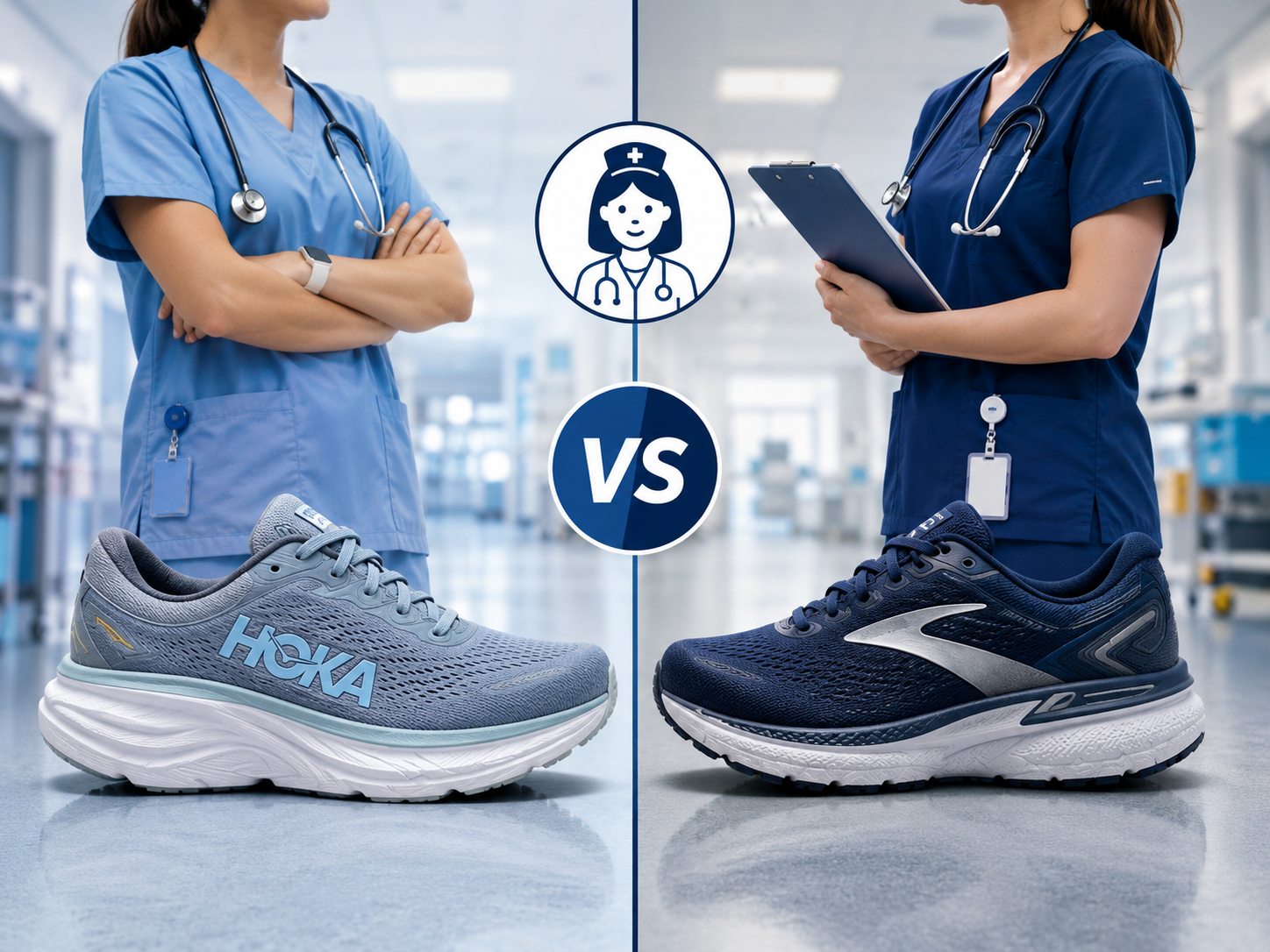
Hoka vs Brooks for Nurses
Quick decision: Hoka is the clearer starting point when a nurse wants a highly cushioned platform and, in the Bondi SR, a model specifically positioned for professional use with a water-resistant leather upper and slip-resistant outsole. Brooks is the clearer starting point when you prefer a traditional running-shoe feel, balanced cushioning, multiple support levels, and familiar walking models such as Ghost 18 or Adrenaline GTS 25. If your facility requires specific traction or other footwear features, compare exact models rather than choosing a brand winner.
This comparison is research-based. We have not run a 12-hour hospital-floor test, and we do not recommend either brand as treatment for foot, knee, or back conditions.
Hoka vs Brooks for nurses: the short version
| Priority | Start with | Models to compare |
|---|---|---|
| Professional slip-resistant Hoka | Hoka | Bondi SR |
| Plush neutral cushioning | Hoka | Bondi 9 |
| Lighter walking-focused Hoka | Hoka | Clifton 10 |
| Balanced everyday Brooks | Brooks | Ghost 18 |
| Structured-support Brooks | Brooks | Adrenaline GTS 25 |
| Very high Brooks cushioning | Brooks | Ghost Max / Glycerin families |
See the broader Nursing Shoes hub for other comparisons. For clog-based occupational options, our Crocs vs Dansko for Nurses guide covers a different footwear format.
Start with the work requirement, not the foam
Healthcare footwear decisions are often framed as cushioning contests. That is backwards if your employer has requirements around traction, upper material, color, or cleanability. A standard road-running shoe can feel excellent and still be the wrong product for a workplace policy.
Hoka has a particularly clear professional model in the Bondi SR. Brooks’ core Ghost, Glycerin, and Adrenaline lines are primarily running and walking shoes. If your unit requires a documented work outsole, verify the exact Brooks product rather than assuming a road shoe qualifies.
Hoka models nurses are most likely to compare
Bondi SR
Hoka positions the Bondi SR for professional use. The current product page lists water-resistant leather, an EVA midsole, a slip-resistant rubber/tread package, and full-ground-contact rubber. This is the Hoka that deserves priority when the comparison is specifically about hospital or service work.
Bondi 9 and Clifton 10
The standard Bondi and Clifton families are better treated as comfort-first athletic options for workplaces that allow ordinary sneakers. Bondi is the plusher route; Clifton is the lighter, more walking-oriented route. Neither should inherit Bondi SR’s workplace claims simply because it carries the Hoka name.
Brooks models nurses are most likely to compare
Ghost 18
Brooks describes the current Ghost 18 as a road-running and walking shoe with balanced cushioning, balanced support, a secure heel, and RoadTack rubber outsole. It is a straightforward option for facilities that allow standard athletic footwear.
Adrenaline GTS 25
The Adrenaline GTS 25 adds Brooks GuideRails and structured support. That makes it different from the Ghost rather than simply “more supportive Brooks.” Nurses who prefer a guided platform may want to compare these two Brooks families before comparing brands.
Ghost Max and Glycerin
Brooks also offers higher-cushion choices. They are useful when a nurse wants more underfoot volume than the standard Ghost, but they remain model-specific athletic shoes. Do not turn higher stack into a claim about treating pain or preventing injury.
Cushioning: Hoka is easier to understand, Brooks gives more ride choices
Hoka’s identity is relatively simple: Bondi is plush, Clifton is lighter, and Bondi SR adapts the cushioned concept to professional use. Brooks spreads its cushioning across Ghost, Ghost Max, Glycerin, and support-focused GTS variants.
The practical question is not “which foam reduces fatigue more?” without a real test. It is whether you prefer a thicker Hoka platform or Brooks’ more conventional geometry and whether that preference still works with your workplace rules.
Traction and cleanability
Bondi SR has the clearest documented work-use story in this matchup because Hoka explicitly lists a slip-resistant outsole and water-resistant leather. Standard Bondi and Clifton models are not the same product.
Brooks Ghost and Adrenaline use road-running constructions. Their outsoles provide ordinary traction for the intended use, but that should not be translated into an occupational slip-resistance claim. If your facility requires a specific work rating, verify before buying.
For cleaning, leather can be simpler to wipe than open mesh, but facility infection-control rules always take priority. A wipeable upper is not the same thing as a shoe being approved for a clinical decontamination process.
Walking-heavy versus standing-heavy shifts
For constant walking, Clifton 10 or Brooks Ghost 18 are the more natural lightweight comparisons. For someone who prefers a thicker platform, Bondi or Ghost Max/Glycerin families are more relevant.
There is no credible basis for declaring that one brand “wins hour 10” without an actual controlled wear test. Fit, floor surface, movement pattern, and individual preference matter more than a simulated time chart.
Fit and widths
Both brands offer multiple widths in important models. The useful step is to compare the exact model’s width availability and last. Do not size up in length solely to create extra width unless the manufacturer’s fit guidance points you there.
A shoe can also feel roomy in the toe box but tight at the instep, or wide in the forefoot but loose at the heel. Try the work socks you normally wear and pay attention to heel security during turns and stairs.
Which brand fits common nursing priorities?
| Priority | Better starting point | Reason |
|---|---|---|
| Documented Hoka work model | Hoka Bondi SR | Professional-use positioning and documented slip-resistant outsole |
| Traditional everyday sneaker feel | Brooks Ghost 18 | Balanced road/walking design |
| Structured support preference | Brooks Adrenaline GTS 25 | GuideRails and structured support |
| Plush neutral platform | Hoka Bondi | Hoka’s most cushioned road-shoe family |
| Lighter walking feel | Hoka Clifton or Brooks Ghost | Both are less work-boot-like than occupational clogs |
What neither brand solves automatically
Neither brand guarantees fit, shift comfort, infection-control suitability, or compliance with your employer’s footwear policy. A popular nursing shoe can still be wrong for your unit. Nurses who need a molded clog, a washable enclosed shoe, or a particular occupational outsole may be better served by another product family.
Frequently asked questions
Is Hoka Bondi SR better than Brooks Ghost for nurses?
They solve different problems. Bondi SR is positioned for professional use and lists work-oriented features including slip resistance and water-resistant leather. Ghost 18 is a balanced running/walking shoe. If your workplace has a traction requirement, Bondi SR is easier to verify; if standard athletic shoes are allowed, fit and ride preference become more important.
Are all Hoka shoes slip resistant?
No. Bondi SR is the work-focused Hoka in this comparison. Do not transfer its specifications to standard Bondi or Clifton models.
Are Brooks running shoes work shoes?
Not automatically. Brooks road shoes can be used in workplaces that allow ordinary athletic footwear, but they should not be described as occupationally slip resistant or safety rated unless the exact product documentation says so.
Final verdict
Start with Hoka if you want a plush platform and especially if Bondi SR’s professional-use features fit your unit. Start with Brooks if you prefer a traditional athletic feel, want clear neutral-versus-structured-support choices, or already know Ghost/Adrenaline geometry suits you.
For nurses, the exact model and workplace requirement are more important than a brand-level trophy.
Sources and research scope
Manufacturer information was checked on current Hoka and Brooks pages linked above. Product specifications can change. This article does not claim hands-on hospital testing, medical outcomes, or universal lifespan estimates.