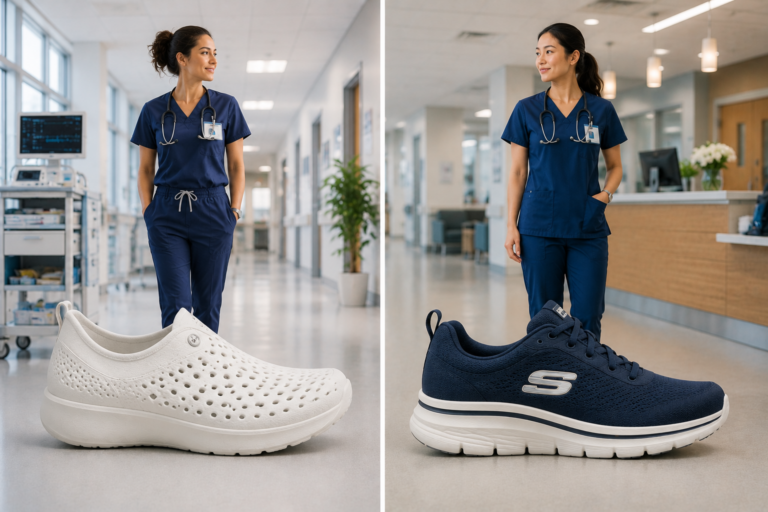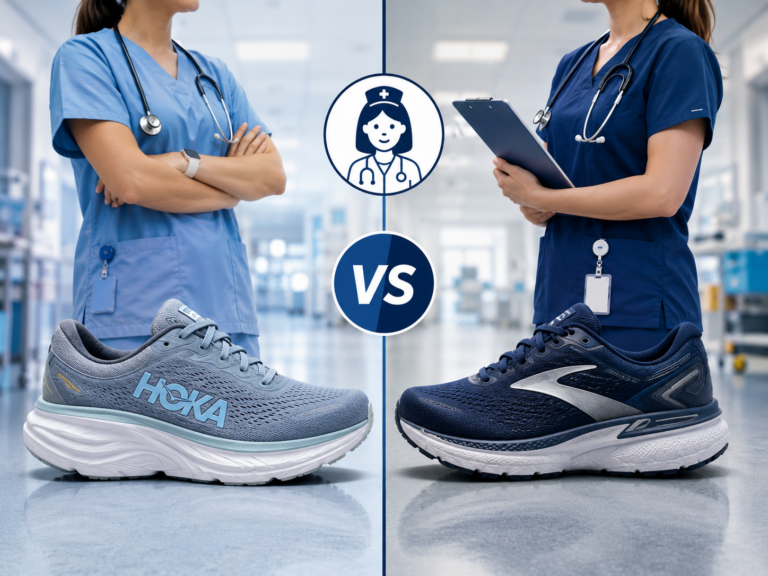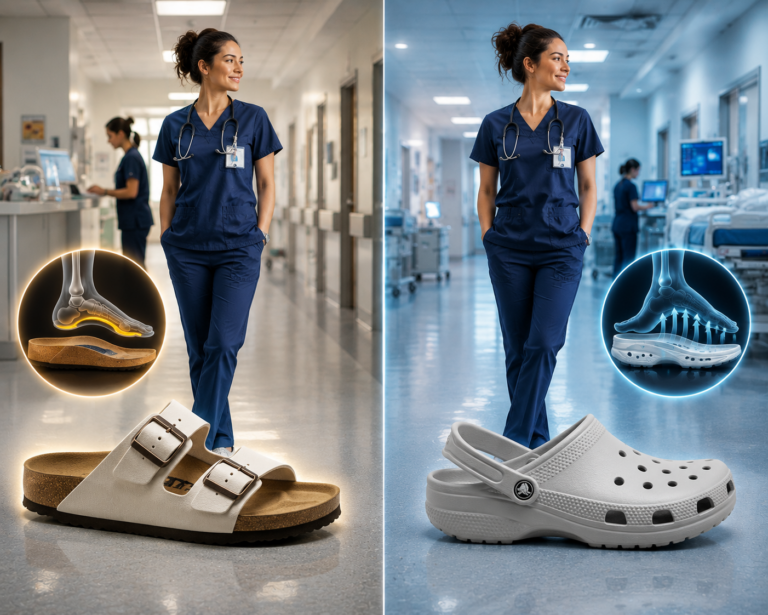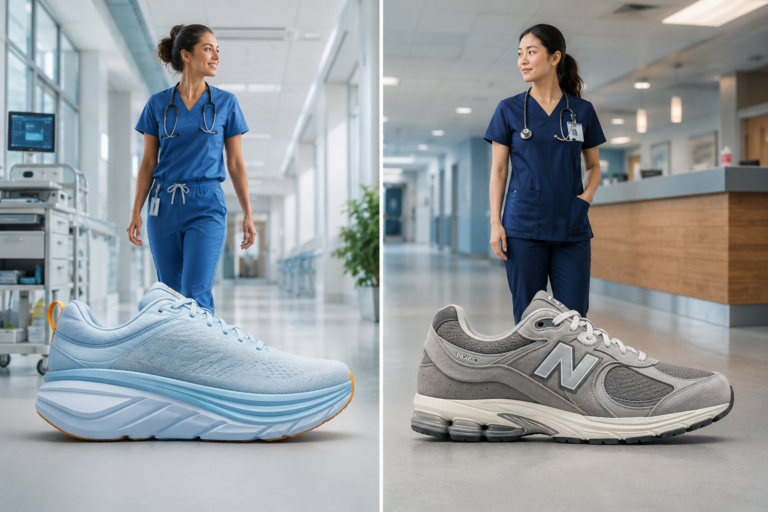

Skechers vs Hoka for Nurses
Working as a nurse means spending long hours on your feet. Whether you’re rushing between patient rooms, standing through lengthy procedures, or walking several miles during a 12-hour shift, the wrong pair of shoes can leave you with sore feet, aching knees, and lower back pain before the day is over.
That’s why two brands consistently appear in conversations among healthcare professionals: Skechers and Hoka.
Skechers has earned a loyal following thanks to its affordable pricing, slip-resistant Work collection, and comfortable memory foam insoles. Hoka, on the other hand, has become one of the most recommended brands for nurses because of its plush cushioning, rocker sole design, and exceptional shock absorption.
But which brand is actually better for nurses?
The answer isn’t as simple as choosing the more expensive shoe. Your ideal choice depends on factors like your foot shape, hospital policies, budget, whether you have plantar fasciitis or flat feet, and even the department where you work.
In this guide, we’ll compare Skechers and Hoka across the factors that matter most during long nursing shifts, including:
- Comfort after 12 hours
- Cushioning and impact protection
- Arch support
- Slip resistance
- Durability
- Weight
- Breathability
- Ease of cleaning
- Price and long-term value
- The best models for different nursing specialties
By the end, you’ll know exactly which brand fits your needs and whether spending extra on Hoka is worth it—or if Skechers offers the better value for your work environment.
Quick Verdict
If you don’t have time to read the full comparison, here’s the short answer.
| If You Want… | Winner |
|---|---|
| Maximum Cushioning | 🏆 Hoka |
| Best for 12-Hour Shifts | 🏆 Hoka |
| Better Value for Money | 🏆 Skechers |
| Best Budget Option | 🏆 Skechers |
| Better Arch Support | 🏆 Hoka (most models) |
| Best Slip-Resistant Work Shoes | 🏆 Skechers Work Series |
| Better for Plantar Fasciitis | 🏆 Hoka |
| Better for Knee Pain | 🏆 Hoka |
| Easier to Clean | 🏆 Skechers Work Models |
| Lightweight Feel | 🏆 Skechers |
| Best Overall for Most Nurses | ⭐ Hoka |
Our Overall Recommendation
If your budget allows it and you regularly work 10- to 12-hour shifts, Hoka is our top recommendation. Its thick EVA midsole, rocker geometry, and excellent shock absorption help reduce foot and leg fatigue on hard hospital floors.
However, Skechers remains an excellent choice for nurses who want dependable comfort without spending premium prices. The brand also offers one of the best selections of slip-resistant work shoes, making it a practical option for hospitals, clinics, and long-term care facilities.
Skechers vs Hoka at a Glance
| Feature | Skechers | Hoka | Winner |
|---|---|---|---|
| Comfort | Excellent | Outstanding | 🏆 Hoka |
| Cushioning | Very Good | Excellent | 🏆 Hoka |
| Arch Support | Very Good (Arch Fit) | Excellent | 🏆 Hoka |
| Slip Resistance | Excellent (Work Line) | Excellent (Bondi SR only) | 🏆 Skechers |
| Weight | Lighter | Slightly Heavier | 🏆 Skechers |
| Breathability | Good | Excellent | 🏆 Hoka |
| Durability | Good | Very Good | 🏆 Hoka |
| Ease of Cleaning | Excellent | Good | 🏆 Skechers |
| Price | $$ | $$$ | 🏆 Skechers |
| Overall for Nurses | Excellent | Outstanding | 🏆 Hoka |
Why Choosing the Right Nursing Shoes Matters
Many people underestimate how physically demanding nursing can be.
Research and workplace observations consistently show that nurses can walk 4 to 7 miles (6 to 11 km) during a single 12-hour shift, often on unforgiving vinyl, tile, or concrete floors. Over weeks and months, that repetitive impact can contribute to:
- Foot fatigue
- Heel pain
- Plantar fasciitis
- Shin splints
- Knee pain
- Hip discomfort
- Lower back pain
- Swollen feet by the end of a shift
The right shoes won’t eliminate every ache, but they can make a significant difference by reducing impact forces, improving stability, and supporting your natural gait.
When comparing Skechers and Hoka, we focused on the qualities that matter most in a healthcare setting:
- Cushioning for long hours on hard floors
- Reliable arch support
- Stability during constant walking
- Slip resistance for wet or polished surfaces
- Durability under daily use
- Breathability for all-day comfort
- Ease of cleaning after spills
- Overall value for the price
Rather than declaring one brand the winner in every category, we’ll explain where each one excels so you can choose the option that matches your work environment and foot needs.
How We Evaluated Skechers and Hoka
To make this comparison as useful as possible, we based our evaluation on several sources rather than relying on marketing claims alone.
Our assessment considers:
- Manufacturer specifications, including midsole materials, outsole design, and available work-specific models.
- Features that matter in clinical settings, such as slip resistance, cushioning, support, and ease of cleaning.
- Common feedback patterns from healthcare workers across verified retailer reviews and nursing communities.
- Guidance from podiatry and ergonomics experts on footwear for prolonged standing and walking.
Every nurse has different feet, body mechanics, and workplace requirements. Instead of claiming one shoe is universally “best,” this guide explains which brand tends to perform better for different situations, helping you make an informed decision.
Comfort Comparison: Which Brand Feels Better During a 12-Hour Shift?
Comfort is the number one reason nurses switch shoes. When you’re walking thousands of steps, responding to emergencies, or standing for long periods during medication rounds or surgeries, every step matters.
Both Skechers and Hoka are known for comfortable footwear, but they achieve comfort in different ways.
Skechers focuses on plush insoles and affordability. Most nursing-friendly models feature Air-Cooled Memory Foam, Max Cushioning, or the Arch Fit system, which create a soft, cushioned feel from the moment you put them on.
Hoka, on the other hand, prioritizes reducing fatigue over an entire shift. Instead of relying mainly on a soft insole, Hoka combines thick EVA foam with its signature Meta-Rocker sole to encourage a smoother heel-to-toe transition while walking.
Skechers Comfort
One reason Skechers remains so popular among nurses is that many models feel comfortable immediately, with little or no break-in period.
Popular comfort technologies include:
- Air-Cooled Memory Foam insoles
- Arch Fit support system (available on select models)
- Max Cushioning midsoles
- Hands-Free Slip-ins for quick on-and-off convenience
Most nurses describe Skechers as soft and forgiving during shorter shifts, making them a solid choice for outpatient clinics, doctor’s offices, and part-time healthcare work.
Pros
✔ Comfortable straight out of the box
✔ Softer underfoot feel
✔ Great value for the price
✔ Wide range of widths and styles
Cons
✘ Cushioning may compress faster with heavy daily use
✘ Less impact absorption than premium Hoka models
Hoka Comfort
Hoka shoes feel different the first time you wear them.
Instead of sinking into a soft insole, you stand on a thick, highly cushioned platform that distributes pressure across your entire foot. The brand’s Meta-Rocker geometry helps guide each step, reducing the effort needed to move from heel strike to toe-off.
Many nurses report that Hoka shoes don’t necessarily feel dramatically softer than Skechers when trying them on in a store. The difference becomes noticeable after several hours on hard hospital floors, when legs and feet tend to feel less fatigued.
Pros
✔ Outstanding long-distance comfort
✔ Excellent shock absorption
✔ Reduces fatigue during extended shifts
✔ Helps minimize pressure on knees and lower back
Cons
✘ Higher price
✘ Some models require a short break-in period
Winner: Comfort
🏆 Hoka
Skechers offers impressive comfort for the price, but Hoka’s cushioning system is designed to stay comfortable hour after hour. For nurses regularly working 10- to 12-hour shifts, Hoka has the edge.
Cushioning & Impact Absorption: The Concrete Floor Test
Hospital floors are designed for durability and hygiene—not comfort. Most are made from vinyl, tile, or sealed concrete, all of which transfer impact forces back into your feet and joints with every step.
The longer you work on these surfaces, the more important proper cushioning becomes.
Skechers Cushioning
Skechers uses several cushioning technologies across its lineup.
Air-Cooled Memory Foam
This removable insole molds to your foot, creating a soft, cushioned feel. It’s comfortable for everyday wear but provides limited long-term structural support compared to performance midsoles.
Max Cushioning
Found in models like the Skechers Max Cushioning Elite, this technology adds a thicker foam midsole for better shock absorption than standard Skechers shoes.
Arch Fit
Although primarily designed for support, Arch Fit also contributes to comfort by improving pressure distribution under the foot.
For nurses on 8-hour shifts or lighter workloads, these systems perform well. However, under heavy daily use, memory foam can gradually compress, reducing its cushioning over time.
Hoka Cushioning
Cushioning is where Hoka built its reputation.
Instead of emphasizing the insole, Hoka focuses on a thick compression-molded EVA midsole that absorbs impact before it reaches your joints.
Popular nursing models like the Bondi SR and Clifton provide a highly cushioned ride while maintaining enough stability for long periods of standing and walking.
Another advantage is the Meta-Rocker design, which creates a rolling motion that can reduce strain on the ankles and calves during repetitive walking.
Many healthcare workers notice the biggest difference near the end of a long shift, when fatigue typically starts to set in.
Hospital Shift Performance
After 4 Hours
At this point, both brands generally feel comfortable.
Skechers still provides plenty of cushioning, while Hoka begins to show its advantage by distributing pressure more evenly across the foot.
Winner: Tie
After 8 Hours
This is when the differences become more noticeable.
Skechers remains comfortable, but some users report increased heel pressure or forefoot fatigue, particularly in models that rely heavily on memory foam.
Hoka continues to deliver consistent cushioning, helping reduce soreness in the feet and lower legs.
Winner: 🏆 Hoka
After 12 Hours
For nurses finishing a full shift, cushioning durability becomes critical.
Hoka’s thick EVA midsole generally retains its supportive feel better throughout the day, while some Skechers models may feel flatter after hours of continuous use.
If your job requires walking several miles each shift, Hoka is more likely to keep your feet comfortable until clock-out.
Winner: 🏆 Hoka
Winner: Cushioning
🏆 Hoka
Both brands provide above-average cushioning, but Hoka’s midsole technology is specifically engineered for long-distance comfort and impact reduction. For nurses spending all day on hard hospital floors, it offers better long-term protection against foot and joint fatigue.
Arch Support: Which Brand Is Better for Foot Health?
Arch support is one of the most important factors when choosing nursing shoes, especially if you deal with plantar fasciitis, flat feet, or foot fatigue after long shifts.
While both Skechers and Hoka offer supportive options, they take different approaches.
Skechers Arch Fit Technology
The Arch Fit collection was developed using extensive foot scan data and is designed to provide better support than traditional memory foam shoes.
Key benefits include:
- Removable supportive insole
- Better pressure distribution across the foot
- Available in multiple widths
- Suitable for many people with mild to moderate arch support needs
For nurses who spend hours standing at medication carts or workstations, Arch Fit models can provide a noticeable improvement over standard athletic shoes.
Hoka’s Support System
Rather than relying on a specialized insole, Hoka builds support into the shoe itself.
Features include:
- Active Foot Frame construction that helps cradle the foot.
- Meta-Rocker geometry that promotes a smoother walking motion.
- Stability-focused models, such as the Gaviota and Arahi, designed for overpronation.
This integrated approach often provides better long-term support, especially for nurses covering long distances during each shift.
Best Choice by Foot Type
| Foot Type | Better Choice | Why |
|---|---|---|
| Neutral Feet | Tie | Both offer excellent comfort. |
| Flat Feet | Hoka Gaviota or Skechers Arch Fit | Depends on the level of support needed. |
| High Arches | Hoka | Better shock absorption and pressure distribution. |
| Mild Plantar Fasciitis | Hoka | More consistent cushioning and support. |
| Wide Feet | Tie | Both brands offer wide-width options in many models. |
Winner: Arch Support
🏆 Hoka (Overall)
🏆 Skechers Arch Fit (Best Value)
If your primary concern is long-term support during demanding hospital shifts, Hoka generally comes out ahead. However, Skechers Arch Fit delivers impressive support at a significantly lower price, making it an excellent value for many nurses.
Slip Resistance: Which Brand Is Safer on Hospital Floors?
Comfort is important, but in a hospital, traction can be just as critical.
Nurses often walk across freshly mopped hallways, polished tile, patient rooms, and areas where water or other liquids may be present. A shoe with poor grip increases the risk of slips and falls, which can lead to serious injuries.
This is where it’s important to understand a common misconception:
Not every Skechers or Hoka shoe is slip-resistant.
Many people assume that because a shoe is comfortable, it’s automatically suitable for hospital work. In reality, most running shoes are designed for pavement or trails—not slick indoor flooring.
If your employer requires slip-resistant footwear, always check the manufacturer’s specifications before buying.
Skechers Slip Resistance
Skechers has one of the largest occupational footwear collections on the market.
The Skechers Work™ line is specifically designed for healthcare professionals, restaurant workers, warehouse employees, and anyone working in environments where traction is essential.
Many models feature:
- Slip-resistant rubber outsoles
- Oil-resistant designs (on selected models)
- ASTM F2913 tested traction (varies by model)
- Easy-to-clean synthetic or leather uppers
- Machine-washable options (selected mesh models)
Popular choices include:
- Skechers Max Cushioning Elite SR
- Skechers Work Slip-ins
- Skechers Sure Track
- Skechers Squad SR
For nurses whose hospital requires certified slip-resistant shoes, Skechers offers plenty of affordable options.
Pros
✔ Large selection of work-specific shoes
✔ Certified slip-resistant options
✔ Budget-friendly
✔ Excellent grip on smooth hospital floors
Hoka Slip Resistance
Unlike Skechers, most Hoka shoes are designed primarily for running.
Popular models like the Clifton and Bondi provide excellent cushioning, but they are not necessarily slip-resistant.
For healthcare workers, Hoka created the Bondi SR, where SR stands for Slip Resistant.
The Bondi SR includes:
- Slip-resistant rubber outsole
- Water-resistant leather upper
- Enhanced traction on wet surfaces
- Easy-to-clean exterior
- Plush Bondi cushioning
Although the Bondi SR is one of the best premium nursing shoes available, Hoka’s selection of occupational footwear is much smaller than Skechers’.
Pros
✔ Excellent grip on Bondi SR
✔ Durable outsole
✔ Easy-to-clean leather upper
Cons
✘ Limited slip-resistant lineup
✘ Higher price
Hospital Floor Squeak Test
This is something many reviews never mention—but experienced healthcare workers often do.
Some highly cushioned shoes can produce a squeaking sound when walking across freshly cleaned hospital floors, especially after disinfectants or floor finishes have been applied.
The cause usually isn’t poor quality. Instead, it’s the interaction between the rubber outsole and smooth, polished flooring.
Skechers
Some users report occasional squeaking, particularly with newer slip-resistant models. The sound often decreases as the outsole wears in.
Hoka
The Bondi SR can also squeak on certain hospital floors. This doesn’t necessarily affect traction or safety, but it can be noticeable in quiet wards.
Bottom line: If a shoe squeaks, it doesn’t automatically mean it’s unsafe. Traction is far more important than noise, and squeaking varies depending on the flooring and cleaning products used in your workplace.
Winner: Slip Resistance
🏆 Skechers
While the Hoka Bondi SR offers excellent traction, Skechers simply provides more certified slip-resistant choices across a wider range of prices.
Breathability: Which Shoe Keeps Your Feet Cooler?
Long shifts can leave your feet hot and sweaty, especially if you’re constantly moving between patient rooms or working in warmer environments.
Breathable shoes help improve comfort by allowing heat and moisture to escape.
Skechers
Most Skechers nursing shoes use engineered mesh uppers that allow good airflow.
Advantages include:
- Lightweight feel
- Good ventilation
- Comfortable in warmer climates
- Many machine-washable models
The downside is that mesh isn’t ideal when liquids are involved. In busy hospital settings, spilled fluids can soak through more easily than leather or coated synthetic uppers.
Hoka
Most Hoka running models also use breathable engineered mesh, often with a slightly more premium construction.
The Bondi SR is different. Instead of mesh, it features a water-resistant leather upper that’s easier to wipe clean but naturally less breathable.
Which Should You Choose?
If you prioritize airflow, mesh models from either brand perform well.
If your workplace regularly exposes you to spills, blood, or cleaning chemicals, a leather work shoe may be the more practical choice—even if it sacrifices some ventilation.
Winner: Breathability
🏆 Hoka (Running Models)
🏆 Tie (Work Models)
Weight: Does a Lighter Shoe Reduce Fatigue?
Many nurses assume that lighter shoes automatically mean less fatigue.
While weight is important, it’s only one piece of the puzzle.
A lightweight shoe with poor support can actually leave your feet feeling more tired than a slightly heavier shoe with better cushioning.
Skechers
Skechers generally produces lighter shoes than Hoka.
Benefits include:
- Easier to walk in
- Less bulky feel
- Comfortable for shorter shifts
- Quick break-in period
Hoka
Hoka shoes often look bulky because of their thick midsoles, but many models are surprisingly light for their level of cushioning.
Although some models weigh slightly more than Skechers, the extra foam helps absorb impact throughout the day.
Many nurses find that the additional cushioning offsets the slight increase in weight.
Winner: Weight
🏆 Skechers
If minimizing shoe weight is your top priority, Skechers usually comes out ahead.
However, if your goal is reducing fatigue after a 12-hour shift, Hoka’s superior cushioning often matters more than the difference of a few ounces.
Durability: Which Brand Lasts Longer?
Nursing shoes go through a lot.
Depending on your role, you may walk several miles every shift, pivot frequently, and spend hours standing on hard surfaces. Over time, this constant use compresses midsoles and wears down outsoles.
Skechers Durability
Skechers offers solid durability for its price range.
With regular hospital use, many nurses report replacing their shoes after 4 to 8 months, depending on the model, walking distance, and body weight.
The first component to wear out is often the cushioning rather than the outsole.
Signs it’s time to replace your Skechers include:
- Flattened cushioning
- Increased foot fatigue
- Uneven outsole wear
- Reduced arch support
Hoka Durability
Hoka shoes generally maintain their cushioning longer than many budget-friendly alternatives.
Many healthcare workers find that models like the Bondi SR and Clifton remain supportive for 6 to 12 months under regular use.
The exact lifespan depends on:
- Shift length
- Walking distance
- Body weight
- Floor surface
- Rotation between multiple pairs
Estimated Lifespan
| Brand | Typical Lifespan* |
|---|---|
| Skechers | 4–8 months |
| Hoka | 6–12 months |
*Estimates vary based on usage, shoe model, and individual wear patterns.
Winner: Durability
🏆 Hoka
Although Hoka costs more upfront, many nurses find that its cushioning holds up longer, making it a worthwhile investment for heavy daily use.
Price & Long-Term Value
Price is often where Skechers and Hoka differ the most.
| Brand | Typical Price Range |
|---|---|
| Skechers | $60–$110 |
| Hoka | $140–$185 |
At first glance, Skechers appears to be the obvious value choice.
But the better question is:
Which shoe gives you the best value over months of demanding hospital work?
Skechers Is Better If You…
- Have a limited budget
- Need several pairs for rotation
- Prefer replacing shoes more frequently
- Want excellent comfort without spending premium prices
Hoka Is Better If You…
- Work 12-hour shifts several days a week
- Experience foot, knee, or lower back pain
- Want maximum cushioning
- Prefer buying one premium pair that may last longer
Cost Per Month
Sometimes, a more expensive shoe isn’t actually more expensive in the long run.
| Brand | Average Price | Estimated Lifespan | Approximate Cost Per Month |
|---|---|---|---|
| Skechers | $85 | 5 months | $17/month |
| Hoka | $170 | 10 months | $17/month |
This simple comparison highlights why many nurses view Hoka as an investment rather than just a higher-priced shoe. If it lasts roughly twice as long while reducing fatigue, the monthly cost can end up being surprisingly similar.
Overall Winner: Practical Features
| Category | Winner |
|---|---|
| Slip Resistance | 🏆 Skechers |
| Breathability | 🏆 Hoka |
| Weight | 🏆 Skechers |
| Durability | 🏆 Hoka |
| Price | 🏆 Skechers |
| Long-Term Value | 🏆 Hoka (for heavy use) |
Head-to-Head Shoe Comparisons
Rather than comparing Skechers and Hoka as brands, let’s look at the models nurses most commonly choose. Each shoe has its own strengths, and the best option depends on your work environment, foot type, and budget.
Hoka Bondi SR vs Skechers Max Cushioning Elite SR
Best for: Nurses working long shifts in hospitals where slip resistance is essential.
| Feature | Hoka Bondi SR | Skechers Max Cushioning Elite SR |
|---|---|---|
| Best For | 12-hour hospital shifts | Budget-friendly comfort |
| Cushioning | ⭐⭐⭐⭐⭐ | ⭐⭐⭐⭐☆ |
| Slip Resistance | Certified work outsole | Certified work outsole |
| Upper | Water-resistant leather | Synthetic/Mesh (varies by model) |
| Arch Support | Excellent | Very Good |
| Weight | Slightly heavier | Slightly lighter |
| Price | $$$ | $$ |
Hoka Bondi SR Review
The Bondi SR is widely regarded as one of the best nursing shoes available.
It combines Hoka’s signature cushioning with a slip-resistant outsole and a water-resistant leather upper, making it well suited to busy hospital environments where spills are part of the job.
Many nurses choose the Bondi SR because it stays comfortable throughout long shifts and is easy to wipe clean after work.
Pros
- Outstanding cushioning
- Excellent shock absorption
- Slip-resistant outsole
- Easy-to-clean leather upper
- Great for foot, knee, and back pain
Cons
- Expensive
- Less breathable than mesh shoes
- Bulky appearance may not appeal to everyone
Skechers Max Cushioning Elite SR Review
If you’re looking for a comfortable work shoe without spending premium money, this is one of Skechers’ strongest options.
It offers generous cushioning, dependable traction, and a lower price than the Bondi SR.
While it doesn’t quite match Hoka’s long-distance comfort, it performs very well for most healthcare professionals.
Pros
- Excellent value
- Comfortable immediately
- Slip-resistant outsole
- Lightweight feel
Cons
- Cushioning compresses faster with heavy use
- Not as supportive during very long shifts
Verdict
🏆 Winner: Hoka Bondi SR
If you spend 10–12 hours on hard hospital floors several days a week, the Bondi SR justifies its higher price with better long-term comfort and support.
If your budget is limited, the Skechers Max Cushioning Elite SR remains an excellent alternative.
Hoka Clifton vs Skechers Arch Fit 2.0
Best for: Nurses who want a lightweight shoe for everyday hospital walking.
| Feature | Hoka Clifton | Skechers Arch Fit 2.0 |
|---|---|---|
| Cushioning | ⭐⭐⭐⭐⭐ | ⭐⭐⭐⭐☆ |
| Arch Support | Excellent | Excellent |
| Weight | Lightweight | Very Lightweight |
| Breathability | Excellent | Very Good |
| Price | $$$ | $$ |
| Best For | Heavy walking | Everyday comfort |
Hoka Clifton
The Clifton is one of Hoka’s most versatile shoes.
Compared to the Bondi, it’s lighter and slightly firmer, making it a favorite among nurses who spend most of their shift walking rather than standing in one place.
It provides an excellent balance of cushioning, responsiveness, and breathability.
Best For
- Emergency department nurses
- Travel nurses
- Home healthcare
- Nurses walking several miles each shift
Skechers Arch Fit 2.0
The Arch Fit 2.0 is built around Skechers’ supportive insole system, developed using extensive foot scan data.
It’s lighter than many maximal-cushion shoes and provides impressive support for its price.
For nurses who don’t need maximum cushioning but still want all-day comfort, it’s a strong option.
Best For
- Clinic nurses
- Outpatient settings
- Nursing students
- Budget-conscious buyers
Verdict
🏆 Winner: Hoka Clifton
The Clifton offers better long-term cushioning and fatigue reduction, while the Arch Fit 2.0 stands out as one of the best value options in its price range.
Hoka Gaviota vs Skechers Arch Fit Slip-ins
Best for: Nurses with flat feet, overpronation, or chronic foot pain.
| Feature | Hoka Gaviota | Skechers Arch Fit Slip-ins |
|---|---|---|
| Stability | ⭐⭐⭐⭐⭐ | ⭐⭐⭐⭐☆ |
| Arch Support | ⭐⭐⭐⭐⭐ | ⭐⭐⭐⭐☆ |
| Ease of Use | Traditional laces | Hands-Free Slip-ins |
| Cushioning | Excellent | Very Good |
| Price | $$$ | $$ |
Hoka Gaviota
The Gaviota is designed for people who need extra stability without sacrificing cushioning.
Its supportive platform helps control excessive inward foot rolling (overpronation), making it a good option for nurses with flat feet or recurring joint pain.
Best For
- Flat feet
- Overpronation
- Knee discomfort
- Long shifts on hard floors
Skechers Arch Fit Slip-ins
One of Skechers’ biggest innovations is the Hands-Free Slip-ins system.
For nurses who are constantly taking shoes on and off or simply appreciate convenience, Slip-ins make getting ready for work easier.
Combined with the Arch Fit insole, this model offers a practical mix of comfort and support.
Best For
- Busy nurses
- Wide feet
- Easy on-and-off convenience
- Budget-conscious buyers
Verdict
🏆 Winner: Hoka Gaviota
For maximum stability and support, the Gaviota is difficult to beat.
If convenience and affordability matter more, Skechers Arch Fit Slip-ins are a compelling alternative.
Which Shoe Is Best for Different Types of Nurses?
Not every nursing job places the same demands on your feet. Someone working in the operating room may spend hours standing in one spot, while an emergency department nurse can walk several miles during a shift.
Here’s a quick guide to help you choose based on your role.
| Nurse Type | Recommended Shoe | Why It Stands Out |
|---|---|---|
| Emergency Room (ER) | Hoka Clifton | Lightweight, responsive, and comfortable for constant walking. |
| ICU Nurse | Hoka Bondi SR | Excellent cushioning for long hours on hard floors. |
| Operating Room (OR) | Hoka Bondi SR | Superior shock absorption and easy-to-clean upper. |
| Labor & Delivery | Hoka Bondi SR | Comfortable for prolonged standing and frequent movement. |
| Clinic Nurse | Skechers Arch Fit 2.0 | Great comfort at a lower price point. |
| Nursing Student | Skechers Arch Fit 2.0 | Affordable while providing solid support. |
| Home Healthcare | Hoka Clifton | Lightweight and comfortable for frequent travel. |
| Certified Nursing Assistant (CNA) | Skechers Max Cushioning Elite SR | Slip-resistant, comfortable, and budget-friendly. |
| Travel Nurse | Hoka Clifton | Easy to wear for long days across different settings. |
Quick Buying Guide
If you’re still unsure which shoe to choose, here’s a simple recommendation.
Choose Hoka if you:
- Work 12-hour shifts regularly.
- Walk several miles every day.
- Experience plantar fasciitis, knee pain, or back pain.
- Want premium cushioning and long-term comfort.
- Don’t mind paying more for performance.
Choose Skechers if you:
- Have a tighter budget.
- Prefer lightweight shoes.
- Need a certified slip-resistant work shoe at a lower price.
- Want machine-washable options (on selected models).
- Like the convenience of Hands-Free Slip-ins.
Editor’s Note: No single shoe is perfect for every nurse. Your foot shape, gait, workplace requirements, and personal preferences all play a role. If possible, try shoes on later in the day—when your feet are naturally more swollen—to get a more realistic fit. Also, replace shoes when the midsole loses its cushioning, even if the outsole still looks good.
Which Brand Is Better for Different Foot Problems?
The best nursing shoe isn’t the same for everyone. Your foot shape, medical conditions, and daily workload all influence which brand will feel most comfortable.
Here’s a quick overview before we explore each condition in more detail.
| Foot Condition | Recommended Brand | Why |
|---|---|---|
| Plantar Fasciitis | 🏆 Hoka | Superior cushioning and heel support help reduce strain on the plantar fascia. |
| Heel Pain | 🏆 Hoka | Thick EVA midsoles absorb impact on hard floors. |
| Knee Pain | 🏆 Hoka | Better shock absorption may reduce stress on the knees. |
| Lower Back Pain | 🏆 Hoka | Excellent cushioning helps lessen fatigue from prolonged standing. |
| Flat Feet | 🏆 Hoka Gaviota or Skechers Arch Fit | Depends on the level of support needed. |
| High Arches | 🏆 Hoka | Better pressure distribution and cushioning. |
| Wide Feet | 🤝 Tie | Both brands offer wide-width options in many models. |
| Bunions | 🤝 Tie | Wide toe boxes are available in selected models from both brands. |
| Budget Comfort | 🏆 Skechers | Excellent value without sacrificing everyday comfort. |
Plantar Fasciitis
If you’ve ever taken your first steps after getting out of bed and felt a sharp pain under your heel, you know how frustrating plantar fasciitis can be.
For nurses, long hours on hard hospital floors often make the problem worse.
Why Hoka Wins
Hoka shoes combine thick cushioning with a smooth rocker design that helps reduce pressure during the walking cycle. Many nurses with plantar fasciitis appreciate how this combination can make long shifts more manageable.
Recommended models:
- Hoka Bondi SR
- Hoka Clifton
- Hoka Gaviota
When Skechers Makes Sense
The Skechers Arch Fit collection can be a good option if you’re looking for supportive shoes at a lower price. While it may not provide the same level of cushioning as Hoka’s premium models, it offers excellent value.
Flat Feet
Flat feet often require additional stability to prevent excessive inward rolling of the foot.
Best Hoka
- Gaviota
- Arahi
Best Skechers
- Arch Fit 2.0
- Arch Fit Work
If you have significant overpronation, Hoka’s stability models generally provide more structured support.
Knee Pain
Every step sends force through your knees.
Shoes that absorb more impact can help reduce the stress caused by walking several miles during a shift.
Because Hoka’s midsoles are designed to absorb impact efficiently, many healthcare workers choose them when knee discomfort becomes a recurring issue.
Winner: 🏆 Hoka
Lower Back Pain
Back pain isn’t always caused by your shoes, but supportive footwear can play an important role.
When your feet remain comfortable, your posture and walking mechanics often improve, reducing overall fatigue.
For nurses spending 10–12 hours on hard flooring, Hoka’s plush cushioning may provide better long-term comfort.
Winner: 🏆 Hoka
Wide Feet
Good news—both brands offer wide-width options for many of their popular models.
If you have wide feet:
Skechers Advantages
- Wide sizing available in many collections.
- Naturally roomy fit in several Work models.
- Often easier to find at local retailers.
Hoka Advantages
- Wide versions available in popular models like Bondi, Clifton, and Gaviota.
- Spacious forefoot in many designs.
Winner: 🤝 Tie
What Nurses Say
While every person’s experience is different, certain patterns appear repeatedly in verified customer reviews and nursing communities.
Why Nurses Choose Hoka
- “My feet hurt much less after a 12-hour shift.”
- “The cushioning makes a noticeable difference on hospital floors.”
- “They cost more, but they’ve been worth it for me.”
- “My knees feel less tired at the end of the day.”
Why Nurses Choose Skechers
- “Great comfort for the price.”
- “The Slip-ins save time when I’m rushing out the door.”
- “The Work series grips well on hospital floors.”
- “Easy to replace without breaking the budget.”
Overall, Hoka tends to receive the strongest praise for all-day comfort, while Skechers earns high marks for affordability, convenience, and workplace-friendly features.
Frequently Asked Questions
Are Hoka shoes worth the extra money for nurses?
If you regularly work 10–12 hour shifts or deal with chronic foot, knee, or back pain, many nurses find the extra cushioning and support worth the higher price. For shorter shifts or tighter budgets, Skechers offers excellent value.
Are Skechers good for standing all day?
Yes. Collections such as Arch Fit and Max Cushioning provide plenty of comfort for prolonged standing. However, nurses who spend their entire shift walking may prefer Hoka’s more supportive midsoles.
Which brand lasts longer?
In general, Hoka shoes maintain their cushioning longer under heavy daily use. Skechers remains durable for the price but may need replacing sooner if worn every day.
Which brand is better for plantar fasciitis?
Hoka is often the preferred choice because of its thick cushioning and supportive geometry. Skechers Arch Fit is a strong budget-friendly alternative.
Are Hokas slip-resistant?
Only selected models, such as the Bondi SR, are specifically designed with slip-resistant outsoles. Standard running models like the Clifton are not marketed as occupational slip-resistant shoes.
Are Skechers machine washable?
Many Skechers mesh models are machine washable—always check the care instructions for your specific pair. Leather and specialty work shoes usually require hand cleaning.
Which brand is better for wide feet?
Both brands offer wide-width options in many of their most popular nursing shoes, making this category a tie.
How often should nurses replace their shoes?
A good rule of thumb is every 6 to 12 months, depending on how often you work, how far you walk, your body weight, and the specific model. If the cushioning feels flat or your feet start hurting again, it’s probably time for a new pair.
Final Verdict
Both Skechers and Hoka make excellent shoes for nurses, but they serve slightly different needs.
Choose Hoka if you:
- Work long 10–12 hour shifts.
- Walk several miles every day.
- Need maximum cushioning.
- Have plantar fasciitis, knee pain, or back pain.
- Want premium comfort and don’t mind spending more.
Top Picks:
🥇 Hoka Bondi SR
🥈 Hoka Clifton
🥉 Hoka Gaviota
Choose Skechers if you:
- Want the best value for your money.
- Need reliable slip-resistant work shoes.
- Prefer lightweight footwear.
- Like the convenience of Hands-Free Slip-ins.
- Need a comfortable shoe without paying premium prices.
Top Picks:
🥇 Skechers Max Cushioning Elite SR
🥈 Skechers Arch Fit 2.0
🥉 Skechers Arch Fit Slip-ins
Our Overall Winner
After comparing comfort, cushioning, support, durability, traction, and value, Hoka earns the top spot for most nurses, especially those working demanding 12-hour hospital shifts.
Its superior shock absorption and long-lasting cushioning make it an excellent investment for reducing fatigue during long days on hard floors.
That said, Skechers remains one of the best value brands on the market. If you’re shopping on a budget or need a dependable slip-resistant work shoe, you’ll find several excellent options in the Skechers Work and Arch Fit collections.
Ultimately, the best nursing shoe is the one that fits your feet, meets your workplace requirements, and keeps you comfortable from the beginning of your shift to the moment you clock out.